


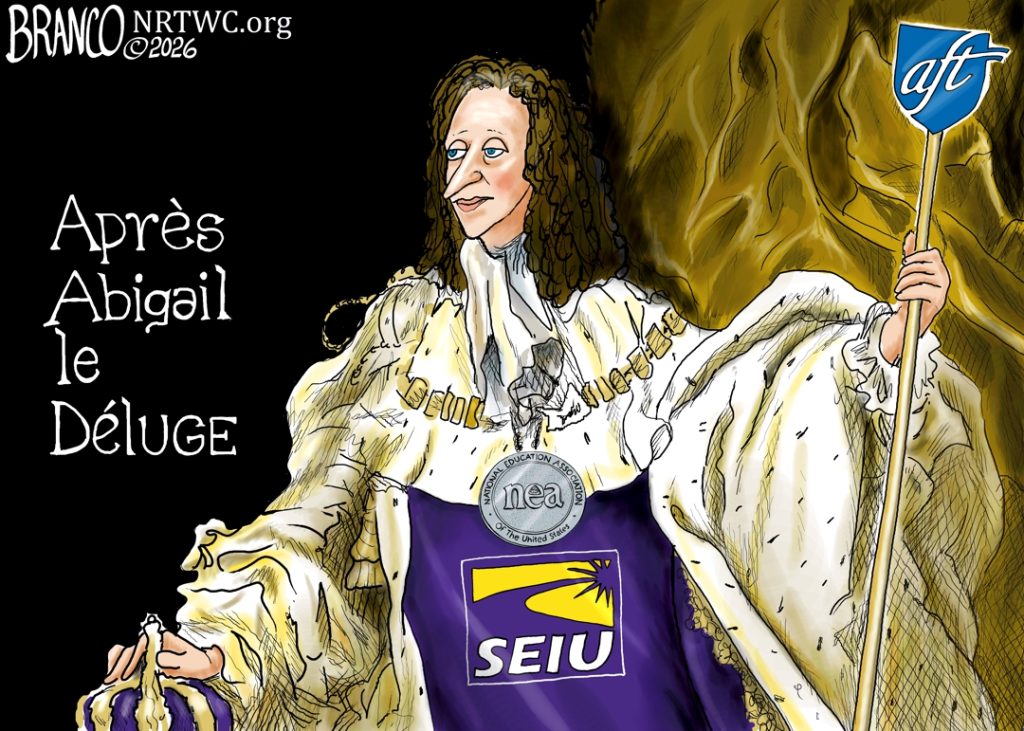
Attempted Whitewash of Union Power Grab Thwarted in Virginia
In November 2025, union-label Democrat politicians, riding on a flood of Big Labor money and manpower flowing into their campaigns from out of state, took over Virginia’s statewide executive offices and greatly expanded their majority in the commonwealth’s House of Delegates.
National Right to Work Committee members and supporters immediately began preparing to fight to save Virginia’s beloved Right to Work law.
This year they succeeded, as a full-scale committee mobilization prompted state Senate Majority Leader Scott Surovell (Fairfax) to retreat from Right to Work destruction just weeks after having listed it as one of six things lawmakers “must” do to support Big Labor in 2026.
But the reinstitution of forced union financial support as a job condition was not the only looming threat to the individual freedom and prosperity of Virginia employees.
Legislation Would Effectively Give Big Labor Control Over Local Governments


Even after they had given up, for the time being, on Right to Work destruction, Mr. Surovell and other union-label Richmond politicians continued to push for passage of a mandatory monopoly bargaining law similar to those already on the books in Big Labor strongholds like California, Illinois, and New York.
National Right to Work Committee Vice President John Kalb explained: “Currently, Virginia has no state law forcing any government employer to engage in any form of bargaining with any labor union. But union bosses are chomping at the bit to transform Virginia into a mandatory monopoly-bargaining state, not simply with regard to teachers and other K-12 employees, but also with regard to virtually every other kind of front-line state or local civil servant.
“And this year, the Virginia General Assembly rubber-stamped legislation that would grant sweeping monopoly powers to government union bosses across the commonwealth, including in localities whose elected leaders have already made it clear they oppose so-called union ‘exclusivity.’
“Under this legislation, H.B.1263/ S.B.378, K-12 schools and other government agencies won’t be able to set or change key terms and conditions of public servants’ employment without the permission of government union bosses.
“And if public officials and union bosses can’t come to an agreement, then core contract provisions for people who are paid by taxpayers will be set by professional ‘arbitrators’ who are no more accountable to taxpayers than union bosses are.”
Decades of experience show mandatory union monopoly-bargaining statutes vastly enhance government union bosses’ power to pad public payrolls with additional dues-paying civil servants. The inevitable result is heavier tax burdens for ordinary employees and firms of all sizes.
Meanwhile, the best available evidence shows outcomes for key public services are typically worse in states with powerful government unions.
The harmful impact of mandatory government unionism for Virginia is so obvious that even many local Democrat politicians spoke out against H.B.1263/ S.B.378 as it was being steamrolled through the state Capitol exclusively by Democrat legislators.
Right to Work Mobilization Puts the Heat on Governor
A notable case in point was Democrat Babur Lateef, the school board chairman in Prince William County. In a TV interview, Mr. Lateef warned that, if it is signed into law, H.B.1263/S.B.378 will be “the largest single tax increase in Virginia history . . . .” Moreover, it will “bankrupt local governments and bankrupt school divisions.”
Union-label state Democrat politicians like Mr. Surovell and Gov. Abigail Spanberger evidently calculated that a mandatory monopoly-bargaining law would be a less politically costly way than Right to Work destruction for them to pay back the Big Labor bosses who had been critical to their 2025 electoral successes.
If so, they failed to sufficiently factor in the Committee’s ability to mobilize concerned citizens against looming threats to public employees’ personal freedom and taxpayers’ pocketbooks.
“Early in this year’s legislative session, recognizing that mandatory monopoly bargaining, rather than Right to Work destruction, was the gravest immediate danger, the Committee contacted by mail 60,000 individuals, businesses and families, sounding the alarm about H.B.1263/S.B.378,” recalled Mr. Kalb.
“Over the course of just a few weeks, Committee staff members prepared and placed a total of five op-eds, including two published the same day in the Washington Post and the Richmond Times-Dispatch, opposing the mandatory monopoly bargaining legislation.
“Later in the session, after it became clear Majority Leader Surovell, the lead sponsor of S.B.378 in his chamber, and House Speaker Don Scott [Portsmouth] were determined to send the power grab to Gov. Spanberger’s desk, no matter what, the Committee began mobilizing citizens to contact her directly.”
Ball Ends up Back in Gov. Spanberger’s Court

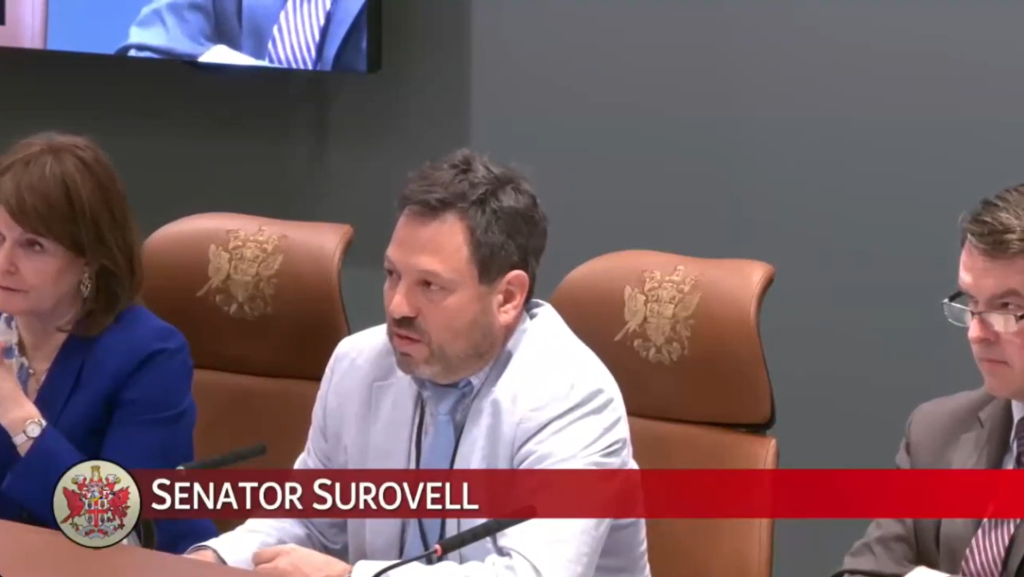
In the end, the intense opposition from local elected officials of both major parties as well from ordinary citizens obviously made an impression on the governor.
On April 13, acting just minutes before H.B.1263/S.B.378 would have become law without her signature, Ms. Spanberger sent it back to the General Assembly, while proposing a number of amendments that would supposedly mitigate the scheme’s harmful impact on taxpayers.
The most cynical of all of them would have delayed the imposition of mandatory union monopoly bargaining on Virginia localities until January 1, 2030, just 18 days before Ms. Spanberger’s governorship must end, since Virginia law bars the commonwealth’s chief executives from running for consecutive reelection.
“Attempting to make the effective date of H.B.1263/S.B.378’s single worst provision occur well over three years from now, when the governor is already a lame duck, displays an indifference to future calamities for her constituents worthy of France’s King Louis [“After me, the flood”] XV,” said Mr. Kalb.
“Fortunately, on April 22, two days after the Committee distributed a letter to Richmond lawmakers urging them to reject Ms. Spanberger’s bid to whitewash H.B.1263/S.B.378, the General Assembly voted it down.
“That means the mandatory monopoly bargaining scheme that was earlier agreed upon by the Virginia House and Senate is back on Ms. Spanberger’s desk, and the ball is back in her court.”
As this Newsletter goes to press in late April, it is still unclear if Ms. Spanberger will finally side with independent-minded civil servants and taxpayers, or with her union paymasters.
This article was originally published in our monthly newsletter. Go here to access previous newsletter posts.
To support our cause and help end forced unionism, go here to donate.