MIX: Democratic Party’s Big Labor backbone

MIX: Democratic Party’s Big Labor backbone

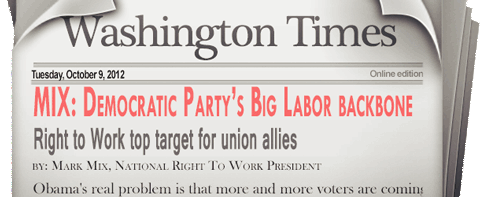
Right to Work top target for union allies From the Washington Times: As President Obama and Vice President Joseph R. Biden campaign for re-election, they feel compelled time and again to remind anyone who has gathered to hear them that America's economic troubles started well before they got to the White House. [media-credit name=" " align="alignright" width="480"][/media-credit]American voters surely know that. The Obama ticket's real problem is that more and more voters are coming to understand that the current administration has no clue about which policies would help the national economy, and workers in particular, get back on track. Emblematic of the president's befuddlement was his jibe against Right to Work laws at a Labor Day rally in Toledo, Ohio. Right to Work laws make it illegal to deny an applicant a job or to fire an employee simply for refusing to pay dues or fees to an unwanted union. Mr. Obama insisted without offering any evidence that individual freedom of choice over union affiliation is somehow bad for wages and salaries. At a campaign event in Detroit the same day, Mr. Biden repeated basically the same canard and vowed that the Obama administration would block national Right to Work legislation. What are the facts about Right to Work and employee compensation? Nationwide, inflation-adjusted U.S. Commerce Department data show that wage and salary disbursements to private-sector employees grew by just 1.8 percent from 2000 to 2010. That's the smallest gain for any decade since the Great Depression. But regional data show that employees and job seekers in the 22 states that had Right to Work laws on the books at the beginning of the millennium fared far better than average, with real private-sector wages and salaries increasing by 8.6 percent, or nearly five times the national average.

Battleground Michigan

Battleground Michigan

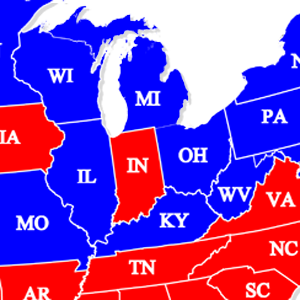
Shikha Dalmia of Reason looks at big labor's effort keep Michigan a second rate economic state through a series of referendums on the statewide ballot next month: We've seen Gov. Scott Walker's battle in Wisconsin and the Chicago Teachers Union strike next door. Now in Michigan comes another Midwestern political showdown that will carry enormous implications for the role of unions in American life. [media-credit name=" " align="alignright" width="300"][/media-credit]The Michigan Supreme Court recently approved the placement of a proposed constitutional amendment on the November ballot. If passed by voters, the so-called Protect Our Jobs amendment would give public-employee unions a potent new tool to challenge any laws—past, present or future—that limit their benefits or collective-bargaining powers. It would also bar Michigan from becoming a right-to-work state in which mandatory union dues are not a condition of employment. The budget implications are dire. Michigan public unions began pushing the initiative last year, shortly after Michigan Gov. Rick Snyder—facing a $2 billion fiscal hole—capped public spending on public-employee health benefits at 80% of total costs. This spring, national labor unions joined the amendment effort after failing to prevent Indiana from becoming a right-to-work state. Bob King of the United Auto Workers said that Michigan's initiative would "send a message" to other states tempted to follow Indiana's example. The UAW, along with allies in the AFL-CIO and the Teamsters, poured $8 million into gathering 554,000 signatures—some 200,000 more than needed—to put Protect Our Jobs on the Michigan ballot.

The Teachers Strike May Have Been In Chicago, But It's All Our Problem

The Teachers Strike May Have Been In Chicago, But It's All Our Problem

Matt Kibbe looks at why the "resolution" of the teacher's strike in Chicago is not in the best interests of the children and taxpayers of the state: The Chicago Teachers Union Strike may be resolved for now, but the events illustrate a serious problem facing the United States: union bosses are manipulating government leaders, using teachers and students as human shields in their fight to maintain power over the educational system. Their stranglehold on education has to end if our children are to have any hope of getting the education they need to compete in the world. [media-credit name=" " align="aligncenter" width="300"][/media-credit]Teacher pay got a lot of attention in coverage of the debate, but it was far from the only issue at play in the strike, which ended Wednesday under the promise of a resolution that appeased the union bullies. The primary disagreements were over who has the power to hire and fire teachers, and accountability for student performance. The union insisted that it should have the right to dictate who gets hired to fill jobs in the district. Primarily, it wanted to take hiring authority away from school principals by requiring that laid-off teachers be hired back. Union leaders also rejected the perfectly reasonable demand from the city of Chicago that standardized test scores play a role in evaluating teacher performance. A roofer is judged by how well his shingles keep out the rain. A CFO is judged by her company’s balance sheet. A journalist is judged by the accuracy and fairness of his story. Yet somehow union leaders think teachers shouldn’t be judged by the outcome of their work. Teachers’ unions exist to promote what’s best for teachers, not students. As Albert Shanker, the late president of the American Federation of Teachers, once reportedly put it, “When schoolchildren start paying union dues, that’s when I’ll start representing the interests of schoolchildren.” (Shanker’s supporters dispute that he said this, but the quotation’s staying power illustrates the accuracy with which it represents union motives.) Because they exist to protect the status quo, unions oppose the kind of meaningful education reform America needs. They oppose education tax credits, school vouchers, charter schools, merit pay, and virtually all attempts to impose real accountability. They instead support a system that sees the United States spending nearly two and a half times more per pupil today than in 1970. What have we received in return? Stagnant math and reading scores for 17-year-olds, and a decline in science scores.

The Teachers Strike May Have Been In Chicago, But It's All Our Problem

The Teachers Strike May Have Been In Chicago, But It's All Our Problem

Matt Kibbe looks at why the "resolution" of the teacher's strike in Chicago is not in the best interests of the children and taxpayers of the state: The Chicago Teachers Union Strike may be resolved for now, but the events illustrate a serious problem facing the United States: union bosses are manipulating government leaders, using teachers and students as human shields in their fight to maintain power over the educational system. Their stranglehold on education has to end if our children are to have any hope of getting the education they need to compete in the world. [media-credit name=" " align="aligncenter" width="300"][/media-credit]Teacher pay got a lot of attention in coverage of the debate, but it was far from the only issue at play in the strike, which ended Wednesday under the promise of a resolution that appeased the union bullies. The primary disagreements were over who has the power to hire and fire teachers, and accountability for student performance. The union insisted that it should have the right to dictate who gets hired to fill jobs in the district. Primarily, it wanted to take hiring authority away from school principals by requiring that laid-off teachers be hired back. Union leaders also rejected the perfectly reasonable demand from the city of Chicago that standardized test scores play a role in evaluating teacher performance. A roofer is judged by how well his shingles keep out the rain. A CFO is judged by her company’s balance sheet. A journalist is judged by the accuracy and fairness of his story. Yet somehow union leaders think teachers shouldn’t be judged by the outcome of their work. Teachers’ unions exist to promote what’s best for teachers, not students. As Albert Shanker, the late president of the American Federation of Teachers, once reportedly put it, “When schoolchildren start paying union dues, that’s when I’ll start representing the interests of schoolchildren.” (Shanker’s supporters dispute that he said this, but the quotation’s staying power illustrates the accuracy with which it represents union motives.) Because they exist to protect the status quo, unions oppose the kind of meaningful education reform America needs. They oppose education tax credits, school vouchers, charter schools, merit pay, and virtually all attempts to impose real accountability. They instead support a system that sees the United States spending nearly two and a half times more per pupil today than in 1970. What have we received in return? Stagnant math and reading scores for 17-year-olds, and a decline in science scores.