Oklahoma's Right to Work Anniversary -- A Success Story!

Oklahoma's Right to Work Anniversary -- A Success Story!

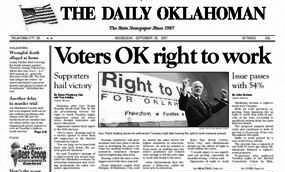
  In 2001, Sooners defied Big Labor by approving a statewide ban on forced union dues. Since its Right to Work law took effect, Oklahoma has become a national leader in private-sector compensation and job growth.   Oklahoma Celebrates Right to Work Anniversary -- Sooner Experience Reinforces Case For Federal Forced-Dues Repeal (Source: October 2011 NRTWC Newsletter) On September 25 a decade ago, one of Big Labor's most formidable fear-and-loathing campaigns ever failed when Oklahoma approved a statewide ban on compulsory union dues and fees and thus became the nation's 22nd Right to Work state. Almost immediately, the very union bosses who had been shrilly predicting that a Sooner Right to Work law would swiftly lead to disaster moved to prevent the law from having any impact at all. When the Right to Work law had been in effect just seven weeks, Big Labor lawyers launched an underhanded bid to overturn it. This legal attack kept the law's future under a cloud for an extended period. The state's attorneys and Right to Work attorneys intervening on behalf of several independent-minded workers prevailed in 2003 when the Oklahoma Supreme Court unanimously rejected AFL-CIO union kingpins' demand that it overturn the law. Oklahoma's Private-Sector Compensation Growth Has Far Outpaced U.S. Average "Since Big Labor's legal assault on Oklahomans' Right to Work was thwarted, the state has had one of the strongest economies in the country, as measured by a number of key indicators," said Greg Mourad, vice president of the National Right to Work Committee. "For example, from 2003 to 2010, inflation-adjusted U.S. Commerce Department data show private-sector employer outlays for employee compensation, including wages, salaries, benefits and bonuses, grew by 12.2% in Oklahoma, after adjusting for inflation. "Sooners' real private-sector compensation expanded at a rate more than three-and-a-half times as great as the national average of 3.4%, and faster than in 41 other states." Oklahoma Also a Standout For Job Creation


Oklahoma's Right to Work Anniversary -- A Success Story!

Oklahoma's Right to Work Anniversary -- A Success Story!

  In 2001, Sooners defied Big Labor by approving a statewide ban on forced union dues. Since its Right to Work law took effect, Oklahoma has become a national leader in private-sector compensation and job growth.   Oklahoma Celebrates Right to Work Anniversary -- Sooner Experience Reinforces Case For Federal Forced-Dues Repeal (Source: October 2011 NRTWC Newsletter) On September 25 a decade ago, one of Big Labor's most formidable fear-and-loathing campaigns ever failed when Oklahoma approved a statewide ban on compulsory union dues and fees and thus became the nation's 22nd Right to Work state. Almost immediately, the very union bosses who had been shrilly predicting that a Sooner Right to Work law would swiftly lead to disaster moved to prevent the law from having any impact at all. When the Right to Work law had been in effect just seven weeks, Big Labor lawyers launched an underhanded bid to overturn it. This legal attack kept the law's future under a cloud for an extended period. The state's attorneys and Right to Work attorneys intervening on behalf of several independent-minded workers prevailed in 2003 when the Oklahoma Supreme Court unanimously rejected AFL-CIO union kingpins' demand that it overturn the law. Oklahoma's Private-Sector Compensation Growth Has Far Outpaced U.S. Average "Since Big Labor's legal assault on Oklahomans' Right to Work was thwarted, the state has had one of the strongest economies in the country, as measured by a number of key indicators," said Greg Mourad, vice president of the National Right to Work Committee. "For example, from 2003 to 2010, inflation-adjusted U.S. Commerce Department data show private-sector employer outlays for employee compensation, including wages, salaries, benefits and bonuses, grew by 12.2% in Oklahoma, after adjusting for inflation. "Sooners' real private-sector compensation expanded at a rate more than three-and-a-half times as great as the national average of 3.4%, and faster than in 41 other states." Oklahoma Also a Standout For Job Creation

Public Servants' Right to Work in Jeopardy

Public Servants' Right to Work in Jeopardy

The experience of state after state shows that public-sector compulsory unionism as well as private-sector compulsory unionism devours job- and income-creating opportunities for taxpaying businesses and employees. Credit: Michael Ramirez/Investors Business Daily  Union Bosses Aim to Kill Recent Buckeye State Reform Next Month (Source: October 2011 NRTWC Newsletter) Over the past decade, the citizens of forced-unionism Ohio have been afflicted with one of the worst-performing state economies in the country. Across the U.S. as a whole, despite the severe recent recession, private employers' inflation-adjusted outlays for employee compensation (including wages, salaries, bonuses and benefits) did increase from 2000 to 2010, by an average of 4.3%. And many states fared much better than that. In the 22 states with Right to Work laws on the books protecting both private- and public-sector employees from being fired for refusal to pay dues or fees to an unwanted union, real private-sector employee compensation grew by an aggregate 11.3%. Private employees in 20 of the 22 Right to Work states experienced 2000-2010 compensation growth greater than the national average. Unfortunately, in the 28 states without Right to Work laws on the books, private-sector outlays for employee compensation rose only by a combined 0.7%, after adjusting for inflation. Thirteen of the 14 states with the lowest compensation growth lack a Right to Work law. Ohio was one of just five states with negative real private-sector compensation growth over the last decade. In 2010, Ohio's business expenditures for private employee compensation were 6.6% less than they had been in 2000. Region, Job Mix Can't Account For Buckeye State's Shrinking Private Employee Compensation When confronted with such data, apologists for the forced-unionism policies that prevailed across the board in Ohio for decades until this year try to explain them away by blaming the Buckeye State's location in the U.S. Midwest or its historically high manufacturing density for its abysmal economic record. But such excuses won't wash.

Public Servants' Right to Work in Jeopardy

Public Servants' Right to Work in Jeopardy

The experience of state after state shows that public-sector compulsory unionism as well as private-sector compulsory unionism devours job- and income-creating opportunities for taxpaying businesses and employees. Credit: Michael Ramirez/Investors Business Daily  Union Bosses Aim to Kill Recent Buckeye State Reform Next Month (Source: October 2011 NRTWC Newsletter) Over the past decade, the citizens of forced-unionism Ohio have been afflicted with one of the worst-performing state economies in the country. Across the U.S. as a whole, despite the severe recent recession, private employers' inflation-adjusted outlays for employee compensation (including wages, salaries, bonuses and benefits) did increase from 2000 to 2010, by an average of 4.3%. And many states fared much better than that. In the 22 states with Right to Work laws on the books protecting both private- and public-sector employees from being fired for refusal to pay dues or fees to an unwanted union, real private-sector employee compensation grew by an aggregate 11.3%. Private employees in 20 of the 22 Right to Work states experienced 2000-2010 compensation growth greater than the national average. Unfortunately, in the 28 states without Right to Work laws on the books, private-sector outlays for employee compensation rose only by a combined 0.7%, after adjusting for inflation. Thirteen of the 14 states with the lowest compensation growth lack a Right to Work law. Ohio was one of just five states with negative real private-sector compensation growth over the last decade. In 2010, Ohio's business expenditures for private employee compensation were 6.6% less than they had been in 2000. Region, Job Mix Can't Account For Buckeye State's Shrinking Private Employee Compensation When confronted with such data, apologists for the forced-unionism policies that prevailed across the board in Ohio for decades until this year try to explain them away by blaming the Buckeye State's location in the U.S. Midwest or its historically high manufacturing density for its abysmal economic record. But such excuses won't wash.

New evidence

New evidence "Right To Work boon for Oklahoma"

Families are fleeing compulsory unionism states and moving to Right Work States like Oklahoma.  And, that is not all that is OKay in Oklahoma since it became the 22nd Right To Work state in 2001.  From a recent analysis by J. Scott Moody and Wendy P. Warcholik of the Oklahoma Council of Public Affairs: On September 25, 2001, Oklahoma voters went to the polls and passed a constitutional amendment—Right to Work (RTW)—which gave workers the choice to join or financially support a union. This made Oklahoma the 22nd state in the union to join the ranks of Right To Work states. Fast forward to today, and opponents of the law are still at work trying to discredit it. A recent study by the [Big Labor related] Economic Policy Institute (EPI), for example, claimed that Right To Work in Oklahoma has been a dismal failure. One of EPI’s most important pieces of evidence is that manufacturing employment is lower today than it was before Right To Work. [However,] the EPI study did not consider whether Oklahoma’s manufacturing industry may have chosen to boost productivity instead of hiring more workers. Chart 1 shows the growth in Gross Domestic Product (GDP) of the manufacturing industry from 2003 to 2010 using a growth index. Oklahoma’s manufacturing GDP has grown 45 percent in that time period, outstripping that of the average manufacturing growth in in non-Right To Work states (22 percent).

New evidence "Right To Work boon for Oklahoma"

New evidence "Right To Work boon for Oklahoma"

Families are fleeing compulsory unionism states and moving to Right Work States like Oklahoma.  And, that is not all that is OKay in Oklahoma since it became the 22nd Right To Work state in 2001.  From a recent analysis by J. Scott Moody and Wendy P. Warcholik of the Oklahoma Council of Public Affairs: On September 25, 2001, Oklahoma voters went to the polls and passed a constitutional amendment—Right to Work (RTW)—which gave workers the choice to join or financially support a union. This made Oklahoma the 22nd state in the union to join the ranks of Right To Work states. Fast forward to today, and opponents of the law are still at work trying to discredit it. A recent study by the [Big Labor related] Economic Policy Institute (EPI), for example, claimed that Right To Work in Oklahoma has been a dismal failure. One of EPI’s most important pieces of evidence is that manufacturing employment is lower today than it was before Right To Work. [However,] the EPI study did not consider whether Oklahoma’s manufacturing industry may have chosen to boost productivity instead of hiring more workers. Chart 1 shows the growth in Gross Domestic Product (GDP) of the manufacturing industry from 2003 to 2010 using a growth index. Oklahoma’s manufacturing GDP has grown 45 percent in that time period, outstripping that of the average manufacturing growth in in non-Right To Work states (22 percent).