Vague ‘Job Growth’ Talk Won’t Rescue Languishing Big Labor-Controlled States

Vague ‘Job Growth’ Talk Won’t Rescue Languishing Big Labor-Controlled States

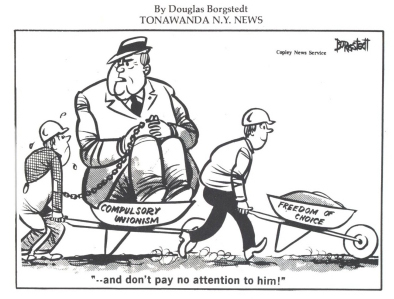
(Source: November 2010 Forced-Unionism Abuses Exposed) Just a few months ago, millions of Americans were dismayed by reports, based on official U.S. Labor Department Bureau of Labor Statistics (BLS) data, that from 1999 through 2009 our country endured a “lost decade” in private-sector employment. In this context, the term “lost decade” refers to annual BLS statistics showing that in 2009 there were 107.95 million private-sector jobs nationwide, roughly 370,000 fewer than in 1999, when there were 108.32 million. Americans are right to be deeply concerned by such national data, but they can easily mislead us. Exactly half of the 50 states actually experienced a net gain in private-sector employment during the “lost decade,” and the five biggest absolute gainers, Arizona, Florida, Texas, Nevada, and Virginia, added a combined total of more than 1.6 million private-sector jobs. Meanwhile, California, Illinois, Indiana, Michigan and Ohio, the five states shedding the most private-sector jobs, lost a net total of more than 1.9 million. The five biggest job gainers have one common characteristic: They all have Right to Work laws on the books that prohibit the firing of employees for refusal to join or pay compulsory fees to an unwanted union. Not one of the five biggest job losers has such a law. Consequently, workers in these states are routinely forced into a union as a job condition. Aggregate private-sector employment in the 22 Right to Work states increased by 3.7% during the “lost decade,” even as it fell by 2.8% in the 28 forced-unionism states. The sharp disparity is no coincidence. Leading labor economists such as Dr. Richard Vedder of Ohio University have shown repeatedly that forced unionism hinders job creation.


Right To Work Helps Fuel the Jobs Engine

Right To Work Helps Fuel the Jobs Engine

The publisher of Virginia Business, Bernie Niemeier, reminds readers among the natural advantages of states  such as  California, New York and Virginia it is often the "legal advantages"  "like being the northernmost Right To Work state and having reasonable tort laws and a relatively low corporate income tax rate" that separates Virginia from the pack. Excerpts from Niemeier's  editorial, Job creation is fueled by existing business expansion: Over the past few years, Virginia’s economic development news has been full of big marquee names: Volkswagen, Altria, Hilton, SAIC, Northrop Grumman and others. The commonwealth has held a winning hand in the high-profile game of attracting corporate headquarters from California, New York and other states. Natural advantages such as the Port of Virginia, Dulles Airport and proximity to Washington, D.C., are important parts of our success. Legal advantages — like being the northernmost right-to-work state and having reasonable tort laws and a relatively low corporate income tax rate — also make Virginia an attractive place to do business. When high-profile new business announcements are made, many take credit and rightfully so. Major out-of-state and international relocations involve the governor’s office, the Virginia Economic Development Partnership (VEDP), regional economic development alliances and local-level economic development offices. We’ve been a little less than humble in continually reminding ourselves and others of our reputation as the best-managed state, one of the best states in which to do business and the most business-friendly state, among other accolades. But perhaps Virginia’s existing businesses have been too humble in taking credit for the jobs their expansion and growth have created, especially during difficult economic times. In fact, existing businesses have led the commonwealth in job creation over the past several years.

Good Advice

Labor can spend a billion dollars but the American people clearly rejected their scare tactics and messages.  Now, Bruce Walker has made a persuasive case in favor of pushing new Right To Work laws as a way to protecting workers, creating jobs and promoting prosperity: The 2010 landslide means that Republicans in the House can stop any new legislative initiatives by the Democrats and that Senate Republicans, if united, can stop almost anything Democrats want to do in that body as well. House Republicans can also send to the Senate bills that will put political pressure on Obama and Senate Democrats, like a complete extension of the Bush tax cuts. But at the federal level, Republicans cannot actually do anything without Democrats caving in.  The situation is very different at the state level. Republicans now control both houses of the state legislature and the governorship in a number of states. Republicans now have complete control of state government in twenty states compared to a paltry seven states before the midterm election. Crucially, Republicans now control all state government in five industrial rust belt states: Pennsylvania, Ohio, Michigan, Indiana, and Wisconsin. This control will allow Republicans to draw congressional districts and also, just as importantly, state legislative districts -- a real political blow to Democrats. Unlike the federal government, a party that actually controls the state legislature and governorship can enact laws -- the filibuster is an odd creature almost unique to the United States Senate. There are many things Republicans in control of state governments should do:  limit spending, cut tax rates, reduce regulation. But there is one reform that stout-hearted Republicans running those five rust belt states should definitely do: pass Right To Work laws. The Taft-Hartley Act allows each state the option of enacting right to work laws, which allow workers to not join a labor union as a condition of employment. Twenty-two states have adopted right to work laws, and these states closely resemble the twenty-two states that Obama lost in 2008. Although the leftist establishment media gets a disproportionate amount of attention from conservatives, along with risible "civil rights" leaders and surreally silly academicians, the real political muscle of the Left comes from organized labor -- meaning the bosses who run with those vast empires called "labor unions" and who use the forced dues from members to engage in constant war against conservatives.

Sherman's Folly

Rep. Brad Sherman wants to outlaw Right to Work laws and the Investor's Business Daily takes note: Job Killer: A California congressman wants to eliminate right-to-work laws in 22 states where workers don't have to join unions. If even-higher unemployment is his goal, he has the right idea. Rep. Brad Sherman, a Democrat who represents a large part of Los Angeles' San Fernando Valley, has introduced a bill that would repeal right-to-work statutes. These laws let workers employed at organized companies choose for themselves if they're going to join the union or pay union dues. In the 28 states without right-to-work laws, workers are forced to join the union if their employer has been organized. The depths to which lawmakers beholden to unions are willing to descend are almost bottomless, and labor is the second biggest contributor to Congressman Sherman's campaign in the current cycle. He wants to keep that 100% AFL-CIO rating and seems to have no compunction about wrecking jobs elsewhere (California is not a right-to-work state) to keep his union support. Sherman justifies the bill, H.R. 6384, on the free-rider argument. Right-to-work laws, he says, require unions to represent nondues-paying workers, and he wants those "exempt from paying" what he believes is "their fair share" to be forced into unions.

Sherman's Folly

Rep. Brad Sherman wants to outlaw Right to Work laws and the Investor's Business Daily takes note: Job Killer: A California congressman wants to eliminate right-to-work laws in 22 states where workers don't have to join unions. If even-higher unemployment is his goal, he has the right idea. Rep. Brad Sherman, a Democrat who represents a large part of Los Angeles' San Fernando Valley, has introduced a bill that would repeal right-to-work statutes. These laws let workers employed at organized companies choose for themselves if they're going to join the union or pay union dues. In the 28 states without right-to-work laws, workers are forced to join the union if their employer has been organized. The depths to which lawmakers beholden to unions are willing to descend are almost bottomless, and labor is the second biggest contributor to Congressman Sherman's campaign in the current cycle. He wants to keep that 100% AFL-CIO rating and seems to have no compunction about wrecking jobs elsewhere (California is not a right-to-work state) to keep his union support. Sherman justifies the bill, H.R. 6384, on the free-rider argument. Right-to-work laws, he says, require unions to represent nondues-paying workers, and he wants those "exempt from paying" what he believes is "their fair share" to be forced into unions.

Right to Work Poised to Gain Senate Strength

Right to Work Poised to Gain Senate Strength

One of the Survey 2010's top target states is Nevada, where Big Labor Senate Majority Leader Harry Reid (pictured at a union event) is now running neck and neck with pro-Right to Work challenger Sharron Angle. Image Credit: USW-Canada Survey Results in, Committee Members Put Heat on the Candidates (Source: October 2010 NRTWC Newsletter) With the results of the National Right to Work Committee's federal Survey 2010 now in, Committee members from coast to coast keep turning up the heat on U.S. Senate and House candidates to publicly pledge 100% support for the Right to Work. Committee members and supporters who receive the Newsletter through the U.S. Postal Service can find out whether and how their candidates responded to the Right to Work survey by consulting the Survey 2010 results roster enclosed with this month's issue. Pro-Right to Work Americans who have not yet received their Survey 2010 results may obtain a copy by contacting the Committee by e-mail -- Members@NRTW.org  -- or by dialing 1-800-325-7892. By calling, writing, and visiting their candidates and urging them to declare themselves in opposition to forced unionism, Committee members are making forced unionism and the Right to Work red-hot issues in state after state this year. Right to Work Activity Key to Stopping Big Labor At this writing, just a few weeks remain until Election Day. And reports from a wide array of pollsters and pundits indicate that the caucus of politicians who support Big Labor's agenda on forced-unionism issues such as federally-mandated "card checks" will shrink significantly after voters go to the polls.