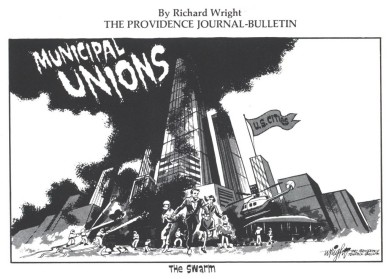
Big Labor Choosing Profiteering over Teachers' Jobs

Big Labor Choosing Profiteering over Teachers' Jobs

In Las Vegas, the Clark County School Board is refusing to allow competitive bidding for health insurance for teachers forcing the school district to use a costly insurance program owned by the union itself.  This decision alone could lead to the firing of 1,000 school employees. As the Education Action Group notes: The CCEA is not the first teachers union to form its own insurance company and pressure local school boards into purchasing that company’s overpriced coverage. The Maine Education Association, the state’s largest teachers union, established its own insurance entity, the Maine Education Association Benefits Trust, in 1993. The Benefits Trust “ facilitates” the purchase of employee health insurance for Maine’s public schools, essentially selling them coverage provided by the state’s largest carrier, Anthem Blue Cross/Blue Shield. Nearly every school district in the state has been lulled into joining this system over the years, according to officials in several Maine school districts. The Benefits Trust/Anthem scam, which discourages outside competition, has driven insurance prices through the roof for Maine schools. The Michigan Education Association owns its own insurance company, called the Michigan Education Special Services Association (MESSA). For years local union negotiators have pressedschool boards to purchase MESSA employee health insurance, despite its high cost.

Big Labor Choosing Profiteering over Teachers' Jobs

Big Labor Choosing Profiteering over Teachers' Jobs

In Las Vegas, the Clark County School Board is refusing to allow competitive bidding for health insurance for teachers forcing the school district to use a costly insurance program owned by the union itself.  This decision alone could lead to the firing of 1,000 school employees. As the Education Action Group notes: The CCEA is not the first teachers union to form its own insurance company and pressure local school boards into purchasing that company’s overpriced coverage. The Maine Education Association, the state’s largest teachers union, established its own insurance entity, the Maine Education Association Benefits Trust, in 1993. The Benefits Trust “ facilitates” the purchase of employee health insurance for Maine’s public schools, essentially selling them coverage provided by the state’s largest carrier, Anthem Blue Cross/Blue Shield. Nearly every school district in the state has been lulled into joining this system over the years, according to officials in several Maine school districts. The Benefits Trust/Anthem scam, which discourages outside competition, has driven insurance prices through the roof for Maine schools. The Michigan Education Association owns its own insurance company, called the Michigan Education Special Services Association (MESSA). For years local union negotiators have pressedschool boards to purchase MESSA employee health insurance, despite its high cost.

Right to Work Opponents Are Wrong

Right to Work Opponents Are Wrong

Writing for the Indianapolis Political Examiner, Abdul-Hakim Shabazz confronts Big Labor's misinformation campaign against Right to Work laws head-on: While at the Statehouse on Organization Day, I took some time to speak to some of the protesters in the hallways about potential ‘Right to Work” (RTW) legislation.  I made it a point to keep an open mind and listen to their arguments against RTW.  After speaking to about half a dozen or so, I have come to the conclusion that the arguments against RTW are not based on logic, but based on emotion; albeit the emotion is fear and it is the most powerful of emotions, but it still a pathos-driven argument. I reached the conclusion that the arguments were emotionally-based, because the “logical” arguments against RTW aren’t very logical at all.  Allow me to walk through the main points. Right to Work is really right to work for less The data shows that when adjusted for costs of living, salaries in right to work states are comparable to non-RTW states. RTW is a way to break the unions Unions still exist under RTW laws, membership just can’t be compelled.  If a union is providing quality service and responding to its members needs, it shouldn’t have to worry about members bolting and leaving their ranks. RTW allow non-union workers to “freeload” off the union. When the employees agree to form a union, they can decide whether the collective bargaining agreement applies only to members or all employees.  So if a union decides to represent people who aren’t members and aren’t paying dues then that sounds like a personal problem to me. RTW interferes with an employer’s right to contract I find this argument the most intriguing.  Primarily since it usually comes from people who have no problem imposing government regulations on business (i.e. smoking bans), but for some reason this regulation they have some concern.

Sick of being FORCED to pay for union bosses' politics? Right To Work is the Answer

Terry Bowman, a UAW member,  writes in the The Detroit News that to end forced-dues-funded politics "the best and easiest solution is to pass a Right To Work law."  And, he is right.  The surest way to end compulsory-dues for politics is to end compulsory-dues. From Mr. Bowman's editorial: A worker's constitutional rights seem to take a back seat to the political privileges of the union. Earlier this year, UAW local 898 officials displayed their political views for everyone who drove by the union hall. "Recall Gov. Snyder, sign up here!" was the message glaring from the parking lot sign for all passers-by to see. A recent Harris poll shows that 60 percent of union households say that unions are too involved in politics, and we know that 40 percent or more of union households vote Republican. Unfortunately, union members who disagree with these partisan political attacks are forced, as a condition of employment, to financially support this message. Federal laws are supposed to restrict union officials from using regular dues for political purposes. Regrettably, it still happens all the time. In a 1988 Supreme Court decision called Communication Workers of America vs. Beck, unions were forbidden to collect full union dues from non-members; only those dues that are supposed to reflect the true cost to the union as a collective bargaining agent. In other words, members could choose to resign their union membership and then only pay what is called the "agency fee" to keep their job. Obviously, there are problems with this ruling. Workers who wish to exercise these rights have to jump through hoops, and they are then persecuted and ridiculed on the job for doing so. The agency fee also includes all the educational and subjective political activities that unions engage in. Union newsletters and magazines are full of political propaganda, and union officials travel the country spewing hateful venom and a destructive worldview, yet their salaries are paid for with regular union dues. And there is so much more.

Sick of being FORCED to pay for union bosses' politics? Right To Work is the Answer

Terry Bowman, a UAW member,  writes in the The Detroit News that to end forced-dues-funded politics "the best and easiest solution is to pass a Right To Work law."  And, he is right.  The surest way to end compulsory-dues for politics is to end compulsory-dues. From Mr. Bowman's editorial: A worker's constitutional rights seem to take a back seat to the political privileges of the union. Earlier this year, UAW local 898 officials displayed their political views for everyone who drove by the union hall. "Recall Gov. Snyder, sign up here!" was the message glaring from the parking lot sign for all passers-by to see. A recent Harris poll shows that 60 percent of union households say that unions are too involved in politics, and we know that 40 percent or more of union households vote Republican. Unfortunately, union members who disagree with these partisan political attacks are forced, as a condition of employment, to financially support this message. Federal laws are supposed to restrict union officials from using regular dues for political purposes. Regrettably, it still happens all the time. In a 1988 Supreme Court decision called Communication Workers of America vs. Beck, unions were forbidden to collect full union dues from non-members; only those dues that are supposed to reflect the true cost to the union as a collective bargaining agent. In other words, members could choose to resign their union membership and then only pay what is called the "agency fee" to keep their job. Obviously, there are problems with this ruling. Workers who wish to exercise these rights have to jump through hoops, and they are then persecuted and ridiculed on the job for doing so. The agency fee also includes all the educational and subjective political activities that unions engage in. Union newsletters and magazines are full of political propaganda, and union officials travel the country spewing hateful venom and a destructive worldview, yet their salaries are paid for with regular union dues. And there is so much more.