Union Bosses Going All Out to Capture Congress
During the months leading up to Election Day 2026, Big Labor bosses’ focus on politics has never been more explicit.
Constitutional scholar Richard Epstein of the University of Chicago has written a book on the Card Check Forced Unionism bill calling the most controversial piece of labor legislation in the last 60 years, the Employee Free Choice Act has “some of the worst possible consequences for the workplace-and through it for the overall economy.”
Epstein, in his book The Case against the Employee Free Choice Act (Hoover Press, 2009), examines all the critical proposals contained in EFCA and explains why they constitute a large step backward in labor relations that will work to the systematic detriment of employees, employers, and the public at large:
“The brevity of the statute conceals many serious difficulties about its integration with existing labor laws, even as it gives evidence to the massive shift of power from private ordering to state control,” said Epstein. The source of the controversy lies in three major objectives of the champions of labor reform:
* An increase in the penalties for unfair labor practices (ULPs) by employers during union organization campaigns
* The use of a card-check system to authorize a union for a particular bargaining unit
* A system of mandatory interest arbitration that allows a panel of federal arbitrators to set the terms of a first two-year contract in a 130-day time frame
At the option of a union, a card-check system could, in effect, bypass the protections of the secret ballot by allowing a card check to certify a union.
The union would thereafter deny any employer or employee the option to refuse to deal on the terms demanded by the union, which could leave bankruptcy as the only defense against improvident state arbitration decrees.
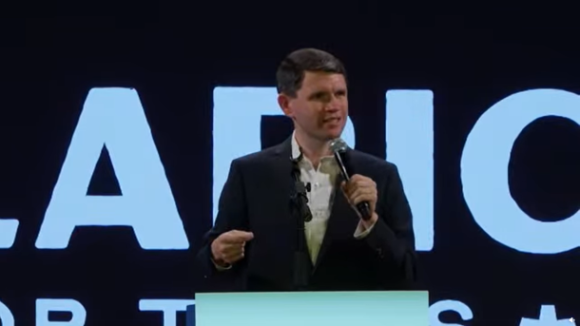
During the months leading up to Election Day 2026, Big Labor bosses’ focus on politics has never been more explicit.
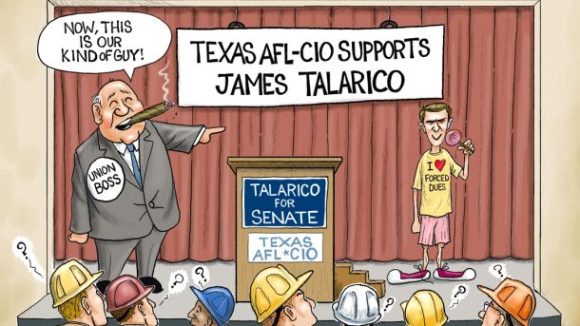
Union bosses are rallying behind Democrat Texas U.S. Senate candidate James Talarico because he opposes Right to Work protections for employees.
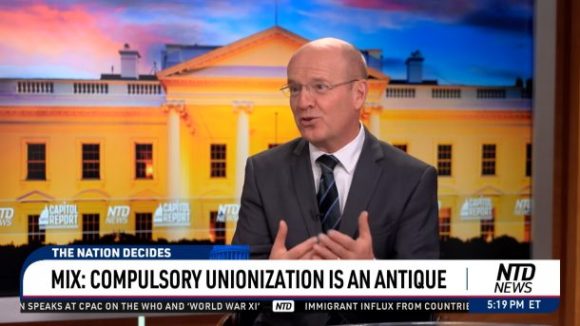
"Vullo makes it clear that using the threat of federal prosecution to force any employer to put employees’ Right to Work on the bargaining table violates the First Amendment.”