The Latest

Greer: Economic Boom in America’s Newest Right to Work State

Greer: Economic Boom in America’s Newest Right to Work State

From Stan Greer at the National Institute for Labor Relations Research: Indiana Performing Well in Job Growth Ball State University economist Michael Hicks: "Indiana just zoomed past the rest of the country in terms of job growth" during the first full month after its Right to Work law took effect. In the U.S.as a whole, the anemic private-sector employment growth of early 2012 got even more feeble last month, as the nation’s business payrolls barely increased by an estimated 0.1%, seasonally-adjusted. (See link) However, job seekers are faring far better in some regions of the country than in others. A notable example is America’s 23rd Right to Work state, Indiana. As the U.S. Bureau of Labor Statistics first reported (see link) and as WIBC news radio in Indianapolis discussed early today, one out of every eight private-sector jobs created in the nation in April was “created in Indiana.” This is remarkable, because the Hoosier State is home to just 2.2% of America’s private-sector employees. Michael Hicks, an economist at Ball State University in Muncie and a frequently quoted analyst of the Indiana economy, is impressed: “We’ve seen good job growth over the last several months in Indiana but it looks like the nation as a whole was slowing down a bit. But last month Indiana just zoomed past the rest of the country in terms of job growth.” Previously, Dr. Hicks had been publicly skeptical about whether Indiana’s new Right to Work statute, which was adopted in early February and took effect in mid-March, would have much impact on job creation. He still insists its “too early to tell,” but now admits “it’s pretty difficult to say” the state’s sudden burst of private-sector payroll job growth in April, even as private-sector job creation nationwide practically ground to a halt, is not related to Indiana’s new ban on compulsory union dues and fees.

Obscene images, urine, punches, blockades -- Philly Unions' Persuasion

Obscene images, urine, punches, blockades -- Philly Unions' Persuasion

Union activists have littered a construction project in Philadelphia with bottles of urine because a new company had the audacity to hire non-union construction workers on a new development project. “We’re going to continue to embarrass the Pestronks [project owners] until they start doing the right thing for our community and our society, and that is pay fair wages and standards that have been established,” said Pat Gillespie, a boss in the Philadelphia Building and Trades Council. Of course, doing the "right thing" means filling the union's coffers.  And, apparently, "the right thing for our community and our society" doesn't mean revitalizing a neighborhood as the construction project will do. A statement from the Pestronks' website: "Our dispute is solely with the organized extortion being carried out by the Building Trade Unions management. They are trying to force a majority of non-local workers onto our projects, and force us to pay a huge tax to sustain the Unions’ power structure. The unmatched public defamation of our company, harassment, bullying, vandalism, racism, property damage, and physical assault all add up to EXTORTION by the Philadelphia Building Trades Unions."

Obscene images, urine, punches, blockades -- Philly Unions' Persuasion

Obscene images, urine, punches, blockades -- Philly Unions' Persuasion

Union activists have littered a construction project in Philadelphia with bottles of urine because a new company had the audacity to hire non-union construction workers on a new development project. “We’re going to continue to embarrass the Pestronks [project owners] until they start doing the right thing for our community and our society, and that is pay fair wages and standards that have been established,” said Pat Gillespie, a boss in the Philadelphia Building and Trades Council. Of course, doing the "right thing" means filling the union's coffers.  And, apparently, "the right thing for our community and our society" doesn't mean revitalizing a neighborhood as the construction project will do. A statement from the Pestronks' website: "Our dispute is solely with the organized extortion being carried out by the Building Trade Unions management. They are trying to force a majority of non-local workers onto our projects, and force us to pay a huge tax to sustain the Unions’ power structure. The unmatched public defamation of our company, harassment, bullying, vandalism, racism, property damage, and physical assault all add up to EXTORTION by the Philadelphia Building Trades Unions."

Big Labor continues to demand more from you taxpayers

Big Labor continues to demand more from you taxpayers

A New York State law that determines arbitration awards for unions threatening to strike for more taxpayer money bases its outcome on the government's "ability to pay." With taxpayers footing the bill, Big Labor always seems to win greater benefits and pay -- all at the cost of taxpayers' "ability to pay" more.  From the New York Post's Nicole Gelinas: Last week, a set of arbitrators gave a union, covering Staten Island and Queens bus workers, the same generous contract that a different arbitration panel awarded to the Transport Workers Union three years ago. It’s a bad sign for the Metropolitan Transportation Authority’s (MTA) future — including its near future, because the TWU contract is up again. At the heart of the problem is a gaping flaw in the state’s supposedly tough Taylor Law — namely, the way it forces the MTA into binding arbitration. New Yorkers don’t hear much about the 45-year-old Taylor Law unless transit workers are threatening to strike. But the law does much more than prohibit public workers from striking or threatening to strike, more even than imposing penalties for illegal strikes. It also orders that, when public unions and their employers can’t agree on contracts, “disputes over wages and other contract clauses shall be submitted to [so-called] impartial recommendations so that government workers will not be shortchanged by administrators chronically lacking funds.”  Basically, unelected bureaucrats give other bureaucrats raises.] A state panel, the Public Employment Relations Board, makes those recommendations. And, for the MTA, the law directs that these “recommendations” are binding — so, even if arbitrators devise a horrible deal, taxpayers are stuck.

Hands Off -- Judge rules Wisconsin public union members must opt in on dues

Hands Off -- Judge rules Wisconsin public union members must opt in on dues

In a blow to Big Labor's continual push to make forced unionism the default position, unions will now have to ask people to sign up rather than require employees to figure out how to protect their paychecks from unwanted union confiscation. From Pioneer Press' Patrick Marley MADISON, Wisconsin -- State unions were dealt a setback Friday when a federal judge said they would have to get their members to opt in, rather than opt out, to having the state deduct union dues from their paychecks. What's more, the judge did not rule on dues deductions for unions that he earlier found the state improperly decertified. The state's largest unions were decertified, and the ruling -- at least for now -- will make it harder for them to get money from dues. But U.S. District Court Judge William Conley gave unions one beneficial ruling by saying that members who sign up to have their dues deducted from their paychecks can be required to make a yearlong commitment.

Calfornia Reaping What Jerry Brown Planted in the 1970s

Calfornia Reaping What Jerry Brown Planted in the 1970s

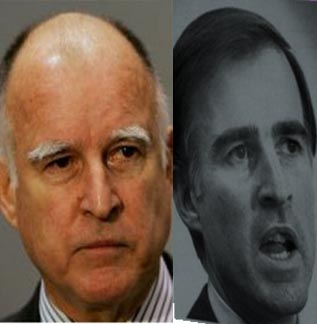
It's not often that a politician has to deal with a problem he created nearly twenty-five years ago. Most politicians sacrifice the short-term political benefit and leave the political headache to future generations of taxpayers and politicians. That's why it is ironic that while Jerry Brown wrestles with a spending and debt crisis in California he is forced to deal with a problem of his own making. In 1976, during Brown's first term as governor, he approved collective bargaining rights for government workers. Since that decision, the government workers unions power and influence have grown California's government spending through the roof as they bargained against the taxpayers for greater salary and benefits that many of their private sector counterparts. One thing you can say about Jerry Brown is that politics runs through his veins. Since 1976, Brown has been defeated for re-election, run for the presidency, elected mayor of a large city and won the governorship again forcing him to deal with a $16 billion deficits and a powerful opposition for reform from government union bosses -- union bosses empowered by his 1976 decision. Brown's solution to this problem shows that while he may have extraordinary staying power he has underwhelming temerity. While he talks about taking on the special interests and making drastic cuts to the state's budget, he is offering large tax increases and minor reforms to the power of the unions. Should the state defeat his tax increase initiative this November, he will be forced to take on the monster of his own making. Don't count on Jerry Brown asking that California become a Right to Work state but it would be a sign that he was serious in addressing the problem of his own making. Chriss Street at Breitbart looks at this problem in greater detail:

International Brotherhood of Boilermakers, Iron Ship Builders, Blacksmiths, Forgers and Helpers Union Bosses Grow Fat

International Brotherhood of Boilermakers, Iron Ship Builders, Blacksmiths, Forgers and Helpers Union Bosses Grow Fat

Forced-Dues Fed Fat Cats The salaries, perks and benefits of the International Brotherhood of Boilermakers, Iron Ship Builders, Blacksmiths, Forgers and Helpers is raising eyebrows -- to say the least -- among the 59,000 members of the union.  It appears that union members are finding their union due's money spent on the personal benefit of the union bosses including family members on the payroll; Outrageous salaries among the union bosses and suspicious travel reimbursements. McClatchy Newspapers has the story: First-class travel. Six-figure salaries for half the 132 officers and staffers. Plenty of plum jobs for family members. Life is good at the top of the International Brotherhood of Boilermakers, Iron Ship Builders, Blacksmiths, Forgers and Helpers. The union, with its headquarters in Kansas City, Kan., represents about 59,000 workers in the U.S. and Canada who make and repair boilers, fit pipes and work on ships and power plants. The recession has hit their trade hard, reducing union membership.

Right to Work States Enjoy 'Growth Advantage'

Right to Work States Enjoy 'Growth Advantage'

Compulsory Unionism Negatively Correlated With Compensation Growth (source: National Right To Work Committee April 2012 Newsletter) By prohibiting compulsory union dues, state Right to Work laws spur the growth of private-sector employee compensation in the form of wages, salaries, benefits and bonuses, as well as employment growth. Last month, the U.S. Commerce Department's Bureau of Economic Analysis (BEA) issued its estimates for 2011 state personal income. The BEA also issued estimates for an array of specific kinds of income, including employee compensation, at the state level. The 2011 BEA income data in general, and the compensation data especially, show once again that there is a strong negative correlation between compulsory unionism and economic growth. Overall, private-sector employee compensation (including wages, salaries, benefits and bonuses) grew by 6.4% nationwide over the past decade, after adjusting for inflation. Historically speaking, this was slow growth. However, states that protect employees from being fired for refusal to pay dues or fees to an unwanted union typically fared far better than the rest. (From 2001 to 2011, 22 states had Right to Work laws prohibiting forced union dues on the books. Last month Indiana became the 23rd Right to Work state.) A review of how compensation and jobs grew (or failed to grow) in each state suggests the U.S. Congress could dramatically improve America's economic prospects for the next decade by repealing forced union dues and fees nationwide. Current federal law authorizes and promotes the payment of compulsory union dues and fees as condition of getting or keeping a job. Right to Work States' 2001-2011 Compensation Increase Nearly Double the National Average