The Latest

Right to Work Opponents Are Wrong

Right to Work Opponents Are Wrong

Writing for the Indianapolis Political Examiner, Abdul-Hakim Shabazz confronts Big Labor's misinformation campaign against Right to Work laws head-on: While at the Statehouse on Organization Day, I took some time to speak to some of the protesters in the hallways about potential ‘Right to Work” (RTW) legislation.  I made it a point to keep an open mind and listen to their arguments against RTW.  After speaking to about half a dozen or so, I have come to the conclusion that the arguments against RTW are not based on logic, but based on emotion; albeit the emotion is fear and it is the most powerful of emotions, but it still a pathos-driven argument. I reached the conclusion that the arguments were emotionally-based, because the “logical” arguments against RTW aren’t very logical at all.  Allow me to walk through the main points. Right to Work is really right to work for less The data shows that when adjusted for costs of living, salaries in right to work states are comparable to non-RTW states. RTW is a way to break the unions Unions still exist under RTW laws, membership just can’t be compelled.  If a union is providing quality service and responding to its members needs, it shouldn’t have to worry about members bolting and leaving their ranks. RTW allow non-union workers to “freeload” off the union. When the employees agree to form a union, they can decide whether the collective bargaining agreement applies only to members or all employees.  So if a union decides to represent people who aren’t members and aren’t paying dues then that sounds like a personal problem to me. RTW interferes with an employer’s right to contract I find this argument the most intriguing.  Primarily since it usually comes from people who have no problem imposing government regulations on business (i.e. smoking bans), but for some reason this regulation they have some concern.

NLRB's Boeing Sham

NLRB's Boeing Sham

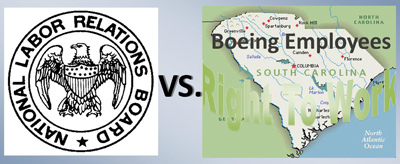
The Wall Street Journal looks at the political decision to file a complaint against Boeing and the political decision to withdraw it: What a sham, or scam, or choose a synonym. On Wednesday, the International Association of Machinists approved a new contract with Boeing in which the company agreed to make its 737 Max jet with union labor in Washington state. Yesterday, after getting the machinist all-clear, the National Labor Relations Board (NLRB) dropped its lawsuit against Boeing's investment in South Carolina. Has there ever been a more blatant case of a supposedly independent agency siding with a union over management in collective bargaining? Boeing says the new contract wasn't tied directly to a settlement of the NLRB complaint, and that it always made sense to build the 737 Max in Renton, Washington because its work force has experience on the current 737 and offers natural efficiencies. But it's hard to resist the conclusion that Boeing felt obliged to make the agreement to save its more than $1 billion investment in South Carolina, where it is building 787s. Boeing might have won a legal battle in the end, but first it would have to run through an administrative law judge, then the politicized and Obama-stacked NLRB, and only then would it get to an appellate court. Meanwhile, its investment was in jeopardy and its legal bill was rising.

NLRB's Boeing Sham

NLRB's Boeing Sham

The Wall Street Journal looks at the political decision to file a complaint against Boeing and the political decision to withdraw it: What a sham, or scam, or choose a synonym. On Wednesday, the International Association of Machinists approved a new contract with Boeing in which the company agreed to make its 737 Max jet with union labor in Washington state. Yesterday, after getting the machinist all-clear, the National Labor Relations Board (NLRB) dropped its lawsuit against Boeing's investment in South Carolina. Has there ever been a more blatant case of a supposedly independent agency siding with a union over management in collective bargaining? Boeing says the new contract wasn't tied directly to a settlement of the NLRB complaint, and that it always made sense to build the 737 Max in Renton, Washington because its work force has experience on the current 737 and offers natural efficiencies. But it's hard to resist the conclusion that Boeing felt obliged to make the agreement to save its more than $1 billion investment in South Carolina, where it is building 787s. Boeing might have won a legal battle in the end, but first it would have to run through an administrative law judge, then the politicized and Obama-stacked NLRB, and only then would it get to an appellate court. Meanwhile, its investment was in jeopardy and its legal bill was rising.

Feds probe union pension scam

Feds probe union pension scam

Federal law enforcement officials have issued subpoenas and opened a criminal investigation to determine how union officials were able to work one day as a substitute teacher yet be eligible for $100,000 pension plan -- for life. From the Chicago Tribune: Federal authorities have begun a criminal investigation into how nearly a dozen union officials became eligible for inflated city pensions, according to subpoenas obtained by the Tribune and WGN-TV through an open-records request. The Chicago municipal employees and laborers pension funds each received subpoenas from a federal grand jury in October seeking "records pursuant to an official criminal investigation." The request seeks documentation on 11 labor leaders who appeared in reports from a joint Tribune/WGN-TV investigation. The reports focused on a 1991 law that allowed union leaders who once worked for the city to receive credit in public pension plans for their private union work. When they retire, the union officials' pensions aren't based on their old city paychecks but on their much higher union salaries. That opened the door for them to land public pensions that far exceeded their pay as city employees — even as they continued to earn lucrative salaries from their unions. At least eight union officials named in the subpoena who either receive city pensions or are eligible for them also earned credit in union pension funds for the same period of work, despite a state law that was supposed to prevent that. The joint investigation found that some of those labor leaders were participating in up to three pension funds at the same time, accruing retirement benefits that reached as high $500,000 a year.

Newt 'Leadership' Flashback

Newt 'Leadership' Flashback

Right to Work to Capitol Hill: ‘Keep Your Promises’ On January 18, 2011, By NRTW Committee Staff (Source: January 2011 NRTWC Newsletter) Former Speakers Newt Gingrich (R-Ga., left) and Dennis Hastert (R-Ill.) both made campaign pledges to support roll-call votes on forced-dues repeal, but blocked action on such legislation when Congress was in session. Politicians Pledging to Back Right to Work Take Charge of House Thanks in significant part to the efforts of National Right to Work Committee members across the country, starting this month the U.S. House of Representatives will be led by a speaker and a majority leader who have pledged full support for Americans’ Right to Work without being forced to join or pay dues to a union. Now Committee members’ job is to make sure Speaker John Boehner (R-Ohio), Majority Leader Eric Cantor (R-Va.), and other members of Congress turn their pro-Right to Work promises into action. John Boehner, Eric Cantor Owe Leadership Posts to Worker-Freedom Advocates Mr. Boehner and Mr. Cantor enjoy their top leadership positions in the House in part due to pro-Right to Work Americans’ support for congressional candidates nationwide who had pledged to oppose compulsory unionism.

Newt 'Leadership' Flashback

Newt 'Leadership' Flashback

Right to Work to Capitol Hill: ‘Keep Your Promises’ On January 18, 2011, By NRTW Committee Staff (Source: January 2011 NRTWC Newsletter) Former Speakers Newt Gingrich (R-Ga., left) and Dennis Hastert (R-Ill.) both made campaign pledges to support roll-call votes on forced-dues repeal, but blocked action on such legislation when Congress was in session. Politicians Pledging to Back Right to Work Take Charge of House Thanks in significant part to the efforts of National Right to Work Committee members across the country, starting this month the U.S. House of Representatives will be led by a speaker and a majority leader who have pledged full support for Americans’ Right to Work without being forced to join or pay dues to a union. Now Committee members’ job is to make sure Speaker John Boehner (R-Ohio), Majority Leader Eric Cantor (R-Va.), and other members of Congress turn their pro-Right to Work promises into action. John Boehner, Eric Cantor Owe Leadership Posts to Worker-Freedom Advocates Mr. Boehner and Mr. Cantor enjoy their top leadership positions in the House in part due to pro-Right to Work Americans’ support for congressional candidates nationwide who had pledged to oppose compulsory unionism.