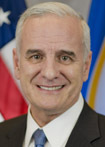
Gov. Mark Dayton (D-Big Labor)
Trey Kovacs looks at Minnesota Governor Mark Dayton's quest to empower union bosses by any means necessary:
Minnesota State Senator Mike Parry (R-Waseca) recently caused a stir with strong accusations against Governor Mark Dayton. “It’s no secret that the labor unions helped buy the Governor’s Office for Mark Dayton… he began to return the favor, most recently by trying to help unionize some of Minnesota’s in-home, private child care providers,” said Parry in a fundraising letter.
Sen. Parry’s allegations elicited a strong reaction from Dayton, who called it “inaccurate and deeply offensive.” A review of the facts, however, shows that the real reason the governor is so upset: the truth hurts.
Since 2005, the American Federation of State, County and Municipal Employees (AFSCME) and Service Employees International Union (SEIU) have been trying to organize child care providers Minnesota. Associated Press found that AFSCME wrote a $125,000 check to Gov. Dayton’s Recount Fund once restrictive campaign contribution limits ceased. Combined AFSCME and SEIU PACs contributed $14,000 to Dayton during his campaign. The Minnesota Family Council calculates that Big Labor stands to gain up to $3.3 million a year in dues from unionizing child care providers.
On November 15, Gov. Dayton issued Executive Order 11-31, calling an election to unionize all licensed, registered, and subsidized child care providers in the state. In defense of his order, the governor claimed that holding a union election would ensure that union membership would be “voluntary” and that child care providers not eligible to vote for unionization would be unaffected. Opponents countered that union dues will be compulsory and costs will rise.
For the most part, child care providers are self-employed. So how could they be unionized? Dayton and the unions have a simple solution: declare them state employees because they receive state aid to serve needy children. Under their view, anyone who receives any form of state aid qualifies as a state employee.
To push back against this power grab, on November 28, a group of 11 child care providers sued to block Dayton’s executive order, arguing that it violates state and federal laws. The National Labor Relations Act and Minnesota Labor Relations Act do not allow employers to form, join, or assist labor organizations.
The Minnesota Labor Relations Act indicates that a union cannot gain exclusive representation of workers, unless a majority of workers choose union representation. Dayton’s mandate blatantly violates that provision, as it excludes a majority of child care providers from the voting process. Only 4,300 government-subsidized providers will cast ballots, but a vote for unionization could also force the state’s 6,700 non-subsidized child care providers into a union.
As a result of the suit, Minnesota District Court Judge Dale Lindman issued an injunction to postpone the union election. He stated that laws must be passed by the legislature and remarked that the order “strikes me as being very harmful to the parties that are involved.”