Politicians Accelerate Chicago’s Race to Ruin
Chicago's financial crisis deepens due to reckless union-backed legislation increasing pension liabilities, with leaders failing to take corrective action.
Yesterday, the U.S. Supreme Court heard oral arguments in Harris v. Quinn, a high-stakes labor-policy case in which the High Court is being directly urged, for the first time in more three decades, to overturn on First Amendment grounds state statutes and executive orders authorizing government union bosses to get public servants fired for refusal to pay dues or fees to an unwanted union.
After a contentious hearing, few legal observers professed to have a clear idea of how broad a ruling the justices would issue in the case, or even on which side the majority would come down.
Regardless of the ultimate outcome, the January 21 hearing at least offered concerned citizens a window into the minds of Big Labor apologists who claim that, despite their apparent conflict with freedom of speech, forced-dues statutes are necessary in states where government union bosses are authorized by law to bargain on behalf of employees who don’t want a union as well as those who do. Without forced dues, they contend, monopoly bargaining fosters so-called “free riding” by union nonmembers.
In a key exchange highlighted by Sean Higgins of the Washington Examiner in his Harris hearing wrap-up (see the first link below for Higgins’ account and the second for the hearing transcript itself), Justice Sam Alito asked Service Employees International Union lawyer Paul Smith to explain how he could justify this label for a worker who sincerely and plausibly believes his union monopoly-bargaining agent is not acting in his best interest:
JUSTICE ALITO: All right. Now, what do you say to the young employee who is not very much concerned at this point about pensions, but realizes there’s a certain pot of money, and it’s either going to go for pensions or it’s going to go for salary at the present time. So that employee who’s not a member of the union has to pay for the union to bargain with the — the State to achieve something that’s contrary to that person’s interest. But you say that person is a free rider.
MR. SMITH: Yes, Your Honor. . . .
In other words, according to Smith, a forced passenger who has perfectly good reason (or reasons) to believe he or she is harmed by union monopoly bargaining, and therefore refuses to pay union dues, is a “free rider,” as far as his client is concerned!
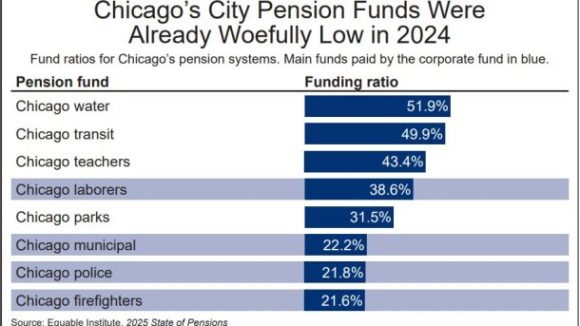
Chicago's financial crisis deepens due to reckless union-backed legislation increasing pension liabilities, with leaders failing to take corrective action.
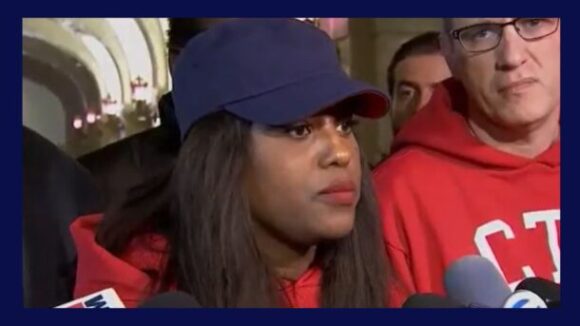
With CTU President Stacy Davis Gates calling the shots, taxpayer costs for Chicago schools are skyrocketing even as educational outcomes get worse and worse. But the miserable status quo works for Big Labor politicians.
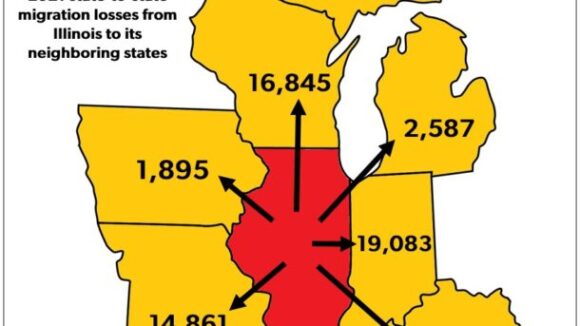
Year after year, Big Labor-dominated Illinois is losing taxpaying citizens to states where union bosses wield less unwarranted power. That’s now true of neighboring Indiana, Iowa, Kentucky, Michigan, Missouri and Wisconsin.