Politicians Accelerate Chicago’s Race to Ruin
Chicago's financial crisis deepens due to reckless union-backed legislation increasing pension liabilities, with leaders failing to take corrective action.
Channel 7 in Chicago, an ABC-TV affiliate, aired a news story late last week regarding Harris v. Quinn, a U.S. Supreme Court case in which a National Right to Work Legal Defense Foundation attorney is representing eight Illinois home care givers who are suing the administration of Big Labor Democratic Gov. Pat Quinn and Service Employees International Union (SEIU) bosses. Oral arguments are scheduled for tomorrow. (See below for a link to a video and complete transcript of last week’s TV news account.)
The Channel 7 story unfortunately does not mention the fact that the Right to Work Foundation is furnishing legal help for the plaintiffs (free of charge), but it does give lead plaintiff Pamela Harris, who cares for her disabled son in their home, an opportunity to explain, briefly but pungently, what the case is about:
The ABC7 I-Team has learned of a legal fight pitting Governor Pat Quinn against families with loved ones who have disabilities. The issue is whether those families be considered public employees.
This is about a government-funded program that subsidizes families who care for disabled relatives at home instead of having them institutionalized. Five years ago Gov. Quinn designated those home providers– including family members– as public employees, allowing a union to organize them, a union that backs the governor. It’s now headed to the supreme court.
“Every night I pray please God, let me live one more day than Josh,” said Pam Harris, Josh’s mother and caretaker. Josh Harris, 25, has Rubinstein-Taybi syndrome compounded by physical disabilities and mental illness. His family is in the Illinois home-based support services program which allows disabled adults to live in their homes. The state and federal governments pay home healthcare workers a monthly stipend, far less than what an institution costs, and Josh is able to live at home.
In January 2009, Governor Quinn signed an executive stating these home care givers– even moms and dads– are public employees available to be unionized by Illinois’ Service Employees International. Those who didn’t want to join the union would still have to pay for representation.
“What we are talking about is unionizing family members, parents in a home. For me, that is inconsistent and intrusive and will interfere with Josh’s care,” said Pam Harris. She and other disability program members voted the union down and sued Quinn in a class-action lawsuit that will be heard at the U.S. Supreme Court on Tuesday.
If the court rules Quinn was wrong in declaring home-care providers public employees, unions could lose several hundred thousand members across the country.
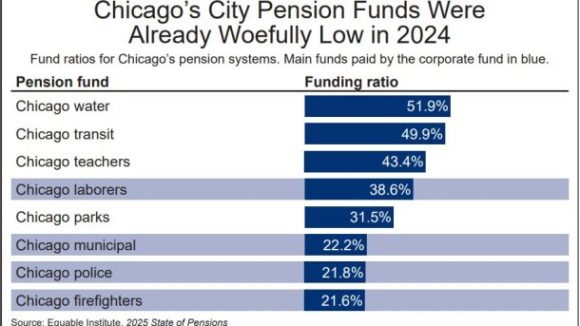
Chicago's financial crisis deepens due to reckless union-backed legislation increasing pension liabilities, with leaders failing to take corrective action.

With CTU President Stacy Davis Gates calling the shots, taxpayer costs for Chicago schools are skyrocketing even as educational outcomes get worse and worse. But the miserable status quo works for Big Labor politicians.
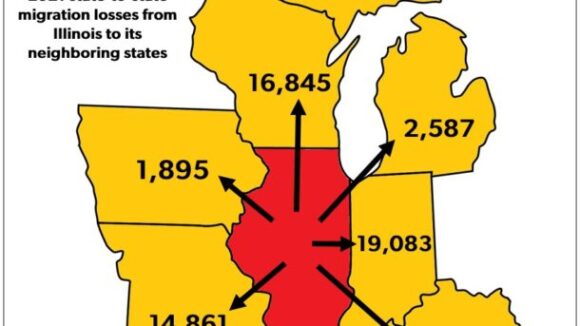
Year after year, Big Labor-dominated Illinois is losing taxpaying citizens to states where union bosses wield less unwarranted power. That’s now true of neighboring Indiana, Iowa, Kentucky, Michigan, Missouri and Wisconsin.