Union-Only Port Terminal Suspends Operations
Committee President Mark Mix: “If I were a Leatherman dockworker, I certainly wouldn’t count on Longshore Union bosses to show any flexibility” to get the terminal reopened and “save my job.”
Fred Barnes, in The Weekly Standard, has an insightful take on the comparative economies of Right to Work state Alabama and forced-unionism state Ohio.
. . . When the U.S. Air Force awarded a $40 billion contract for 179 new aerial refueling tankers, Ohio wasn’t in the running as a site where the aircraft might be built. Instead, they’ll be built in Alabama outside Mobile.
Why? The answer is simple: Alabama’s business climate is good and Ohio’s isn’t. When major business projects are looking for the best site, job-hungry Ohio is rarely considered. And NAFTA has little or nothing to do with it. . . .
Ohio was once an economic powerhouse, but now it lags behind Alabama in almost everything that might lure new business to the state. “Ohio has raced past 41 other states and now ranks 5th in state and local taxes measured as a percentage of income,” David Hansen, president of the Buckeye Institute, wrote last year. Alabama, in contrast, ranks 46th in tax burden.
In economic competitiveness, Ohio has fallen to 47th in the nation, according to the American Legislative Exchange Council. Alabama is 18th. “The cost of doing business makes us very competitive,” says Bob Sisson, vice president of the Mobile Chamber of Commerce. Relative to Ohio, it certainly does. . . .
One more thing. Ohio is a highly unionized state. The Wall Street Journal called this “Ohio’s most crippling handicap” in job creation. Alabama is a right-to-work state in which union organizing is difficult.
This, of course, gives Alabama an important talking point. After all, other things being equal, would a large corporation prefer to locate a new factory in a union state or a right-to-work state? Would it rather hire a union workforce or a non-union one? Those questions answer themselves. . . .
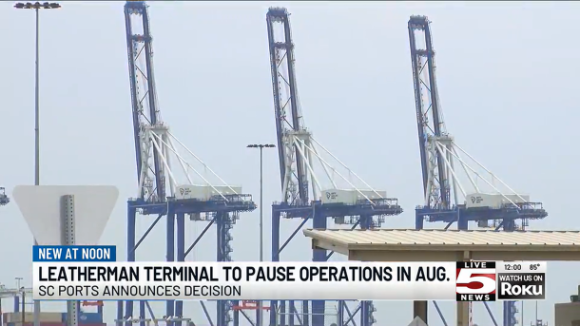
Committee President Mark Mix: “If I were a Leatherman dockworker, I certainly wouldn’t count on Longshore Union bosses to show any flexibility” to get the terminal reopened and “save my job.”
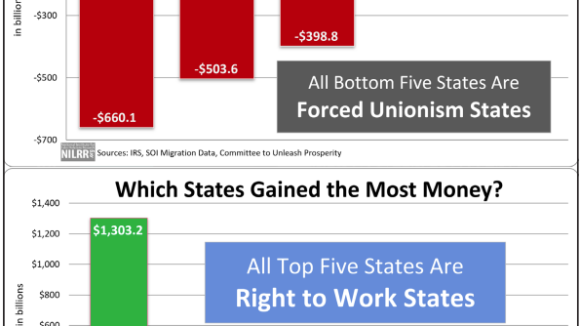
... States that continuously lacked Right to Work protections for employees from 2012-23 lost a net total of $2.05 trillion in cumulative AGI solely as a consequence of domestic out-migration of taxpayers during that 11-year period.

One of the key goals of the U.S. Department of Labor since President Donald Trump’s second term commenced in January 2025 has been to expand the number of apprenticeships in America to “at least a million.”