Barone Notes Growth in Right to Work States
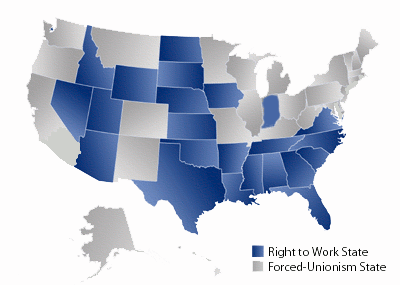
The 22 states with right-to-work laws grew 15% in the last decade. The others grew 6%. Michael Barone writes. Sign-Up For NRTWC’s Free Daily E-mailed Update Summary…
Barbara Comstock takes note that in Virginia, it was Democrat Gov. Doug Wilder who signed HB1872 and SB 962 into law, prohibiting government unions from pressuring politicians to expand benefits and salaries: This was an outright ban, one of…
Looks like the the Congressional Budget Office (CBO) has been busy scoring bills again and this time it looked at an old Big Labor hog known as Davis-Bacon. According to the non-partisan CBO assessment, repealing Davis-Bacon would save taxpayers at…
Stephen Lerner, the SEIU boss who left the union and now advocates economic war on the USA, is still on the payroll of the SEIU! Is anyone really shocked?…
According to the March 29th Richard Rahn (Newsmax) article, Right to Work and Lower Taxes appear to deliver a one-two punch in states fights against unemployment and personal income decline. In fact, Right To Work states lead in economic prosperity and personal income growth. State Economic Climate Economic Performance Ranking 2010 Business Tax Climate Ranking 2011 Small Business Survival Ranking 2011 Population Growth 2000-2010 Right to Work Florida 5 5 6 17.6% Yes Virginia 8 12 14 13.0% Yes Tennessee 10 27 11 11.5% Yes Texas 19 13 3 20.6% Yes California 46 49 48 10.0% No New Jersey 48 48 50 4.5% No New York 50 50 49 2.1% No Sources: American Legislative Exchange Council, Tax Foundation, Small Business and Entrepreneurship Council, U.S. Census Bureau, National Right to Work Legal Defense Foundation. From Rahn's article: “Fiscal crisis hits the states” has become this year’s most boring and repetitive headline. But what is largely overlooked is that some states are doing relatively well — such as my home state of Virginia — and are, in fact, balancing their budgets without draconian budget cuts or tax increases. Given the ongoing fight between public-employee unions and some state governors, it is interesting to observe that the “right to work” states (that is, those states where workers are not forced to join a union against their will in order to obtain a specific job) also had much better performances than in those states where workers are not protected from involuntary unionism.
From RealClearPolitics by Michael Barone : “The 22 states with right-to-work laws grew 15 percent in the last decade. The other states grew just 6 percent. The 16 states where collective bargaining with public employees is not…
(Source: March 2011 NRTWC Newsletter) Time For Politicians in Both Parties to Own Up to Their Mistakes In late February, many concerned Americans in other states were paying close attention to the fierce, and still unresolved, battle over public-sector union monopoly bargaining in Wisconsin. Many observing the Madison showdown from their homes inwere undoubtedly amazed by what they saw. These five states, like roughly a dozen others, have no statutes on the books empowering government union officials to act as state and local public employees' monopoly-bargaining agents. When elected officials in such states make a judgment that a reform in public-employee compensation packages and work rules is necessary and can be prudently implemented to give taxpayers a better return on their money, they have the power to proceed. It is then up to the voting public to judge whether the reform was a good idea or not. In Wisconsin, however, like in other states which statutorily mandate union monopoly bargaining over public employee pay, benefits, and working conditions, elected officials from the governor on down have far less control over the roughly 50% of public expenditures that go into employee compensation. In the Badger State, half of state and local government employees are unionized. Elected officials and their appointees cannot make any significant changes in the way these employees are compensated or in how they are instructed to do their jobs without government union bosses' approval. Today, millions of Americans whose state and local governments operate free from Big Labor constraints appreciate, after watching the bitter struggle in Wisconsin unfold, better than ever before the importance of keeping union monopolists out of the government workplace. Only Intense Right to Work Lobbying Blocked Monopoly-Bargaining Bill What most freedom-loving Virginians, North Carolinians and Texans probably don't realize is that, just last year, the U.S. Congress came within a hair of taking away their prerogative to decide how their state and local government workplaces are run. At the outset of the 2009-2010 Congress, the votes were there to pass the so-called "Public Safety Employer-Employee Cooperation Act" in both the House and the Senate. Furthermore, President Obama was publicly vowing to sign this legislation as soon as it reached his desk. This measure, more accurately labeled the "Police/Fire Monopoly-Bargaining Bill," would have foisted Wisconsin-style labor relations on state and local public-safety departments in all 50 states.

Actuaries trying to accurately reflect the state of the California pension system were rebuffed by the CalPERS Board lead by Neal Johnson of the Service Employees International Union who told the Board it was better to hide…