Forced-Dues Drive Pennsylvania Public Union Salaries,  Outpace Private Sector's and Members' Wages

Forced-Dues Drive Pennsylvania Public Union Salaries, Outpace Private Sector's and Members' Wages

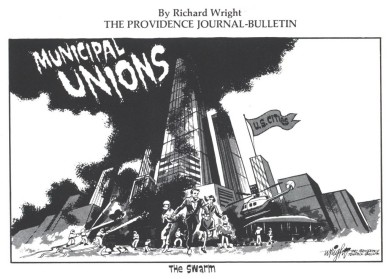
Forced-dues continue to fill the coffers of unions, as well as, union presidents'  and politicians' pockets according to this recent study by the Commonwealth Foundation: Government Unions and Forced Dues Almost half of government workers in Pennsylvania are union members, compared to 9.3 percent in the private sector. Pennsylvania is a forced union state, meaning that workers can be forced to join a union or pay a [so-called] "fair share fee" just to keep their job.  Most government units in Pennsylvania are "agency shops," with a specified union to which workers must pay a fee. When state and local governments automatically deduct dues and fair share fees from government workers' paychecks—as is the practice in Pennsylvania—employees have little or no say in how their money is used. Union Bosses Union bosses collect hefty salaries derived from member dues and fair share fees. In most cases, the salaries are several times the average union member's annual pay. While acknowledging that budgets were tight, AFSCME Council 13 President David Fillman got a 6 percent raise in 2010, making his salary higher than Gov. Tom Corbett's. Dues and fees often go towards expensive conferences, outings and junkets.  For example, in 2009-10 the Pennsylvania State Education Association—the state's largest public sector union—spent: More than $250,000 on a board of directors retreat in Gettysburg. More than $89,000 for a "political institution meeting" at the Radisson Penn Harris in Camp Hill, Pa. $20,000 for advertising in the Pittsburgh Steelers Yearbook. Almost $5,900 at Kimberton Golf Club and more than $5,100 at Concord Country Club in Chadd's Ford. Political Activity and Lobbying

Forced-Dues Drive Pennsylvania Public Union Salaries,  Outpace Private Sector's and Members' Wages

Forced-Dues Drive Pennsylvania Public Union Salaries, Outpace Private Sector's and Members' Wages

Forced-dues continue to fill the coffers of unions, as well as, union presidents'  and politicians' pockets according to this recent study by the Commonwealth Foundation: Government Unions and Forced Dues Almost half of government workers in Pennsylvania are union members, compared to 9.3 percent in the private sector. Pennsylvania is a forced union state, meaning that workers can be forced to join a union or pay a [so-called] "fair share fee" just to keep their job.  Most government units in Pennsylvania are "agency shops," with a specified union to which workers must pay a fee. When state and local governments automatically deduct dues and fair share fees from government workers' paychecks—as is the practice in Pennsylvania—employees have little or no say in how their money is used. Union Bosses Union bosses collect hefty salaries derived from member dues and fair share fees. In most cases, the salaries are several times the average union member's annual pay. While acknowledging that budgets were tight, AFSCME Council 13 President David Fillman got a 6 percent raise in 2010, making his salary higher than Gov. Tom Corbett's. Dues and fees often go towards expensive conferences, outings and junkets.  For example, in 2009-10 the Pennsylvania State Education Association—the state's largest public sector union—spent: More than $250,000 on a board of directors retreat in Gettysburg. More than $89,000 for a "political institution meeting" at the Radisson Penn Harris in Camp Hill, Pa. $20,000 for advertising in the Pittsburgh Steelers Yearbook. Almost $5,900 at Kimberton Golf Club and more than $5,100 at Concord Country Club in Chadd's Ford. Political Activity and Lobbying

Big Labor economist leaves out important details in Right To Work debate

Big Labor’s favorite economists Gordon Lafer’s ‘study’ “Right To Work, The wrong answer for Michigan’s economy” lists several companies that chose Michigan over Right To Work states, but he left out important details according to Tom Gantert at CAPCON.  Lafer fails to mention that Right To Work states offered no incentives, but Michigan offered millions in tax-incentives. Not only that, Lafer uses a laughable term to describe ‘forced-unionism states;’ he refers to them as “free bargaining states.”  As most know, unions are still able to bargain in Right To Work states.  But, what union bosses cannot do is force employees to pay union fees against their will.  For Lafer to refer to compulsory-unionism states as ‘free bargaining’ illustrates the insincerity of his analysis. From CAPCON: Lafer wrote, “Indeed, a series of recent corporate announcements make clear that many auto industry companies continue to prefer Michigan over right-to-work competitors …” But Lafer never mentioned that some of those businesses cited in his report received deals for millions of dollars in tax incentives to locate in Michigan while the competing states offered no incentives, according to research done by Michigan Capitol Confidential. In fact, even the Michigan Economic Development Corp. says those companies wouldn’t have picked this state had it not been for the MEDC’s handouts. MEDC memos received in a Freedom of Information Act request involving the businesses stated in Lafer’s report paint a picture of a state that has difficulty competing with right-to-work states without offering tax breaks. The memos refer to lower taxes and personnel costs in right-to-work states as a reason Michigan has to offer millions in incentives to attract the businesses. “He (Lafer) is listing successes that are actually evidence of failure,” said James Hohman, assistant director of fiscal policy at the Mackinac Center for Public Policy.