Even in Michigan, Big Labor feels pushback
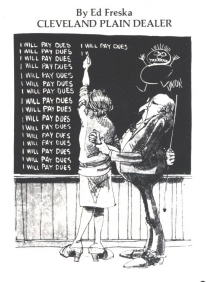
Michigan dials back Big Labor arrogance and power — at least slightly — the legislature passed a bill to prohibit public schools from automatically collecting union dues from the paychecks…
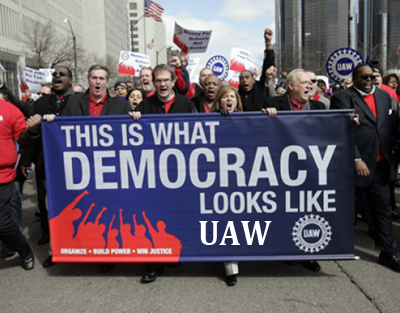
Michele Malkin looks behind the president's rhetoric and self congratulations over "saving" the American auto worker to remind us of those the president choose to leave behind -- workers who were not part of the Big Labor machine in Michigan: The White House fairy tale about the Happily Ever After Auto Bailout is missing a crucial, bloody page. While President Obama bragged about "standing by American workers" at a rowdy United Auto Workers meeting Tuesday, he failed to acknowledge how the Chicago-style deal threw tens of thousands of nonunion autoworkers under the bus. In a campaign pep rally/sermon billed as a "policy speech," Obama nearly broke his arm patting himself on the back for placing his "bets" (read: our money) on the $85 billion federal auto industry rescue. "Three years later," he crowed, "that bet is paying off for America." Big Labor brass cheered Obama's citation of GM's "highest profits in its 100-year history" as the room filled with militant UAW chants of "union made." "Union made" -- but who paid? Scoffing at the criticism that his bailout was a massive union payoff, Obama countered that all workers sacrificed to save the auto industry. "Retirees saw a reduction in the healthcare benefits they had earned," Obama told the congregation, er, crowd. "Many of you saw hours reduced," he sympathized, "or pay and wages scaled back." Let's clear the fumes (again), shall we? The bailout pain was not distributed equally. It was redistributed politically.
From the Heritage Foundation an endorsement of Right To Work Freedoms for Michigan: Did you know that there are no Volkswagen manufacturing plants in the Detroit area? Or Mercedes-Benz? Or Kia? Or Hyundai? Or BMW, for that matter? Apart from having their cars assembled in Michigan, it turns out that those three companies have something else in common: the United Auto Workers union (UAW). It also turns out that every other car manufacturer has something in common, too: not wanting the UAW to do to them what it did to the Big Three. Today, President Obama will address the UAW, and he should receive a rousing welcome. After all, his terms of the auto bailout richly rewarded his union allies at the expense of non-union employees and private investors, giving them, among other prizes, a very large stake of ownership in Chrysler. And together, they stand adamantly opposed to "right-to-work" laws that would empower the nation's unemployed to find economic security with a non-union job. They claim they want to protect "the American auto industry," but this is not about "American cars." The controlling interest of Chrysler is Italy-based Fiat and previously was Germany's Daimler-Benz between 1997 and 2008. This is simply about protecting union fortunes. Chrysler can hire actors in Louisiana to play the part of Detroit workers, and it can produce cinematically brilliant television ads. But wouldn't Detroiters have more pride in a job than a commercial? Chrysler and the UAW must drop its opposition to Michigan's right-to-work legislation if it wants to pretend it cares. Right-to-work legislation protects employees from being fired for not paying union dues. Without that protection, workers are forced to support a union financially even if they'd rather spend their hard earned dollars at home, if the union contract harms them, or if they're opposed to the union's agenda. And if they don't, they lose their jobs. Obviously, when given the freedom of choice, many workers choose not to unionize.
Caterpillar digging into Indiana Caterpillar has been a mainstay Illinois-based company for generations but no longer. The power and influence of big labor has impacted the company for too long, damaging its bottom-line and hurting workers. Now that Illinois' neighbor, Indiana, has become a Right to Work state, Caterpillar is exploring their options, according to The Detroit News' Robert Laurie: Back in 2009, Barack Obama announced that Caterpillar had promised to rehire some of its laid-off workforce if his stimulus proposal passed. This week, the nation's largest manufacturer of mining and construction equipment announced that it would be moving a factory from Canada to Indiana. In the process, it will create 450 new jobs in the state. You'd think the president would be happy, but this is not quite what he had bargained for. Take note, Governor Snyder. Caterpillar's move came almost immediately after Indiana passed a right-to-work law, which will make union dues voluntary in the state. Labor officials claim Right To Work will deplete union funds, making it much more difficult for them to organize factories. Coincidence? Workers who were formerly employed at the London, Ontario factory have been locked out since the beginning of the year after their union refused to accept pay cuts which would have kept the operation profitable. As a result of Big Labor's obstinance, these jobs have been permanently eliminated and the plant relocated. The work will now be done in Muncie, [Indiana].
From the Washington Examiner: In-home health care workers in Connecticut, like their counterparts in Michigan, may see so-called union dues deducted from paychecks they receive through a state subsidy for the poor . . . The Service Employees International Union (SEIU) is trying to unionize in-home health care workers, based on the theory that they qualify as public employees because the money paid to them is subsidized by the state. "The only notice home health care workers receive concerning a union election is a nondescript mailing asking them if they wish to join the union," says the Competitive Enterprise Institute (CEI). "Under this process, the union only needs to receive a majority of returned cards—not a majority of all workers—to be recognized as those workers’ exclusive bargaining representative." The SEIU achieved this goal in Michigan, with the result that even low-income families who receive a Medicaid subsidy to take care of their adult, disabled children are losing $30 a month to the union. "Our daughter is 34 and our son is 30," retired police officer Robert Haynes said of the Michigan unionization. "They have cerebral palsy. They are basically like 6-month-olds in adult bodies. They need to be fed and they wear diapers. We could sure use that $30 a month that's being sent to the union."
Time Magazine suggested that Indiana’s enactment of Right to Work protections for workers is a big deal primarily because of it is the first state in the “Rust Belt” to seek to attract jobs and business through Right to Work laws.
From The Blaze: “For more than two years, the Michigan Education Association [MEA] has had a manual that urges its members to use students as propaganda in contract negotiations and also lays out how to organize strikes,” writes Tome Gantert…
As Indiana soon becomes a haven for business in the "Rust Belt," an influential columnist in Michigan is imploring Gov. Rick Snyder to display leadership on Right To Work. Tom Walsh writes: By discouraging a right-to-work debate in Michigan, is Gov. Rick Snyder guilty of "kicking the can down the road" — and thereby perpetuating the stigma that Michigan has an unfriendly business climate dominated by militant labor unions? It's an interesting question, especially since the kick-the-can analogy has been used so often — by Snyder himself, among others — to assess blame for allowing Michigan's other economic woes to reach crisis proportions. Snyder has said that the state of Michigan, too, suffered from a kick-the-can refusal to face up to fiscal problems until he took office last year.So why do I raise the kick-the-can issue now in connection with right-to-work? Several reasons: