Union Bosses Busted
Workers in the grocery stores in New York City and surrounding areas are forced to pay union dues and fees to keep their jobs. It appears this revenue is not enough for the union officials…

Workers in the grocery stores in New York City and surrounding areas are forced to pay union dues and fees to keep their jobs. It appears this revenue is not enough for the union officials…
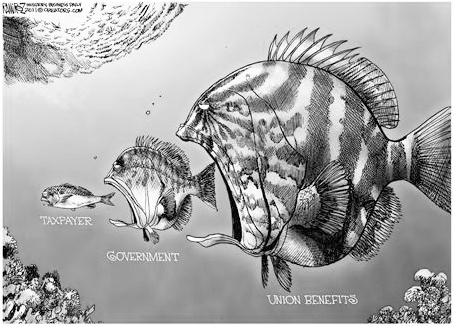
The experience of state after state shows that public-sector compulsory unionism as well as private-sector compulsory unionism devours job- and income-creating opportunities for taxpaying businesses and employees. Credit: Michael Ramirez/Investors Business Daily Union Bosses Aim to Kill Recent Buckeye State Reform Next Month (Source: October 2011 NRTWC Newsletter) Over the past decade, the citizens of forced-unionism Ohio have been afflicted with one of the worst-performing state economies in the country. Across the U.S. as a whole, despite the severe recent recession, private employers' inflation-adjusted outlays for employee compensation (including wages, salaries, bonuses and benefits) did increase from 2000 to 2010, by an average of 4.3%. And many states fared much better than that. In the 22 states with Right to Work laws on the books protecting both private- and public-sector employees from being fired for refusal to pay dues or fees to an unwanted union, real private-sector employee compensation grew by an aggregate 11.3%. Private employees in 20 of the 22 Right to Work states experienced 2000-2010 compensation growth greater than the national average. Unfortunately, in the 28 states without Right to Work laws on the books, private-sector outlays for employee compensation rose only by a combined 0.7%, after adjusting for inflation. Thirteen of the 14 states with the lowest compensation growth lack a Right to Work law. Ohio was one of just five states with negative real private-sector compensation growth over the last decade. In 2010, Ohio's business expenditures for private employee compensation were 6.6% less than they had been in 2000. Region, Job Mix Can't Account For Buckeye State's Shrinking Private Employee Compensation When confronted with such data, apologists for the forced-unionism policies that prevailed across the board in Ohio for decades until this year try to explain them away by blaming the Buckeye State's location in the U.S. Midwest or its historically high manufacturing density for its abysmal economic record. But such excuses won't wash.
The experience of state after state shows that public-sector compulsory unionism as well as private-sector compulsory unionism devours job- and income-creating opportunities for taxpaying businesses and employees. Credit: Michael Ramirez/Investors Business Daily Union Bosses Aim to Kill Recent Buckeye State Reform Next Month (Source: October 2011 NRTWC Newsletter) Over the past decade, the citizens of forced-unionism Ohio have been afflicted with one of the worst-performing state economies in the country. Across the U.S. as a whole, despite the severe recent recession, private employers' inflation-adjusted outlays for employee compensation (including wages, salaries, bonuses and benefits) did increase from 2000 to 2010, by an average of 4.3%. And many states fared much better than that. In the 22 states with Right to Work laws on the books protecting both private- and public-sector employees from being fired for refusal to pay dues or fees to an unwanted union, real private-sector employee compensation grew by an aggregate 11.3%. Private employees in 20 of the 22 Right to Work states experienced 2000-2010 compensation growth greater than the national average. Unfortunately, in the 28 states without Right to Work laws on the books, private-sector outlays for employee compensation rose only by a combined 0.7%, after adjusting for inflation. Thirteen of the 14 states with the lowest compensation growth lack a Right to Work law. Ohio was one of just five states with negative real private-sector compensation growth over the last decade. In 2010, Ohio's business expenditures for private employee compensation were 6.6% less than they had been in 2000. Region, Job Mix Can't Account For Buckeye State's Shrinking Private Employee Compensation When confronted with such data, apologists for the forced-unionism policies that prevailed across the board in Ohio for decades until this year try to explain them away by blaming the Buckeye State's location in the U.S. Midwest or its historically high manufacturing density for its abysmal economic record. But such excuses won't wash.

But National Forced-Dues Repeal Measure Still Being Held Back (Source: September 2011 NRTWC Newsletter) Not long ago, Big Labor was crowing about having thwarted citizen efforts to pass new Right to Work laws in Indiana and New Hampshire this year. But it's now clear that the boasts of the union bosses were premature. Legislative support for abolishing compulsory union membership, dues and fees has been and remains strong in both the Hoosier and Granite States. Union lobbyists have therefore had to rely heavily on Gov. Mitch Daniels (R-Ind.) and union-label Gov. John Lynch (D-N.H.) to prevent enactment of America's 23rd and 24th state Right to Work laws. But now Mr. Daniels, under increasing heat from thousands and thousands of freedom-loving Hoosiers, including many who have supported him in the past, is signaling that he may reconsider his opposition to legislative votes on Right to Work measures in Indianapolis next year. Meanwhile, Mr. Lynch's late-spring veto of H.B.474, which would prohibit the firing of New Hampshire employees for refusal to pay dues or fees to an unwanted union, may now potentially be overridden because of a sustained Right to Work lobbying campaign. States Can't Afford to Ignore Fact That Compulsory Unionism Hinders Economic Growth "In the two years since the severe 2008-9 national recession officially ended, most state economies have recovered only feebly, if at all," commented National Right to Work Committee President Mark Mix. "That's why many Indianans and New Hampshirites, along with the citizens of a number of other states that have yet to enact Right to Work laws, are now emphatically telling their elected officials that they can't afford to ignore the fact that compulsory unionism hinders economic growth. "Trends in employee compensation, that is, wages, salaries, bonuses and benefits, illustrate well the Right to Work growth advantage. "From 2000 to 2010, the inflation-adjusted outlays of private-sector businesses for employee compensation increased by an average of 11.8% in Right to Work states. That increase is nine times as great as forced-unionism states' combined 1.3% rise over the same period. "Twenty of the 22 Right to Work states experienced a real compensation increase greater than the national average of 4.9%. And 14 of the 15 states with the lowest real compensation growth lack a Right to Work law." Mr. Mix added that faster growth constitutes only a part of Right to Work states' edge. Adjusting for regional differences in living costs with the help of indices created by the non-partisan Missouri Economic Research and Information Center (MERIC), in 2010 the average compensation per private-sector employee in Right to Work states was $56,830. That's roughly $1100 more than the average for forced-unionism states. Cost of Living-Adjusted Compensation Higher In Right to Work States

Big Labor history from Robert F. Kennedy’s The Enemy Within: The McClellan Committee's Crusade Against Jimmy Hoffa And Corrupt Labor Unions: As I was going out the door, Hoffa said: "Tell your wife I'm not as bad as everyone thinks I am." I laughed. Jimmy Hoffa had a sense of humor. He must have laughed himself as he said it. In view of all I already knew, I felt that he was worse than anybody said he was. In the next two and a half years, nothing happened to change my opinion. On my way home I thought of how often Hoffa had said he was tough; that he destroyed employers, hated policemen and broke those who stood in his way. It had always been my feeling that if a person was truly tough; if he actually had strength and power; if he really had the ability to excel, he need not brag and boast of it to prove it.
Syndicated columnist Charles Krauthammer has hit the nail on the head -- the president is a wholly-owned subsidiary of Big Labor: In this year’s State of the Union address,[President Obama] proclaimed a national goal of doubling exports by 2014. One obvious way to increase exports is through free-trade agreements. But unions don’t like them. No surprise then that for two years Obama has been sitting on three free-trade agreements — with Colombia, Panama, and South Korea — already negotiated by his predecessor. Nothing new here. In 2009, Obama pushed through a federally run, questionably legal bankruptcy for the auto companies that robbed first-in-line creditors in order to bail out the United Auto Workers. Elsewhere, Delta Air Lines workers have voted four times to reject unionization. A federal agency, naturally, is investigating and, notes economist Irwin Stelzer, can order still another election in the hope that it yields the answer Obama’s campaign team wants. But Democratic fealty to unions does not stop there. Boeing has just completed a production facility in South Carolina for its new 787 Dreamliner. Why? Because by choosing right-to-work South Carolina, Boeing is accused of retaliating against its unionized Washington State workers for previous strikes. It jeopardizes the economic recovery, not only targeting America’s single largest exporter in its attempt to compete with Airbus for a huge global market, but also threatening any other company that might think of expanding in any way displeasing to unions and their NLRB patrons.

What do those fighting back criticism of the National Labor Relations Board (NLRB) have in common? Most are fueled by political contributions from union bosses. The Hill newspaper…
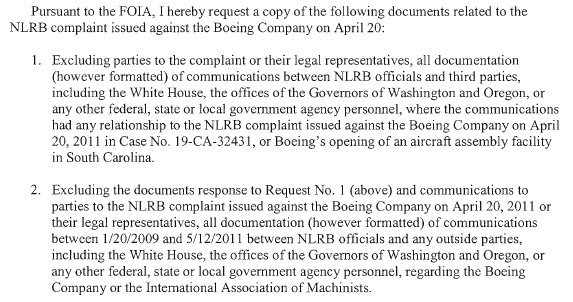
Did the National Labor Relations Board (NLRB) act independently when it filed a complaint against Boeing Aircraft that would cost 1,000 men and women to lose their jobs in South Carolina? Apparently, the National Right to Work Legal Defense Foundation…

“They were warning me that if I continue to complain about their finances, they would have me killed," a New York union member, who caught the union bosses with their hands in the union member coffers, told the New York Daily News: Unionized phone company employees say they were beaten or threatened after they accused their labor bosses of looting their coffers through various scams. One member of Communications Workers of America Local 1101 said that after he reported a time-sheet padding scheme, a thug beat him so badly his spine was injured. Another says he found a dead rat in his locker, while a third said a union officer warned that suspected informants should be brought off company property and "taken care of." The threats come to light as the U.S. Labor Department is probing charges that union bosses lined their pockets at the rank-and-file's expense. Accusations include an unauthorized 401(k) plan union officers gave themselves funded with members' dues, along with hefty weekly allowances, lavish expense accounts and six-figure salaries, union documents show. The feds are also looking into allegations that double-dipping union bosses illegally received pay from Verizon and the local for the same hours, sources said. "This was union greed and that's worse than corporate greed," said Kevin Condy, a reform movement leader of the 6,700-member local that represents mostly Verizon workers in Manhattan and the Bronx. "These guys acted like they felt they were entitled." And, some members charge, the bosses retaliated when threatened with exposure. In August, business agent Patrick Gibbons said he received death threats and his office was vandalized after he complained that union bosses were misappropriating cash. "They were warning me that if I continue to complain about their finances, they would have me killed," Gibbons wrote in an open letter to union members. Six months earlier, Verizon heavy equipment operators Salvatore DiStefano and Sebastian Taravella sued the local in Brooklyn Federal Court. They said they were harassed after telling Verizon security officials a manager allowed workers to leave early but claim a full day's pay - as long as they completed a quota of assigned jobs. DiStefano told the Daily News he was "attacked by a union thug" as he started the morning shift at a Verizon garage in the Bronx in April 2009. "He pounded me with his fists, he spit on me, he choked me and threw me down to the floor," he said. DiStefano said he suffered two herniated discs and had knee problems that required surgery. He got workers' compensation as a result, records show.