


Failure to Keep Pro-Right to Work Campaign Vows ‘Makes No Sense’
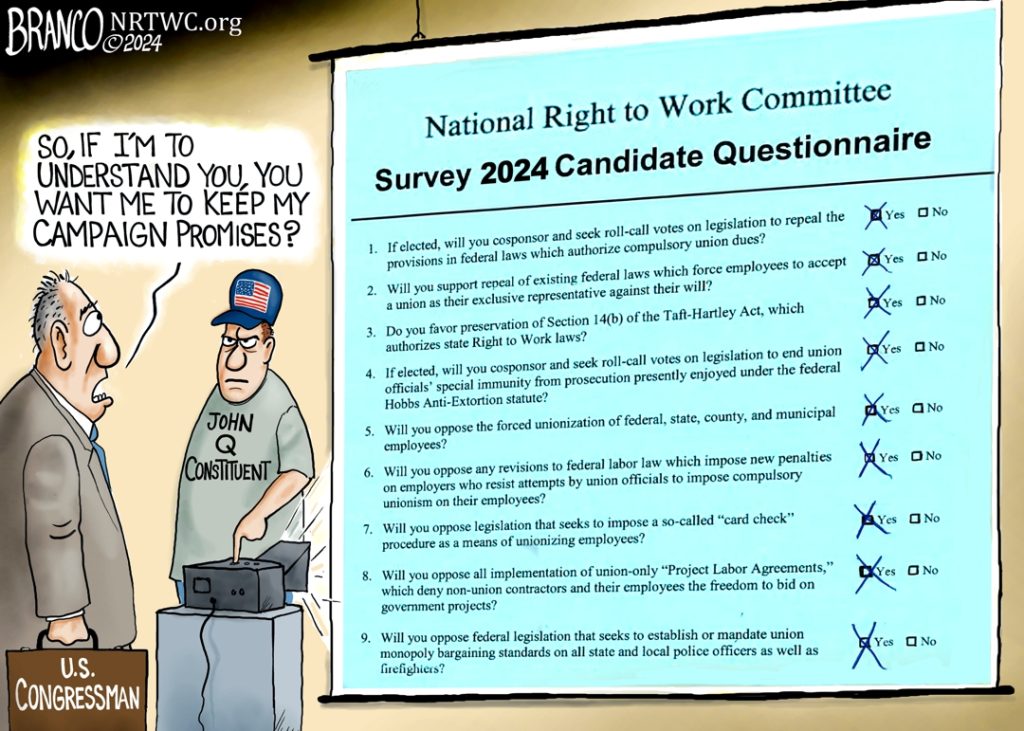
The tail continues to wag the dog on Capitol Hill. A handful of short-sighted Republicans are hurting themselves and their own party by failing to cosponsor the National Right to Work Act, breaking pledges they made to their constituents and helping Big Labor keep the legislation from coming to the floor.
Nearly a year and a half ago, 179 GOP candidates won their elections to the U.S. House after sponsoring or cosponsoring legislation abolishing federally imposed forced union dues and fees and/or promising to do so in the future.
The vast majority of current congressmen and congresswomen who promised in response to their 2024 National Right to Work Committee candidate surveys to support forced-dues repeal are now cosponsors of H.R.1232, the National Right to Work Act.
Constituents of Reps. Evans, Moore and Nunn Are Strongly Pro-Right to Work
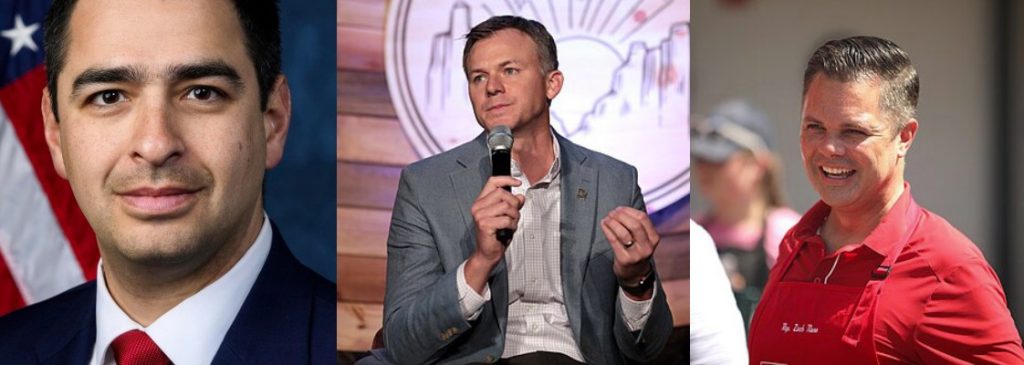
But there are a few who answered their Committee surveys 100% in favor of Right to Work, such as Gabe Evans (R-Colo.), Blake Moore (R-Utah), and Zach Nunn (R-Iowa), and are now, along with their Big Labor Democrat colleagues, sitting on their hands. Despite their campaign promises, they have yet to cosponsor the forced-dues repeal bill.
Their constituents, 80% or more of whom support the Right to Work principle, should be demanding they keep their word.
This spring, the Committee is mobilizing members and supporters in a number of targeted congressional districts and states to convince House members and senators to cosponsor H.R.1232 or its Senate companion, S.533.
Later this year, the Committee’s mobilization will be geared primarily at urging aggressively pro-forced unionism politicians to reverse course.
As the Committee’s Survey 2026 program unfolds, candidates will be given several chances to return their surveys and answer 100% in favor of American employees’ Right to Work.
‘Workers Should Never Be Forced,’ or Coerced, To ‘Pay Dues to a Union’

Committee Vice President Greg Mourad commented:
“This year, as in previous election years, millions of grassroots Right to Work supporters are being enlisted to lobby federal politicians seeking election or reelection to oppose compulsory unionism across the board.
“Blake Moore and Zach Nunn live in states that have already passed Right to Work laws themselves. Gabe Evans represents forced-unionism Colorado, but he won his seat in 2024 after pledging to support Right to Work, which helped him oust pro-forced unionism incumbent Yadira Caraveo.
“It makes no sense that House members whose core constituencies are overwhelmingly and passionately opposed to monopolistic unionism should hesitate to cosponsor H.R.1232. Frankly, I’m baffled by the reluctance of Reps. Moore, Nunn and Evans.”
Of course, it isn’t just in a subset of congressional districts that public opinion strongly supports the Right to Work principle.
“Poll after poll shows that the American people as a whole recognize that compulsory unionism is wrong,” said Mr. Mourad. To illustrate his point, he cited a May 2024 nationwide scientific survey of registered voters overseen by renowned pollster Scott Rasmussen.
The poll found that 82% of voters, including 79% of active union members, agree that workers “should never be forced to join a union or pay dues to a union as a condition of employment.” Moreover, Right to Work support tends to be even higher in GOP-held districts.
“Unfortunately,” observed Mr. Mourad, “federal labor policy has long been in conflict with the common-sense views of the vast majority of ordinary citizens across the country.
“For nine decades, it has explicitly authorized the termination of employees for refusal to join or pay dues or fees to a union, even if they don’t want it and never asked for it.”
But all of this would change if H.R.1232/S.533 became law. This legislation does not add a single word to federal law. It would simply repeal the current provisions in the federal code that authorize and promote the termination of employees for refusal to pay money to an unwanted union.
Employment Growth Superior, Real Incomes Higher in Right to Work States
In addition to enjoying the support of the vast majority of Americans, federal Right to Work legislation would almost certainly foster faster job and income growth around the country, based on decades of experience at the state level.
Statistics compiled from independent nonprofit and official government sources confirm the Right to Work economic advantage, as the National Institute for Labor Relations Research has shown again and again.
For example, from 2014 to 2024, the percentage growth in the number of people employed in Right to Work states was 16.4%, more than double the aggregate rate for forced-unionism states.
Manufacturing employment grew by 10% in Right to Work states over that same period, while it actually shrank in compulsory-unionism states.
In 2022, the average share of all income consumed by state and local taxes in Right to Work states was 9.5%, while the same levies ate up 12.5% of forced dues state residents’ income.
And largely thanks to their lower tax burdens, Right to Work states’ cost-of-living adjusted per capita disposable income as of 2024 was $2,885 higher than that of states where forced union dues are still permitted.
Right to Work has a much greater influence on a state’s climate for overall job and income growth than one might expect. This is partly because, wherever Big Labor is endowed with forced dues privileges, it devotes a substantial share of the cash extracted from workers to lobbying for heavier taxation and more intense regulation of business, and electioneering on behalf of Big Government politicians.
Ideal Is For All Candidates For Federal Office to Oppose Forced Unionism
Forced dues-funded politicians cause the biggest problems in Big Labor-dominated states, but employees and businesses across the country lose valuable economic opportunities because of the actions of union-label U.S. congressmen and senators.
“The bottom line is, Americans find the very idea of compulsory unionism distasteful,” said Mr. Mourad.
“And it has been a disaster in practice. Our aim is for all federal candidates to vow to oppose it in the future, regardless of what their records have been up to now.
“Without a doubt, it is the goal of Right to Work members and supporters to get every candidate this November to oppose Big Labor’s monopoly privileges, as we work toward a day when no worker in America can be forced to join or pay dues to a union.”
This article was originally published in our monthly newsletter. Go here to access previous newsletter posts.
To support our cause and help end forced unionism, go here to donate.