Radical Teacher Unions Get Even More Radical
Incoming NEA President Princess Moss: Teachers Must Be Full-Time Political Activists
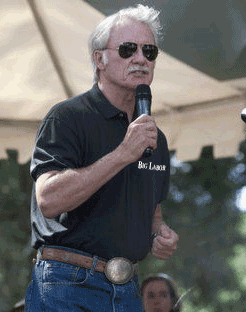 The Oregonian takes Gov. Kitzhaber to task for opposing a ballot initiative that would give state workers the ability of opting out of their union.
Gov. John Kitzhaber gave both barrels on Monday to a proposed initiative that would allow public employees who don’t want to join unions to withhold mandatory union payments. The measure would do nothing more nefarious than give people a choice about the use of their own money. Yet there was the governor telling the audience at a union-sponsored picnic, “We are not going to let ‘right to work’ take root in Oregon, not here, not now, not in Oregon, not ever!”
“And I’m here,” he continued, “to ask you to work with me over the next year to fight … to keep our labor movement strong, to build our middle class and make Oregon the state that launches the comeback of organized labor across the United States of America.”
As The Oregonian’s Jeff Mapes reported, Oregon AFL-CIO President Tom Chamberlain was inspired to remark, “Damn, governor, you sounded like the president of the AFL-CIO.”
The governor would like to ease a relationship with labor strained by his pursuit of PERS reform, perhaps with an eye toward a re-election campaign next year. Spending political capital, which he has in abundance, to defeat an initiative unions fear is a good way to make nice.
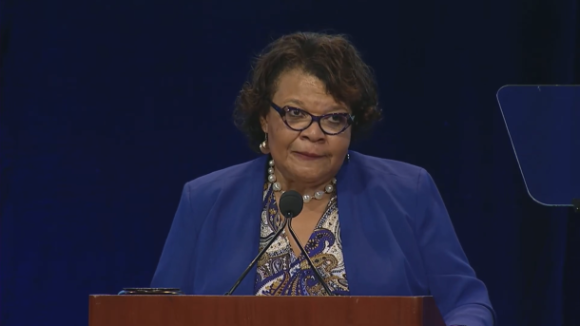
Incoming NEA President Princess Moss: Teachers Must Be Full-Time Political Activists
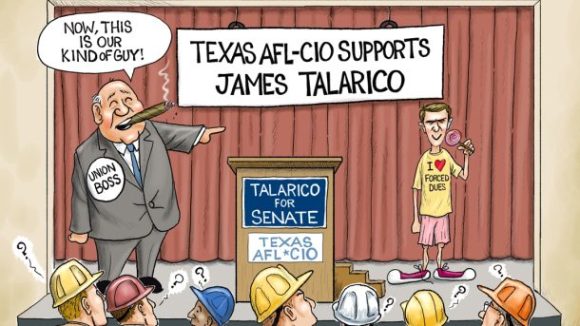
Union bosses are rallying behind Democrat Texas U.S. Senate candidate James Talarico because he opposes Right to Work protections for employees.
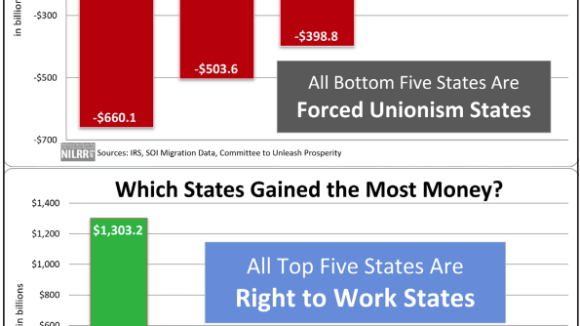
... States that continuously lacked Right to Work protections for employees from 2012-23 lost a net total of $2.05 trillion in cumulative AGI solely as a consequence of domestic out-migration of taxpayers during that 11-year period.