The Latest

NLRB's chief lawyer should stop obstructing Congress

NLRB's chief lawyer should stop obstructing Congress

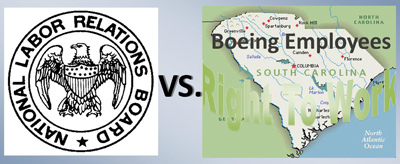
Peter Schaumber, the former chairman of the National Labor Relations Board, is urging the current NLRB to stop stonewalling Congress with regard to their efforts to punish Boeing and Right to Work States: “House Oversight and Government Reform Committee Chairman Darrell Issa of California needs to resolve the impasse over requested Boeing documents with Lafe Solomon, the acting general counsel of the National Labor Relations Board. Congress has a right to know now whether the Boeing complaint reflects benign poor judgment or an abuse of the agency's prosecutorial discretion. Already, we know the filing of this complaint is chilling business investment in the United States, and for good reason. Since mid-May, Solomon has by and large stonewalled the committee's request for pre-complaint documents relating to the Boeing complaint. After a series of unproductive letters, the committee finally issued a subpoena for the documents on Aug. 12. Tensions mounted recently when the agency was found to have deleted certain emails from the few pre-complaint documents it provided the committee. This action demonstrates a decided lack of seriousness in responding to the congressional subpoena. Does the acting general counsel believe his office is immune to oversight? The Supreme Court has long recognized that the power of Congress to investigate "with process to enforce it -- is an essential and appropriate auxiliary to the legislative function" (McGrain v. Daugherty). The fact that the agency is "independent" of the executive branch does not immunize it from congressional oversight; it makes legislative oversight all the more necessary.

NLRB's chief lawyer should stop obstructing Congress

NLRB's chief lawyer should stop obstructing Congress

Peter Schaumber, the former chairman of the National Labor Relations Board, is urging the current NLRB to stop stonewalling Congress with regard to their efforts to punish Boeing and Right to Work States: “House Oversight and Government Reform Committee Chairman Darrell Issa of California needs to resolve the impasse over requested Boeing documents with Lafe Solomon, the acting general counsel of the National Labor Relations Board. Congress has a right to know now whether the Boeing complaint reflects benign poor judgment or an abuse of the agency's prosecutorial discretion. Already, we know the filing of this complaint is chilling business investment in the United States, and for good reason. Since mid-May, Solomon has by and large stonewalled the committee's request for pre-complaint documents relating to the Boeing complaint. After a series of unproductive letters, the committee finally issued a subpoena for the documents on Aug. 12. Tensions mounted recently when the agency was found to have deleted certain emails from the few pre-complaint documents it provided the committee. This action demonstrates a decided lack of seriousness in responding to the congressional subpoena. Does the acting general counsel believe his office is immune to oversight? The Supreme Court has long recognized that the power of Congress to investigate "with process to enforce it -- is an essential and appropriate auxiliary to the legislative function" (McGrain v. Daugherty). The fact that the agency is "independent" of the executive branch does not immunize it from congressional oversight; it makes legislative oversight all the more necessary.

SEIU Siphons

SEIU Siphons "Dues" from Michigan Medicaid

Outrageous.  That is the only way to describe the SEIU's latest scheme to paid their coffers: If you're a parent who accepts Medicaid payments from the State of Michigan to help support your mentally-disabled adult children,  you qualify as a state employee for the purposes of the Service Employees International Union (SEIU). They can now claim and receive a portion of your Medicaid in the form of union dues. Robert and Patricia Haynes live in Michigan with their two adult children, who have cerebral palsy. The state government provides the family with insurance through Medicaid, but also treats them as caregivers. For the SEIU, this makes them public employees and thus members of the union, which receives $30 out of the family's monthly Medicaid subsidy. The Michigan Quality Community Care Council (MQC3) deducts union dues on behalf of SEIU. Michigan Department of Community Health Director Olga Dazzo explained the process in to her members of her staff.  "MQC3 basically runs the program for SEIU and passes the union dues from the state to the union," she wrote in an emailobtained by the Mackinac Center. Initiated in 2006 under then-Gov. Jennifer Granholm, D-Mich., the plan reportedly provides the SEIU with $6 million annually in union dues deducted from those Medicaid subsidies. “We're not even home health care workers. We're just parents taking care of our kids,” Robert Haynes, a retired Detroit police officer, told the Mackinac Center for Public Policy. “Our daughter is 34 and our son is 30. They have cerebral palsy. They are basically like 6-month-olds in adult bodies. They need to be fed and they wear diapers. We could sure use that $30 a month that's being sent to the union.”

SEIU Siphons "Dues" from Michigan Medicaid

SEIU Siphons "Dues" from Michigan Medicaid

Outrageous.  That is the only way to describe the SEIU's latest scheme to paid their coffers: If you're a parent who accepts Medicaid payments from the State of Michigan to help support your mentally-disabled adult children,  you qualify as a state employee for the purposes of the Service Employees International Union (SEIU). They can now claim and receive a portion of your Medicaid in the form of union dues. Robert and Patricia Haynes live in Michigan with their two adult children, who have cerebral palsy. The state government provides the family with insurance through Medicaid, but also treats them as caregivers. For the SEIU, this makes them public employees and thus members of the union, which receives $30 out of the family's monthly Medicaid subsidy. The Michigan Quality Community Care Council (MQC3) deducts union dues on behalf of SEIU. Michigan Department of Community Health Director Olga Dazzo explained the process in to her members of her staff.  "MQC3 basically runs the program for SEIU and passes the union dues from the state to the union," she wrote in an emailobtained by the Mackinac Center. Initiated in 2006 under then-Gov. Jennifer Granholm, D-Mich., the plan reportedly provides the SEIU with $6 million annually in union dues deducted from those Medicaid subsidies. “We're not even home health care workers. We're just parents taking care of our kids,” Robert Haynes, a retired Detroit police officer, told the Mackinac Center for Public Policy. “Our daughter is 34 and our son is 30. They have cerebral palsy. They are basically like 6-month-olds in adult bodies. They need to be fed and they wear diapers. We could sure use that $30 a month that's being sent to the union.”

Heritage Foundation: Right to Work Creates Jobs and Choice

James Sherk of the Heritage Foundation confirms what we have known for decades, enacting Right to Work laws create jobs and promote choice for workers: Union contracts frequently require employees to pay union dues or lose their jobs. This forces workers to support the union financially even if the union contract harms them or they oppose the union’s agenda. Several states, including New Hampshire and Indiana, are considering right-to-work laws, which protect workers from being fired for not paying union dues. Unions oppose these laws because they reduce union membership and income. However, the rest of the economy benefits from right-to-work laws. States can and should reduce unemployment by becoming right-to-work states. Right-to-Work Unions often negotiate contracts requiring all workers to pay union dues or lose their jobs, whether or not they support the union. But many workers reject unions. Some do so because union contracts reduce their pay. Others oppose unions’ political agendas: Unions almost exclusively support Democrats, despite 37 percent of their members voting Republican in the last election.[1] To prevent workers from being forced to support unions financially, 22 states have passed right-to-work laws. Such laws prevent companies from firing workers who do not pay union dues. Workers may still pay voluntarily, but unions cannot threaten their jobs if they do not join. Lawmakers in several states, including New Hampshire, Indiana, and Michigan, are considering right-to-work bills. Forced Unionization Is Not an American Value The government should not force workers to pay for unwanted union representation. In a free society, workers alone should make that choice. Right-to-work laws also make good economic sense. They reduce the incentive for union organizers to target companies that treat their workers well. Since unions hurt businesses, less aggressive union organizing attracts investment—and jobs. Lawmakers considering right-to-work proposals should ignore the union movement’s self-interested opposition. Unions could negotiate contracts that apply only to their members—they simply prefer not to. Unions should not be able to force workers to choose between financially supporting them and losing their jobs. Unions Lose Money When Workers Opt Out