The Latest

Workers Forced to Bankroll Agenda They Oppose

Workers Forced to Bankroll Agenda They Oppose

(Source: December 2010 NRTWC Newsletter) Union bosses like AFL-CIO czar Richard Trumka claim that forced-unionism policies are in union members' best interest. But a new scientific poll shows union members overwhelmingly support the Right to Work principle. New Nationwide Poll Shows Union Members Support Right to Work A scientific survey of union members nationwide, conducted the week before the November elections by well-known pollster Frank Luntz for the National Right to Work Legal Defense Foundation, shows that Big Labor bosses are out of touch with the people they purport to represent as well as the public at large. The poll gauged the opinions of both private- and government-sector union members regarding key aspects of the agenda Big Labor bankrolls with union treasury funds, which consist primarily of dues and fees that workers are forced to fork over as a condition of employment. In the 2009-2010 campaign cycle, union officials funneled forced dues and fees extracted from an estimated nine million union members and forced union fee-paying nonmembers into what appears to have been their largest ever federal mid-term electoral war chest. Top bosses of the AFL-CIO-affiliated American Federation of State, County and Municipal Employees (AFSCME) union openly admit to having spent a total of nearly $87.5 million, mostly union treasury money, on mid-term electioneering. Service Employees International Union (SEIU) bosses acknowledge pouring $44 million, primarily forced-dues money, into 2009-2010 politics. National Education Association (NEA) teacher union chiefs have owned up to siphoning $40 million into politicking over the past two years. Altogether, it's safe to say Organized Labor shelled out more than a billion dollars in reported and unreported contributions, including "in-kind" support like phone banks and get-out-the-vote drives as well as cash, to its favored 2010 congressional candidates. Four Out of Five Union Members Reject Forced Union Membership, Dues

Federal Candidate Survey Mobilizes Millions

Federal Candidate Survey Mobilizes Millions

(Source: December 2010 NRTWC Newsletter) The Committee's federal survey program ensured that politicians like the supposedly "independent" U.S. Rep. Stephanie Herseth Sandlin (D-S.D.) were held accountable for their votes to expand Big Labor's forced-unionism privileges. Program Maximizes Right to Work Gains in 'Year of Opportunity' Thanks to National Right to Work Committee members' generous assistance, the Committee's federal-candidate Survey 2010 checked a massive Big Labor electioneering blitz and sharply increased support in Congress for repeal of federally-imposed forced union dues. To mobilize Right to Work supporters, the Committee distributed a record-smashing total of nearly 8.4 million federal candidate Survey "information packets" through the U.S. Postal Service this year. Above and beyond that, the 2010 program had a massive Internet component, including nearly half a million e-mails transmitted in October alone. All this plus radio, TV, and newspaper advertising. The packets, e-mails and ads let pro-Right to Work citizens know where their candidates stood on compulsory unionism. And most of the packets were mailed out during the during the last five weeks of the general election campaign to specifically targeted states and districts across the country. In a year in which voters were already extremely concerned about Big Labor encroachment of employee freedom and destruction of private-sector jobs, the fall program maximized Right to Work gains in both the U.S. House and the U.S. Senate. Pro-Right to Work Candidates Won in 76 of 106 Targeted Congressional Contests Compared to the House that will permanently disband after a December "lame duck" session, the House that convenes in January will have 55 more members identified, based on their campaign pledges and voting records, as 100% Right to Work supporters. In the Senate, where just 37 out of 100 seats were up for election this year, compared to 435 out of 435 House seats, Right to Work reaped a net gain of five seats.

Right to Work: Rx For Job-Losing States

Right to Work: Rx For Job-Losing States

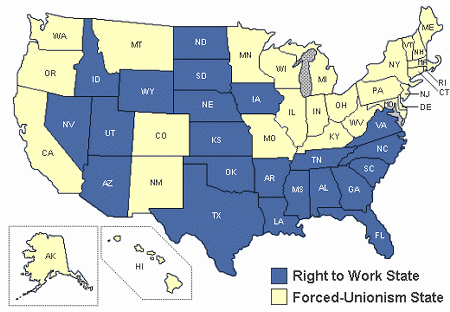
(Source: December 2010 NRTWC Newsletter) In every region of the country where both Right to Work states and forced-unionism states are located, the Right to Work states' long-term economic growth is superior. The Midwestern contrast is especially strong. Legislators Look at 'Oklahoma Model' For Stronger Economic Growth It's been more than seven decades since The Grapes of Wrath, both the John Steinbeck novel and the Hollywood movie it inspired, established the desperate migration of "Okies" from the Dust Bowl to the orchards of California as an icon of the Great Depression. Times have certainly changed. As an October 12 USA Today feature story noted, since 1999, "the number of Californians departing the Golden State for Oklahoma has outnumbered those going the opposite direction by more than 21,000 . . . ." The net influx of people into the Sooner State from California and many other states with sub-par or abysmal job and income growth records is, as USA Today put it, "a sign of Oklahoma's growing economic prowess." To explain the state's recent record of economic success, the USA Today feature specifically mentioned Oklahoma's low and relatively stable housing costs, its concentration of aerospace and defense technology expertise, and its oil and natural gas reserves. But as important as these assets are, Oklahoma had them all in the early 1990's, when its long-term job and income growth still trailed the national average. The real turning point for Oklahoma's transition from an economic laggard to an economic leader was in 1992 -- when the National Right to Work Committee teamed up with local grass-roots activists to map out a multi-year campaign to pass a Sooner Right to Work law. Benefits of Right to Work Campaign Were Evident Long Before State Law Was Passed "In the early 1990's, the 'Dust Bowl' was already a distant memory, but Oklahoma's job climate still seemed pretty dry," commented Matthew Leen, vice president of the National Right to Work Committee. Domestic population migration data reflect Oklahoma's "growing economic prowess." The 1994-2001 Sooner State campaign to pass a Right to Work law, as well as the law itself, helped build that prowess. "From 1984 through 1994, the decade before the Committee program to pass a Right to Work law in Oklahoma was initiated, private-sector employment in Oklahoma increased by less than a third as much as the national average, according to the U.S. Labor Department. "Over that same decade, inflation-adjusted U.S. Commerce Department data show Oklahoma's real personal income grew by just 2.3%, less than a tenth of the nationwide percentage gain. "But in 1994, the seeds of change were