


College-Educated and Blue-Collar Are Fleeing Forced-Dues States
Recently updated federal data on the American workforce and employment show that employer demand for college-educated employees rose at a surprisingly rapid clip from 2014 to 2024, despite the severe, COVID-19-related downturn of 2020.
Over the entire decade, the total population of the U.S., aged 25-64, grew by just 4.3%, but the number of people in that age bracket with at least a bachelor’s degree grew by 27.9%!
And, as of last November, according to the U.S. Bureau of Labor Statistics, the seasonally-adjusted labor force participation for civilians aged 25 and over (including people 65 and over) with one or more higher-education degrees was 72.2%.
That’s 8.5 percentage points higher than the overall labor-force participation for people in that age bracket.
Economic Interests of College-Educated, Blue-Collar Workers Aren’t in Conflict
Also in November, the nationwide seasonally-adjusted unemployment rate for college-educated adults 25 and over was just 2.9%, compared to 3.7% for the 25-and-over workforce as a whole.
The bottom-line significance of these data is employers across the country typically have more difficulty finding a qualified college-educated person to fill a position than a college-educated person has finding a good job.
Of course, not everyone who holds a bachelor’s degree and is in the workforce is doing well economically. But generally speaking it is still a “seller’s market” for college-educated labor in America today.
Furthermore, many businesses that sustain large numbers of jobs for people with associate’s degrees, high school diplomas, or less education also require a substantial number of college-educated people to operate efficiently.
Therefore, the rate at which a state is gaining college-educated people, relative to the national average, is in itself a good measure of how successful the state is in creating and retaining good jobs.
According to this important criterion, states that still lack Right to Work protections for employees are performing quite poorly.
Forty-six states were either Right to Work or forced-unionism for the entire period from 2014 to 2024.
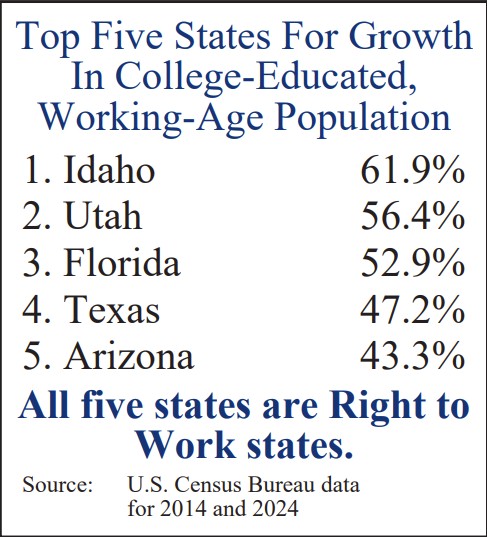
Among these states, the five with the greatest percentage gains in their working-age, college-educated population over that period — Idaho, Utah, Florida, Texas, and Arizona — are all Right to Work states. Ten of the 12 top-ranking states are Right to Work.
Twelve of the 17 Bottom-Ranking States Lack Right to Work Protections
On the other hand, 12 of the 17 states with the lowest percentage growth in their college-educated populations, aged 25-64, from 2014 to 2024 are forced-unionism states.
Right to Work states with rapidly growing college-educated populations are culturally as well as regionally diverse.
These states are located in the Rocky Mountain, Southwestern and Southeastern parts of America.
And Right to Work states have outperformed forced-dues states that are located within the same U.S. Census region.
Forced-Unionism States Seeking a ‘Brain Gain’ Should Pass Right to Work
In the aggregate, the 23 states with longstanding Right to Work laws experienced a decade-long percentage gain in their college-educated, working-age populations of 37.1%. That’s nearly double the average increase for the remaining compulsory-dues states.
“The simple fact is, highly educated employees, like other employees, benefit from Right to Work laws,” said National Right to Work Committee Vice President Matthew Leen.
“Employees of all kinds prefer to live in Right to Work states when they have a choice because living costs are lower and real incomes are higher.
[See pp. 6-7 of this month’s Newsletter for additional information on this topic.]
“Forced-unionism states seeking a ‘brain gain’ should pass Right to Work laws.
“The data show this is a much more effective way for a state to attract additional educated workers than jacking up subsidies for the already heavily subsidized higher education system.
“Policymakers in the 24 states that currently lack Right to Work protections for workers should pay heed.”
This article was originally published in our monthly newsletter. Go here to access previous newsletter posts.
To support our cause and help end forced unionism, go here to donate.