Union Bosses, Enemies of the 99%

Union Bosses, Enemies of the 99%

Gary Beckner argues that the union bosses and Big Labor are enemies of the 99%: Since the class-warfare message of the Occupy Wall Street protests started nearly two months ago, the two largest teachers unions, the National Education Association (NEA) and the American Federation of Teachers (AFT), have taken every chance possible to stand in solidarity with the group of mostly underemployed college students and left-leaning activists. With AFT President Randi Weingarten joining in protests and state affiliates taking part and organizing protests of their own, the teachers unions are quick to point out that “public education, teachers and unions have increasingly come under attack from the one percent,” as Leo Casey, spokesman for the AFT’s New York City local put it. The union support is pouring in state after state. For example, in the union stronghold of California, California NEA affiliate President Dean Vogel called on the rich to pay more taxes. “It’s time to put Main Street before Wall Street, and for corporations to pay their fair share of taxes,” he said. Meanwhile, the union rank and file are resorting to taking the fight into the classroom with lesson plans titled “Who are the 99 percent? Ways to teach about Occupy Wall Street.” As the protests continue and the union rhetoric becomes more radical, one can’t help but find the situation ironic. While the teachers unions claim they are being persecuted by the wealthiest Americans, clearly it is the unions and union bosses themselves that have benefited from a system that takes advantage of taxpayers at the expense of our students. An examination of the staggering amount of money accumulated by the teachers unions puts the situation into perspective. The AFT collected $211 million in dues in 2010, while the even larger NEA pulled in $397 million. Taking into consideration affiliated state groups, the unions collectively take in about $1 billion, more than half of which is taken by force in states with compulsory unionism. If you take into account their vast budgets and revenue streams forcibly collected from teachers, the NEA and AFT numbers align nicely with those of the corporations they so vehemently criticize. In terms of salaries, union executives rake in nearly 10 times the average household income. AFT President Weingarten collected nearly half a million dollars in 2010, a 15 percent increase from the previous year. Are teachers or anyone in the private sector experiencing those increases in times of financial hardship? Clearly, the teachers laid off in 2010 were not made aware of  Weingarten’s impressive haul. Then again, when nearly 600 staffers at the NEA and AFT are raking in more than six figures, the interests of the rank and file seem far off.

Forced-Dues Drive Pennsylvania Public Union Salaries,  Outpace Private Sector's and Members' Wages

Forced-Dues Drive Pennsylvania Public Union Salaries, Outpace Private Sector's and Members' Wages

Forced-dues continue to fill the coffers of unions, as well as, union presidents'  and politicians' pockets according to this recent study by the Commonwealth Foundation: Government Unions and Forced Dues Almost half of government workers in Pennsylvania are union members, compared to 9.3 percent in the private sector. Pennsylvania is a forced union state, meaning that workers can be forced to join a union or pay a [so-called] "fair share fee" just to keep their job.  Most government units in Pennsylvania are "agency shops," with a specified union to which workers must pay a fee. When state and local governments automatically deduct dues and fair share fees from government workers' paychecks—as is the practice in Pennsylvania—employees have little or no say in how their money is used. Union Bosses Union bosses collect hefty salaries derived from member dues and fair share fees. In most cases, the salaries are several times the average union member's annual pay. While acknowledging that budgets were tight, AFSCME Council 13 President David Fillman got a 6 percent raise in 2010, making his salary higher than Gov. Tom Corbett's. Dues and fees often go towards expensive conferences, outings and junkets.  For example, in 2009-10 the Pennsylvania State Education Association—the state's largest public sector union—spent: More than $250,000 on a board of directors retreat in Gettysburg. More than $89,000 for a "political institution meeting" at the Radisson Penn Harris in Camp Hill, Pa. $20,000 for advertising in the Pittsburgh Steelers Yearbook. Almost $5,900 at Kimberton Golf Club and more than $5,100 at Concord Country Club in Chadd's Ford. Political Activity and Lobbying

Forced-Dues Drive Pennsylvania Public Union Salaries,  Outpace Private Sector's and Members' Wages

Forced-Dues Drive Pennsylvania Public Union Salaries, Outpace Private Sector's and Members' Wages

Forced-dues continue to fill the coffers of unions, as well as, union presidents'  and politicians' pockets according to this recent study by the Commonwealth Foundation: Government Unions and Forced Dues Almost half of government workers in Pennsylvania are union members, compared to 9.3 percent in the private sector. Pennsylvania is a forced union state, meaning that workers can be forced to join a union or pay a [so-called] "fair share fee" just to keep their job.  Most government units in Pennsylvania are "agency shops," with a specified union to which workers must pay a fee. When state and local governments automatically deduct dues and fair share fees from government workers' paychecks—as is the practice in Pennsylvania—employees have little or no say in how their money is used. Union Bosses Union bosses collect hefty salaries derived from member dues and fair share fees. In most cases, the salaries are several times the average union member's annual pay. While acknowledging that budgets were tight, AFSCME Council 13 President David Fillman got a 6 percent raise in 2010, making his salary higher than Gov. Tom Corbett's. Dues and fees often go towards expensive conferences, outings and junkets.  For example, in 2009-10 the Pennsylvania State Education Association—the state's largest public sector union—spent: More than $250,000 on a board of directors retreat in Gettysburg. More than $89,000 for a "political institution meeting" at the Radisson Penn Harris in Camp Hill, Pa. $20,000 for advertising in the Pittsburgh Steelers Yearbook. Almost $5,900 at Kimberton Golf Club and more than $5,100 at Concord Country Club in Chadd's Ford. Political Activity and Lobbying

Public Servants' Right to Work in Jeopardy

Public Servants' Right to Work in Jeopardy

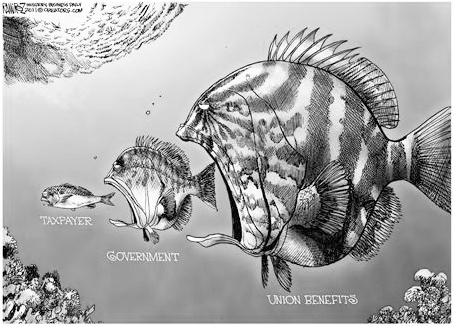
The experience of state after state shows that public-sector compulsory unionism as well as private-sector compulsory unionism devours job- and income-creating opportunities for taxpaying businesses and employees. Credit: Michael Ramirez/Investors Business Daily  Union Bosses Aim to Kill Recent Buckeye State Reform Next Month (Source: October 2011 NRTWC Newsletter) Over the past decade, the citizens of forced-unionism Ohio have been afflicted with one of the worst-performing state economies in the country. Across the U.S. as a whole, despite the severe recent recession, private employers' inflation-adjusted outlays for employee compensation (including wages, salaries, bonuses and benefits) did increase from 2000 to 2010, by an average of 4.3%. And many states fared much better than that. In the 22 states with Right to Work laws on the books protecting both private- and public-sector employees from being fired for refusal to pay dues or fees to an unwanted union, real private-sector employee compensation grew by an aggregate 11.3%. Private employees in 20 of the 22 Right to Work states experienced 2000-2010 compensation growth greater than the national average. Unfortunately, in the 28 states without Right to Work laws on the books, private-sector outlays for employee compensation rose only by a combined 0.7%, after adjusting for inflation. Thirteen of the 14 states with the lowest compensation growth lack a Right to Work law. Ohio was one of just five states with negative real private-sector compensation growth over the last decade. In 2010, Ohio's business expenditures for private employee compensation were 6.6% less than they had been in 2000. Region, Job Mix Can't Account For Buckeye State's Shrinking Private Employee Compensation When confronted with such data, apologists for the forced-unionism policies that prevailed across the board in Ohio for decades until this year try to explain them away by blaming the Buckeye State's location in the U.S. Midwest or its historically high manufacturing density for its abysmal economic record. But such excuses won't wash.

Public Servants' Right to Work in Jeopardy

Public Servants' Right to Work in Jeopardy

The experience of state after state shows that public-sector compulsory unionism as well as private-sector compulsory unionism devours job- and income-creating opportunities for taxpaying businesses and employees. Credit: Michael Ramirez/Investors Business Daily  Union Bosses Aim to Kill Recent Buckeye State Reform Next Month (Source: October 2011 NRTWC Newsletter) Over the past decade, the citizens of forced-unionism Ohio have been afflicted with one of the worst-performing state economies in the country. Across the U.S. as a whole, despite the severe recent recession, private employers' inflation-adjusted outlays for employee compensation (including wages, salaries, bonuses and benefits) did increase from 2000 to 2010, by an average of 4.3%. And many states fared much better than that. In the 22 states with Right to Work laws on the books protecting both private- and public-sector employees from being fired for refusal to pay dues or fees to an unwanted union, real private-sector employee compensation grew by an aggregate 11.3%. Private employees in 20 of the 22 Right to Work states experienced 2000-2010 compensation growth greater than the national average. Unfortunately, in the 28 states without Right to Work laws on the books, private-sector outlays for employee compensation rose only by a combined 0.7%, after adjusting for inflation. Thirteen of the 14 states with the lowest compensation growth lack a Right to Work law. Ohio was one of just five states with negative real private-sector compensation growth over the last decade. In 2010, Ohio's business expenditures for private employee compensation were 6.6% less than they had been in 2000. Region, Job Mix Can't Account For Buckeye State's Shrinking Private Employee Compensation When confronted with such data, apologists for the forced-unionism policies that prevailed across the board in Ohio for decades until this year try to explain them away by blaming the Buckeye State's location in the U.S. Midwest or its historically high manufacturing density for its abysmal economic record. But such excuses won't wash.

Wisconsin Governor in Big Labor Gun Sights

Wisconsin Governor in Big Labor Gun Sights

  Union-Boss Bid to Regain Control Over State Senate Falls Short (Source: September 2011 NRTWC Newsletter) Early this year, Wisconsin Gov. Scott Walker (R) infuriated the union hierarchy, in his own state and nationally, when he introduced legislation (S.B.11) that would abolish forced union dues for teachers and many other public employees and also sharply limit the scope of union monopoly bargaining. In response, teacher union bosses in Madison, Milwaukee, and other cities called teachers out on illegal strikes so they could stage angry protests at the state capitol. Government union militants issued dozens of death threats against Mr. Walker, members of his administration, and their families. Fourteen union-backed state senators, all Democrats, temporarily fled the state to deny the pro-S.B.11 Senate majority a quorum to pass the bill. In raucous demonstrations, union bigwigs and their radical followers actually suggested Mr. Walker's support for public employees' Right to Work made him similar to Mubarak, Mussolini, Stalin, Hitler, or even Satan.