Forced Union Dues Funded Health Care Fight
Open Secrets reports that big labor gave over $200 million to support a government takeover of our health care system.
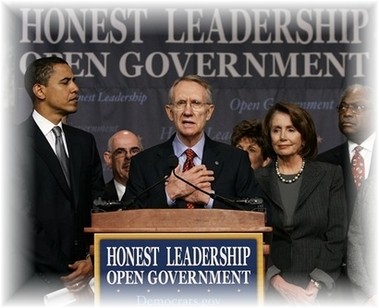
Open Secrets reports that big labor gave over $200 million to support a government takeover of our health care system.
Senator Reaffirms Support For Federal Monopoly-Bargaining Mandate (Source: March 2010 NRTWC Newsletter) Poll after poll indicates that union-label Democratic U.S. Sen. Blanche Lincoln faces a tough battle to get reelected in Right to Work Arkansas this November. And Ms.
Forced-Unionism Expansion Bill Would Kill Prospects For Millions (Source: March 2010 NRTWC Newsletter) According to a scientific poll conducted by the respected Research 2000 firm, 81% of Americans who regularly vote in statewide elections believe workers in unionized workplaces who don’t want a union should “have the right to bargain for themselves.” Unfortunately, for three-quarters of a century, federal labor law has actively promoted what Americans, according to the Research 2000 poll and many others, overwhelmingly oppose. The 1935 National Labor Relations Act (NLRA) and the 1934 Railway Labor Act (RLA) amendments hand union officials the power to force millions of workers, union members and nonmembers alike, to accept a union as their “exclusive” (monopoly) bargaining agent in their dealings with their employer. Attack on Secret Ballot Only One Trick in Union Monopolists’ Playbook And this year Congress is very likely to bring up for floor votes legislation that would help Big Labor corral millions of additional workers into unions. Until recently, union strategists’ primary vehicle for expanding private-sector union monopoly bargaining in the current Congress was S.560/H.R.1409, the cynically mislabeled “Employee Free Choice Act.” This legislation is designed to help union bosses sharply increase the share of all workers who are under union monopoly control by effectively ending secret-ballot elections in union organizing campaigns.
Here’s the Link to the so-called ObamaCare reconciliation bill. Now, the fight is on. In just days, the U.S. House could be voting on the Big Labor paybacks in the Nationalized Health Care scheme, or the ObamaCare Bill passed by…
The SEIU, AFSCME and other groups will target 17 House Democrats with $1.7 million worth of television commercials pushing a government takeover of health care — all paid for with workers’ forced-dues money.
On his nationally-syndicated radio show, Lars Larson discusses Big Labor’s Police and Firefighters Monopoly Bargaining Bills (H.R. 413, S. 1611)with The National Right to Work Committee Vice President Doug Stafford. The bills, which union bosses themselves call the greatest (potential)…
Right-to-Work Laws: Liberty, Prosperity, and Quality of Life By Professor Richard Vedder (Condensed from the original 10-page Article appearing in the Cato Journal, Vol. 30, No. 1 (Winter 2010). Produced by the Cato Institute. Richard Vedder is Edwin and Ruth Kennedy Distinguished Professor of Economics at Ohio University.) The most essential ingredient embodied in the liberty championed by the classical liberal writers of the Enlightenment and beyond is individual choice and right of expression—the right of persons to say what they think, decide for themselves what groups that want to join, what religion that want to profess, what person they want to marry, what goods they want to buy or sell, and what persons they want to represent them where necessity requires collective decision making. One important economic dimension of individual liberty is the right to sell one’s labor services without attenuation—that is, without limits on the terms of the agreement (e.g., wage rates and hours of work), or who will represent the worker in reaching those terms. The eroding of employment liberty in the United States had begun before the 1930s … legislation in the early 1930s such as the Davis-Bacon Act and, to a lesser degree, the Norris-LaGuardia Act began to chip away at bargaining freedom, but it was the National Labor Relations Act of 1935 (Wagner Act) that dramatically revolutionized employment contracts, severely restricting the freedom of workers and employers to reach individual bargaining arrangements.
The Los Angeles Times reports that two labor unions in California have spent a remarkable $318 million influencing public officials in the last decade. The Teacher Association spent $211.8 million and the California State Council of Service Employees spent…
Both House and Senate-Passed Measures Promote Forced Unionism (Source: January 2010 NRTWC Newsletter) In November, the U.S. House of Representatives narrowly adopted one version of President Obama’s health-care “reform” (H.R.3962). And last month, exactly 60 (the minimum number necessary) U.S.