Indiana AFL-CIO: Worker Feedom is a

Indiana AFL-CIO: Worker Feedom is a "smack at organized labor" that will "gut unions"

According to Jeff Harris, Indiana AFL-CIO spokesman Right To Work is a "smack at organized labor" and it will "gut unions."  Apparently, AFL-CIO bosses know that if Hoosiers aren't forced to pay union dues, then many Hoosiers will spend their own money on something else.  This may be why the AFL-CIO embraces the anti-free market Occupy America movement, because these union bosses know that 'services' are overpriced and bear no resemblance to free market pricing. So, will  Big Labor convince the Democrats to flee to Illinois again in effort to hide from their legislative responsibilities? We don't know that answer, yet.  But, we do know Big Labor is planning for a January collective hissy fit at the Indiana capitol building. From Associated Press writers Charles Wilson and Ken Kusmer: Indiana’s Republican House leader on Tuesday promised swift movement on a push to make his state the first in more than a decade to ban labor contracts that require employees to pay union fees. Speaker Brian Bosma of Indianapolis told The Associated Press he is confident he can push the “right-to-work” bill through his chamber during the 2012 session that begins Wednesday and is spending a lot “personal capital” to do so. Bosma, who has been the measure’s most ardent supporter, said he hadn’t yet taken a formal tally of supportive votes, but added he “also wouldn’t bring it forward if I wasn’t confident of success.” The proposal would bar private employee unions from seeking contracts that mandate all workers pay union fees regardless of whether they are members. Supporters say the law would help attract new business to the state. Indiana’s House Democrats successfully blocked the measure last year with a five-week walkout that denied House Republicans the numbers needed to conduct daily business. Democratic leaders have so far declined to say whether they will walk out again this session. Indiana would become the 23rd state to enact a right-to-work law, the first to do so since Oklahoma in 2001. Republicans hold wide margins in the Indiana Assembly: 60-40 in the House and 37-13 in the Senate and GOP Gov. Mitch Daniels has come out with strong support for the measure. “There’s nowhere we are we closer than we are in Indianapolis,” said Greg Mourad, vice president of the National Right to Work Committee, which pushes the measure in Statehouse’s across the country. The group has maintained a state executive director to coordinate volunteer support for the measure over the last few years and recently sent three or more new staff to shore up support in tough districts Indiana.

Indiana AFL-CIO: Worker Feedom is a "smack at organized labor" that will "gut unions"

Indiana AFL-CIO: Worker Feedom is a "smack at organized labor" that will "gut unions"

According to Jeff Harris, Indiana AFL-CIO spokesman Right To Work is a "smack at organized labor" and it will "gut unions."  Apparently, AFL-CIO bosses know that if Hoosiers aren't forced to pay union dues, then many Hoosiers will spend their own money on something else.  This may be why the AFL-CIO embraces the anti-free market Occupy America movement, because these union bosses know that 'services' are overpriced and bear no resemblance to free market pricing. So, will  Big Labor convince the Democrats to flee to Illinois again in effort to hide from their legislative responsibilities? We don't know that answer, yet.  But, we do know Big Labor is planning for a January collective hissy fit at the Indiana capitol building. From Associated Press writers Charles Wilson and Ken Kusmer: Indiana’s Republican House leader on Tuesday promised swift movement on a push to make his state the first in more than a decade to ban labor contracts that require employees to pay union fees. Speaker Brian Bosma of Indianapolis told The Associated Press he is confident he can push the “right-to-work” bill through his chamber during the 2012 session that begins Wednesday and is spending a lot “personal capital” to do so. Bosma, who has been the measure’s most ardent supporter, said he hadn’t yet taken a formal tally of supportive votes, but added he “also wouldn’t bring it forward if I wasn’t confident of success.” The proposal would bar private employee unions from seeking contracts that mandate all workers pay union fees regardless of whether they are members. Supporters say the law would help attract new business to the state. Indiana’s House Democrats successfully blocked the measure last year with a five-week walkout that denied House Republicans the numbers needed to conduct daily business. Democratic leaders have so far declined to say whether they will walk out again this session. Indiana would become the 23rd state to enact a right-to-work law, the first to do so since Oklahoma in 2001. Republicans hold wide margins in the Indiana Assembly: 60-40 in the House and 37-13 in the Senate and GOP Gov. Mitch Daniels has come out with strong support for the measure. “There’s nowhere we are we closer than we are in Indianapolis,” said Greg Mourad, vice president of the National Right to Work Committee, which pushes the measure in Statehouse’s across the country. The group has maintained a state executive director to coordinate volunteer support for the measure over the last few years and recently sent three or more new staff to shore up support in tough districts Indiana.

Newt 'Leadership' Flashback

Newt 'Leadership' Flashback

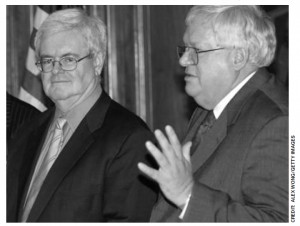
Right to Work to Capitol Hill: ‘Keep Your Promises’ On January 18, 2011, By NRTW Committee Staff (Source: January 2011 NRTWC Newsletter) Former Speakers Newt Gingrich (R-Ga., left) and Dennis Hastert (R-Ill.) both made campaign pledges to support roll-call votes on forced-dues repeal, but blocked action on such legislation when Congress was in session. Politicians Pledging to Back Right to Work Take Charge of House Thanks in significant part to the efforts of National Right to Work Committee members across the country, starting this month the U.S. House of Representatives will be led by a speaker and a majority leader who have pledged full support for Americans’ Right to Work without being forced to join or pay dues to a union. Now Committee members’ job is to make sure Speaker John Boehner (R-Ohio), Majority Leader Eric Cantor (R-Va.), and other members of Congress turn their pro-Right to Work promises into action. John Boehner, Eric Cantor Owe Leadership Posts to Worker-Freedom Advocates Mr. Boehner and Mr. Cantor enjoy their top leadership positions in the House in part due to pro-Right to Work Americans’ support for congressional candidates nationwide who had pledged to oppose compulsory unionism.

Newt 'Leadership' Flashback

Newt 'Leadership' Flashback

Right to Work to Capitol Hill: ‘Keep Your Promises’ On January 18, 2011, By NRTW Committee Staff (Source: January 2011 NRTWC Newsletter) Former Speakers Newt Gingrich (R-Ga., left) and Dennis Hastert (R-Ill.) both made campaign pledges to support roll-call votes on forced-dues repeal, but blocked action on such legislation when Congress was in session. Politicians Pledging to Back Right to Work Take Charge of House Thanks in significant part to the efforts of National Right to Work Committee members across the country, starting this month the U.S. House of Representatives will be led by a speaker and a majority leader who have pledged full support for Americans’ Right to Work without being forced to join or pay dues to a union. Now Committee members’ job is to make sure Speaker John Boehner (R-Ohio), Majority Leader Eric Cantor (R-Va.), and other members of Congress turn their pro-Right to Work promises into action. John Boehner, Eric Cantor Owe Leadership Posts to Worker-Freedom Advocates Mr. Boehner and Mr. Cantor enjoy their top leadership positions in the House in part due to pro-Right to Work Americans’ support for congressional candidates nationwide who had pledged to oppose compulsory unionism.

Sick of being FORCED to pay for union bosses' politics? Right To Work is the Answer

Terry Bowman, a UAW member,  writes in the The Detroit News that to end forced-dues-funded politics "the best and easiest solution is to pass a Right To Work law."  And, he is right.  The surest way to end compulsory-dues for politics is to end compulsory-dues. From Mr. Bowman's editorial: A worker's constitutional rights seem to take a back seat to the political privileges of the union. Earlier this year, UAW local 898 officials displayed their political views for everyone who drove by the union hall. "Recall Gov. Snyder, sign up here!" was the message glaring from the parking lot sign for all passers-by to see. A recent Harris poll shows that 60 percent of union households say that unions are too involved in politics, and we know that 40 percent or more of union households vote Republican. Unfortunately, union members who disagree with these partisan political attacks are forced, as a condition of employment, to financially support this message. Federal laws are supposed to restrict union officials from using regular dues for political purposes. Regrettably, it still happens all the time. In a 1988 Supreme Court decision called Communication Workers of America vs. Beck, unions were forbidden to collect full union dues from non-members; only those dues that are supposed to reflect the true cost to the union as a collective bargaining agent. In other words, members could choose to resign their union membership and then only pay what is called the "agency fee" to keep their job. Obviously, there are problems with this ruling. Workers who wish to exercise these rights have to jump through hoops, and they are then persecuted and ridiculed on the job for doing so. The agency fee also includes all the educational and subjective political activities that unions engage in. Union newsletters and magazines are full of political propaganda, and union officials travel the country spewing hateful venom and a destructive worldview, yet their salaries are paid for with regular union dues. And there is so much more.

Sick of being FORCED to pay for union bosses' politics? Right To Work is the Answer

Terry Bowman, a UAW member,  writes in the The Detroit News that to end forced-dues-funded politics "the best and easiest solution is to pass a Right To Work law."  And, he is right.  The surest way to end compulsory-dues for politics is to end compulsory-dues. From Mr. Bowman's editorial: A worker's constitutional rights seem to take a back seat to the political privileges of the union. Earlier this year, UAW local 898 officials displayed their political views for everyone who drove by the union hall. "Recall Gov. Snyder, sign up here!" was the message glaring from the parking lot sign for all passers-by to see. A recent Harris poll shows that 60 percent of union households say that unions are too involved in politics, and we know that 40 percent or more of union households vote Republican. Unfortunately, union members who disagree with these partisan political attacks are forced, as a condition of employment, to financially support this message. Federal laws are supposed to restrict union officials from using regular dues for political purposes. Regrettably, it still happens all the time. In a 1988 Supreme Court decision called Communication Workers of America vs. Beck, unions were forbidden to collect full union dues from non-members; only those dues that are supposed to reflect the true cost to the union as a collective bargaining agent. In other words, members could choose to resign their union membership and then only pay what is called the "agency fee" to keep their job. Obviously, there are problems with this ruling. Workers who wish to exercise these rights have to jump through hoops, and they are then persecuted and ridiculed on the job for doing so. The agency fee also includes all the educational and subjective political activities that unions engage in. Union newsletters and magazines are full of political propaganda, and union officials travel the country spewing hateful venom and a destructive worldview, yet their salaries are paid for with regular union dues. And there is so much more.