Indiana Passes Right To Work -- National Right to Work Committee Statement

Indiana Passes Right To Work -- National Right to Work Committee Statement

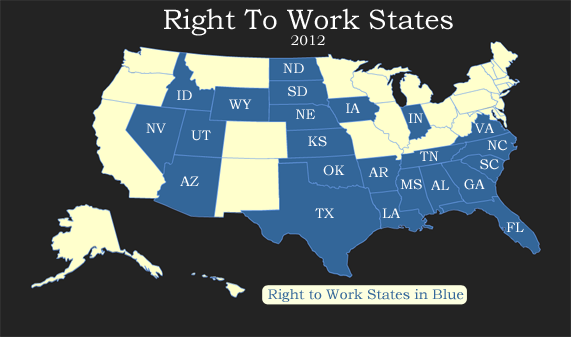
Indianapolis, Indiana – Today, Mark Mix, President of the 2.6 million-member National Right to Work Committee, praised the Indiana House and Senate for passage of the Indiana Right to Work Law. Mr. Mix said, “This is a great day for Indiana’s workers and taxpayers. “After a ten-year struggle involving hundreds of thousands of mobilized Hoosiers, Indiana will finally be able to enjoy all the benefits of a Right to Work law,” said Mr. Mix. “Today, the Indiana Senate passed the Right to Work Bill by a vote of 28 to 22. The bill has already passed the House, so it now goes straight to Governor Daniels, who has vowed to sign it, making Indiana America’s 23rd Right to Work state,” continued Mix. Mr. Mix continued, “The Right to Work Law will free nearly 200,000 Hoosiers who have been forced to pay tribute to a union boss for the privilege of getting up everyday and going to work so they can provide for their families.” Proponents of the bill expect that passage of the Right to Work law will provide significant economic benefits for Indiana and Indiana workers. For the past decade, non-agricultural employment in Right to Work states grew twice as fast compared to that in non-Right to Work states like Indiana, according to data from the Department of Labor. “On the job front,” said Mr. Mix, “virtually every site selection consultant on record has testified that as many as half of their clients will not even consider expanding or relocating to non-Right to Work states.” Governor Daniels experienced this problem firsthand, reporting recently that when Volkswagen was looking to build a production facility in America, he was unable to get the company to even return his phone calls. Volkswagen ended up choosing to open its new facility in the Right to Work state of Tennessee. Today’s action makes Indiana the first Right to Work state in the Manufacturing Belt, and supporters say it will give Hoosiers a significant advantage over all of its neighbors and the rest of the 27 non-Right to Work states. “Besides enjoying an influx of new jobs, Right to Work states also enjoy higher personal income,” said Mr. Mix. In particular, Mr. Mix drew attention to a study by Dr. Barry Poulson, a past president of the North American Economics and Finance Association and also a professor of economics at the University of Colorado, who compared household incomes in 133 metropolitan areas in Right to Work states with those of 158 metropolitan areas in non-Right to Work states. “Among other results, he found that the average real income for households in Right to Work state metro areas, when all else was equal, was $4,258 more than non-Right to Work state metro areas,” said Mr. Mix.

ERA would require employees to reaffirm unions every 3 years

ERA would require employees to reaffirm unions every 3 years

Most employees working under a union contract have never voted to be organized by a union.  Sen. Hatch and Rep. Scott want to fix that wit the Employee Rights Act.  From the Washington Times: In an effort to loosen labor’s grip on workers, two GOP lawmakers want legislation that would require workers to re-affirm the existence of their unions with new votes every three years. Sen. Orrin G. Hatch of Utah and Rep. Tim Scott of South Carolina are pushing the Employee Rights Act that also would place limits on strikes, how fast a union can organize and how membership fees may be used to support political candidates. The bill has yet to receive a committee hearing in either chamber. Few workers - less than 10 percent of union members - vote to organize. Instead, most workers join an existing union as a condition of employment. This bill, however, would give workers a chance to voice their opinions. Union officials would be up for re-election every three years. At that time, employees could decide whether to keep or eliminate their union. “My goal is to make sure that employees of a company make the decision on joining unions,” Mr. Scott said. “This just gives them an opportunity to say, ‘Yes, I want to be a part of the union.’"

Big Labor's Wisconsin Vendetta

Big Labor's Wisconsin Vendetta

WI Teacher Union Losing Its Teacher Healthcare Monopoly Big Labor will spend millions trying to remove Wisconsin Gov. Scott Walker from office but facts about the local economy and the finances of state government is making the argument for removal much more difficult.  As the Wall Street Journal notes, Walker's reforms are working -- saving taxpayers money and putting people back to work: It's not turning out that way: The Apocalypse has not arrived for services, and Mr. Walker was able to balance the state budget without new taxes or looming deficits. They swore revenge for his offenses, and last week Wisconsin Democrats delivered what they say are a million signatures for the recall of Republican Governor Scott Walker... to campaign against reforms that have already saved taxpayers tens of millions of dollars and rescued the state from a budget crisis. Game on. Since last summer,  Big Labor waged and lost a bitter fight over the election of a state Supreme Court Justice and spent millions trying to recall Republican state senators. Last year state senator Spencer Coggs called Mr. Walker's plan "legalized slavery" while others predicted disaster for school districts and public services. In districts like Wauwatosa, Racine, LaCrosse and Eau Claire, the changes in health and pension contributions prevented layoffs that were expected to be widespread and in some cases allowed the boards not to fire a single teacher.

Big Labor's Wisconsin Vendetta

Big Labor's Wisconsin Vendetta

WI Teacher Union Losing Its Teacher Healthcare Monopoly Big Labor will spend millions trying to remove Wisconsin Gov. Scott Walker from office but facts about the local economy and the finances of state government is making the argument for removal much more difficult.  As the Wall Street Journal notes, Walker's reforms are working -- saving taxpayers money and putting people back to work: It's not turning out that way: The Apocalypse has not arrived for services, and Mr. Walker was able to balance the state budget without new taxes or looming deficits. They swore revenge for his offenses, and last week Wisconsin Democrats delivered what they say are a million signatures for the recall of Republican Governor Scott Walker... to campaign against reforms that have already saved taxpayers tens of millions of dollars and rescued the state from a budget crisis. Game on. Since last summer,  Big Labor waged and lost a bitter fight over the election of a state Supreme Court Justice and spent millions trying to recall Republican state senators. Last year state senator Spencer Coggs called Mr. Walker's plan "legalized slavery" while others predicted disaster for school districts and public services. In districts like Wauwatosa, Racine, LaCrosse and Eau Claire, the changes in health and pension contributions prevented layoffs that were expected to be widespread and in some cases allowed the boards not to fire a single teacher.

The Greece Next Door to Wisconsin

The Greece Next Door to Wisconsin

It is worth remembering that Illinois has become the belly of the beast when it comes to pleasing the union bosses at expense of the taxpayer.  Even after raising taxes at the demand of union activists, the state is still suffering through an economic crisis.  This is the point that Wisconsin Gov. Scott Walker has been making -- we can't balance state budgets without reforming the power of the union bosses.  The Wall Street Journal notices the difference between Illinois and Wisconsin in a recent Op-Ed: Run up spending and debt, raise taxes in the naming of balancing the budget, but then watch as deficits rise and your credit-rating falls anyway. That's been the sad pattern in Europe, and now it's hitting that mecca of tax-and-spend government known as Illinois. Though too few noticed, this month Moody's downgraded Illinois state debt to A2 from A1, the lowest among the 50 states. This wasn't supposed to happen. Only a year ago, Governor Pat Quinn and his fellow Democrats raised individual income taxes by 67% and the corporate tax rate by 46%. They did it to raise $7 billion in revenue, as the Governor put it, to "get Illinois back on fiscal sound footing" and improve the state's credit rating. It's worth contrasting this grim picture with that of Wisconsin north of the border. Last winter Madison was occupied by thousands of union protesters trying to bully legislators to defeat Republican Governor Scott Walker's plan. The reforms passed anyway. In contrast to the Illinois downgrade, Moody's has praised Mr. Walker's budget as "credit positive for Wisconsin," adding that the money-saving reforms bring "the state's finances closer to a structural budgetary balance." As a result, Wisconsin jumped in Chief Executive magazine's 2011 ranking of each state's business climate—moving to 17th from 41st. Illinois dropped to 48th from 45th as ranked by the nation's top CEOs.

NRTW Attorneys file suit against MN Gov. Dayton's SEIU-AFSCME payback scheme

NRTW Attorneys file suit against MN Gov. Dayton's SEIU-AFSCME payback scheme

Minnesota Governor Mark Dayton, like former governors Gray Davis (CA), Rod Blagojevich (IL), and Jennifer Granholm (MI) to name a few, knows how to payback the SEIU union bosses -- they all indentured parents and family members who take care of relatives to Big Labor.  It is a shameless act of pure political power compelling people who are not even employees of the state to be required to pay union dues and fees.  In Michigan,  Governor Rick Snyder ended Granholm's SEIU payback scheme.  But, in other states like Minnesota, parents and family members have not been so fortunate.  That is why the National Right To Work Legal Defense is taking the case in an effort to expose the scheme and have the court system eventually rule against everyone of these schemes. Legal schemes that were in a large part a brainchild of Obama's former NLRB member Craig Becker. From The StarTribune article by Jim Ragsdale and Paul  Walsh: Opponents of the drive to unionize in-home child care providers have filed a second suit aimed at blocking a union vote. A group of 12 child-care providers, aided by the National Right to Work Legal Defense Foundation, filed suit Thursday in U.S. District Court in Minneapolis against Gov. Mark Dayton's executive order authorizing a union election. The group argues that the order is unconstitutional because it could ultimately require all providers to be represented by the union, whether they want to or not. The federal complaint says that if either or both unions win the elections in their geographic areas, the union would become the "exclusive" representative of all providers. It said the providers who filed the suit do not want to associate with either union "in any way" and "wish to retain their individual right to choose with whom they associate to lobby the state.'' "In the order, the state is going to designate a representative of these providers for the purposes of petitioning the state,'' said William Messenger, an attorney for the foundation, based in Springfield, Va. "It infringes on the freedom of association -- the First Amendment protects to right to associate or not associate.'' After an organizing drive by the Service Employees International Union and the American Federation of State, County and Municipal Employees, Dayton issued an order setting a union election for those providers who care for children with state subsidies -- about 4,300 of the state's 11,000 licensed in-home providers. The foundation is focused on fighting what it considers "compulsory unionism,'' such as workplaces where employees are required to be members. It is providing legal work on the lawsuit for free, Messenger said. From the related National Right To Work Legal Defense Foundation press release: