



Big Labor Politicians Don’t Care What Workers Prefer
Ever since the COVID-19 pandemic — and politicians’ ham-fisted response to it — dealt a cruel blow to employees and businesses in early 2020, working-age Americans have been fleeing, in greater numbers than ever before, compulsory unionism states.
Data released by the U.S. Census Bureau this June confirm that the stampede of breadwinners and their families out of Big Labor’s stronghold states continued in 2024 and 2025, long after COVID-19- related restrictions on business activities and school lockdowns had ceased to be active problems.
More than ever before, American employees’ “foot voting” is demonstrating they strongly prefer Right to Work over forced unionism.
Big Labor Politicians Don’t Mind That Union Bosses’ Economic Claims Are False
Unfortunately, national Democrat politicians like U.S. Senate Minority Leader Chuck Schumer and House Minority Leader Hakeem Jeffries (both N.Y.) couldn’t care less about that.
National Right to Work Committee Vice President Greg Mourad commented:
“Clearly, there is a huge disconnect between union boss-owned Beltway politicians and the vast majority of Americans who get most of their income furnished to them and/or their loved ones by private-sector businesses.
“Big Labor puppet politicians, echoing union officials and their propagandists, try to justify their support for legislation corralling millions of additional workers into monopolistic unions by loudly claiming that doing so would somehow make those workers more prosperous.
“Cynical politicians and their campaigns try to fool citizens into believing this claim is correct by grossly understating, or altogether ‘forgetting’ about, regional cost-of-living differences when speechifying about living standards in Right to Work states vs. forced unionism states.
“Downplaying or ignoring this key issue enables them to conceal, or so they believe, the proven, economically disastrous effects of compulsory unionism.”
‘Foot-Voting’ Exposes Hollowness of Union Lackeys’ Claims About Workers’ Wishes
Mr. Mourad continued: “The reality is, when they have a choice, working-age people prefer not to live in forced-unionism states. U.S. Census Bureau data make that very clear.
“They show that, over the past decade, the total population of people in their peak earning years [aged 35-54] for the 23 states that have never implemented a Right to Work law, barring the termination of employees for refusal to pay union dues, fell from 41.99 million to 41.70 million.
“That represents a 0.7% decline.
“But in the 23 states that had Right to Work laws on the books the whole decade from 2015 to 2025, there was an overall increase of 2.45 million!”
“And from July 2020 to July 2025, the last five years for which age-grouped population data are available, the trend of ‘foot voting’ against forced unionism by people who have families to support has gotten much stronger.
“Over just those five years, the peak-earning-year population in the 26 states that continuously had Right to Work laws on the books grew by 5.7%, or 2.2 million.
“In both percentage and absolute terms, that increase is roughly five times as great as peak-earning-year population growth in states that have never had Right to Work protections.
“Six of the seven states with the greatest percentage gains in their peak-earning-year population from 2020 to 2025 are Right to Work states. Ten of the 12 states with the greatest absolute gains in peak-earning-year population are Right to Work.”
Breadwinners Favor States Where They Can Better Provide For Their Families

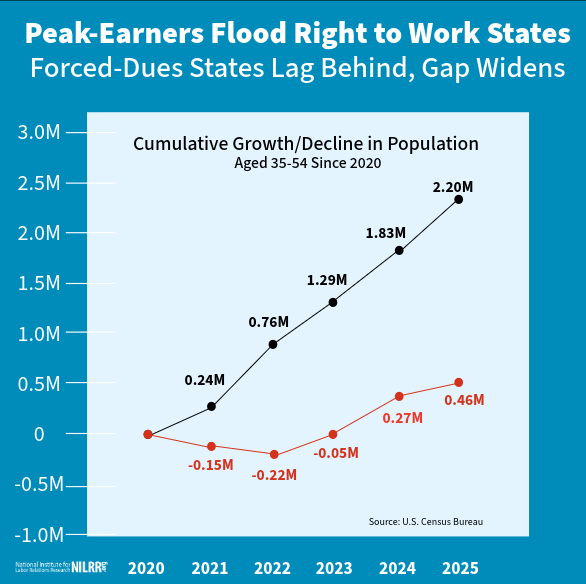
“Census figures indicate forced-dues states lost roughly 881,000 ‘peak earners’ to domestic out-migration from 2020 to 2025, and 96,000 from 2024 to 2025 alone,” added Mr. Mourad.
“If the current trend continues, these states are poised to lose a cumulative net 1.4 million breadwinners to Right to Work states from 2020-30!
“The obvious and correct explanation for the ongoing population shift is that working men and women find again and again that they cannot provide as well for their families in such states as in Right to Work states.”
Mr. Mourad pointed to a recent analysis by the National Institute for Labor Relations Research, which shows that the average cost of living-adjusted disposable income per capita in Right to Work states last year was $65,746, nearly $3,500 higher than the forced-dues state average:
“Once you are aware of the fact that Right to Work states enjoyed, as of last year, a purchasing-power advantage over forced-unionism states equivalent to roughly $14,000 a year for a family of four, it shouldn’t be at all surprising that family breadwinners are flooding Right to Work states.
“On the other hand, it simply defies common sense to believe that people who get the vast majority of their income from their jobs would lopsidedly favor living in states where they are worse off over states where they are better off.”
Right to Work Committee Is Fighting Back
Big Labor’s Capitol Hill politicians appear to be completely incapable of dealing with reality regarding the economic impact of forced unionism and Right to Work. Other elected officials have a clear-eyed perspective on labor policy.
And with the Committee’s assistance, a number of them are fighting back.
As this Newsletter edition goes to press in late August, a total of 149 representatives and senators have signed on to H.R.1232/S.533, otherwise known as the National Right to Work Act.
This legislation would reform federal labor law by removing all provisions that authorize and promote the extraction of forced union dues and fees from employees as a job condition.
“If Big Labor secures a recorded Senate vote this fall on legislation that would make it even easier to grab forced-dues privileges over employees, as it hopes to do, the Committee will seize the opportunity to have S.533 brought up as an amendment,” said Mr. Mourad.
“I am confident that, if workers and other Americans understand there is a choice between Congress’s authorizing even more forced union dues and abolishing forced union dues, elected officials will get the message that forced-dues abolition is the correct choice.”
This article was originally published in our monthly newsletter. Go here to access previous newsletter posts.
To support our cause and help end forced unionism, go here to donate.