Radical Teacher Unions Get Even More Radical
Incoming NEA President Princess Moss: Teachers Must Be Full-Time Political Activists
The Heritage Foundation warns of the negative implication of forcing states to unionize firemen and police forces:
The Senate may soon consider a bill that would force states to allow for the unionization of public employees. In addition to the extraordinary amount of mandates imposed under President Obama, Congress has been attempting to extend the burden of collective bargaining imposed upon every state and local government. Senate Majority Leader Harry Reid (D–NV) recently reintroduced the Public Safety Employer-Employee Cooperation Act in an attempt to rush it through Congress before Republicans take control of the House in January. This legislation would mandate collective bargaining for police, firefighters, and emergency medical personnel—even in states that have passed laws to ensure this can’t happen.
Minnesota Governor Tim Pawlenty made headlines today with his editorial against government unions. It is no secret that unions have increasingly resorted to government employees to boost membership. Minnesota has362,000 union members, and Governor Pawlenty has had his fair share of battles to keep taxpayers from footing the bill.
Government is the easy way to avoid pesky things like efficiency and competition. In September, Heritage expert James Sherk exposed the fact that since last year, most union workers now collect a check paid for by taxpayers. Some of that money is automatically deposited into union coffers to pay for their dues. This is made possible through a taxpayer-funded payroll system.
The rise of government unions has had many troubling effects.
• Federal workers already receive up to 22 percent more than their private counterparts, resulting in $47 billion in additional taxes.
• Many states force government employees to join a union or lose their job.
• Since the beginning of the recession, private sector employment has fallen while federal employment has risen. Government employees have not faced the same hard decisions that many Americans have confronted during the recent economic decline.
• Unions are able to take the money they receive from their members and lobby for increased wages in the form of more taxes.
Congress should let each state decide whether it wants to force its taxpayers to fund overpaid union employees.
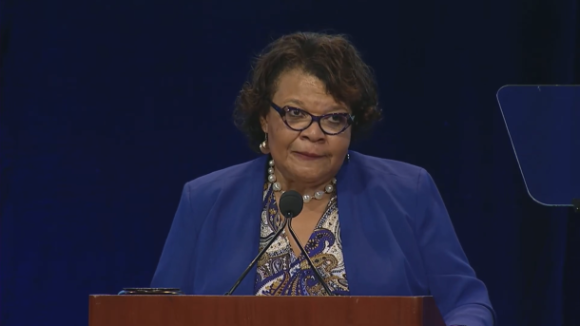
Incoming NEA President Princess Moss: Teachers Must Be Full-Time Political Activists
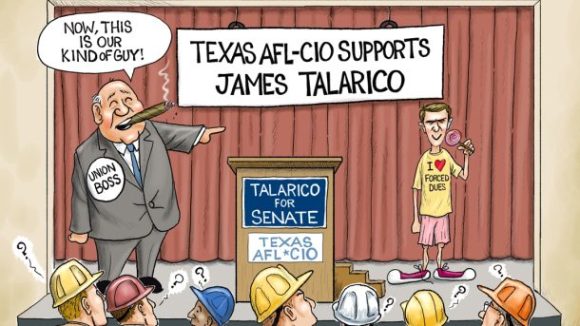
Union bosses are rallying behind Democrat Texas U.S. Senate candidate James Talarico because he opposes Right to Work protections for employees.
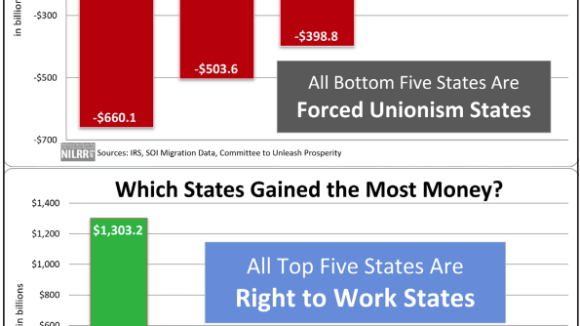
... States that continuously lacked Right to Work protections for employees from 2012-23 lost a net total of $2.05 trillion in cumulative AGI solely as a consequence of domestic out-migration of taxpayers during that 11-year period.