Union-Only Port Terminal Suspends Operations
Committee President Mark Mix: “If I were a Leatherman dockworker, I certainly wouldn’t count on Longshore Union bosses to show any flexibility” to get the terminal reopened and “save my job.”
Jim Walters of the Georgetown Kentucky News-Graphic understands that it will take “new ideas and leadership backbone” to move Kentucky forward economically:
. . . Kentucky’s next governor could wield a positive influence over the commonwealth’s sluggish economy by going south of the border, grabbing Tennessee’s right-to-work policy and bringing it back.
Right-to-work laws simply protect employees from being forced to join unions or pay dues whether or not the benefits are worth those payments. The government doesn’t force any other citizen to pay dues to an organization. Rather, citizens voluntarily choose which organizations to join and support. Union membership should be no different.
Kentucky is at a disadvantage with their Right to Work neighbors like Tennessee when competing for jobs.
“Five nearby right-to-work states that often compete with Kentucky for new jobs – Georgia, Virginia, North Carolina, South Carolina and Tennessee – averaged nearly 287,000 new jobs between 1996 and 2004, the bureau reported. Kentucky added a measly 83,477 new jobs during that same time period,” Walters notes.
If Kentucky is to prosper, it needs a Right to Work law.
Walters gets it.
Let’s hope Kentucky’s next Governor and state legislature understands as well.

Committee President Mark Mix: “If I were a Leatherman dockworker, I certainly wouldn’t count on Longshore Union bosses to show any flexibility” to get the terminal reopened and “save my job.”
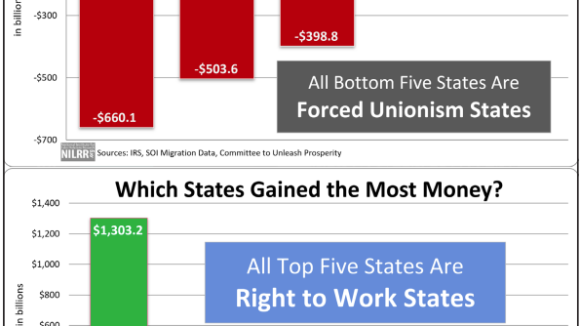
... States that continuously lacked Right to Work protections for employees from 2012-23 lost a net total of $2.05 trillion in cumulative AGI solely as a consequence of domestic out-migration of taxpayers during that 11-year period.

One of the key goals of the U.S. Department of Labor since President Donald Trump’s second term commenced in January 2025 has been to expand the number of apprenticeships in America to “at least a million.”