Big Labor’s Multi-Billion-Dollar Power Grab
Union bosses are rallying behind Democrat Texas U.S. Senate candidate James Talarico because he opposes Right to Work protections for employees.
As Michigan labor unions continue to impede progress and job creation, a group of free-market economists released a report arguing that Michigan’s economy could improve dramatically if it became a Right to Work state like neighboring Indiana.
Timothy Nash, the study’s director, led a team from Northwood University and Central Michigan University. Their findings: States with right-to-work laws performed better economically than Michigan.
Some examples:
Personal income growth: Per capita income grew 20 percent in Michigan from 2000 to 2010; in the U.S., 36 percent; 39 percent in right-to-work states and 34 percent in non-RTW states.
Real growth in gross state product: From 1998 to 2001, Michigan lagged all three benchmark groups with growth of 26.5 percent, compared with 71.5 percent in the U.S. overall; 85 percent in right-to-work and 64 percent non-RTW.
Job growth: Michigan’s nonfarm employment dropped nearly 17 percent from 2001 to 2010. At the same time, the U.S. grew 2 percent, right-to-work states nearly 4 percent and states without such laws 0.5 percent.
The complete, 175-page 2012 Michigan Economic Competitiveness Study can be found on the Michigan Chamber of Commerce website, michamber.com.
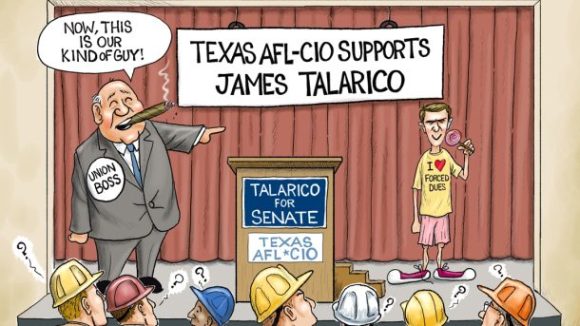
Union bosses are rallying behind Democrat Texas U.S. Senate candidate James Talarico because he opposes Right to Work protections for employees.
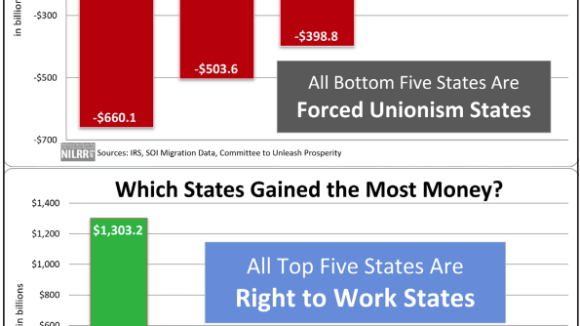
... States that continuously lacked Right to Work protections for employees from 2012-23 lost a net total of $2.05 trillion in cumulative AGI solely as a consequence of domestic out-migration of taxpayers during that 11-year period.

“Since Janus, the actively employed membership of the nation’s largest teacher union, the [NEA], has fallen substantially."