Big Labor’s Multi-Billion-Dollar Power Grab
Union bosses are rallying behind Democrat Texas U.S. Senate candidate James Talarico because he opposes Right to Work protections for employees.
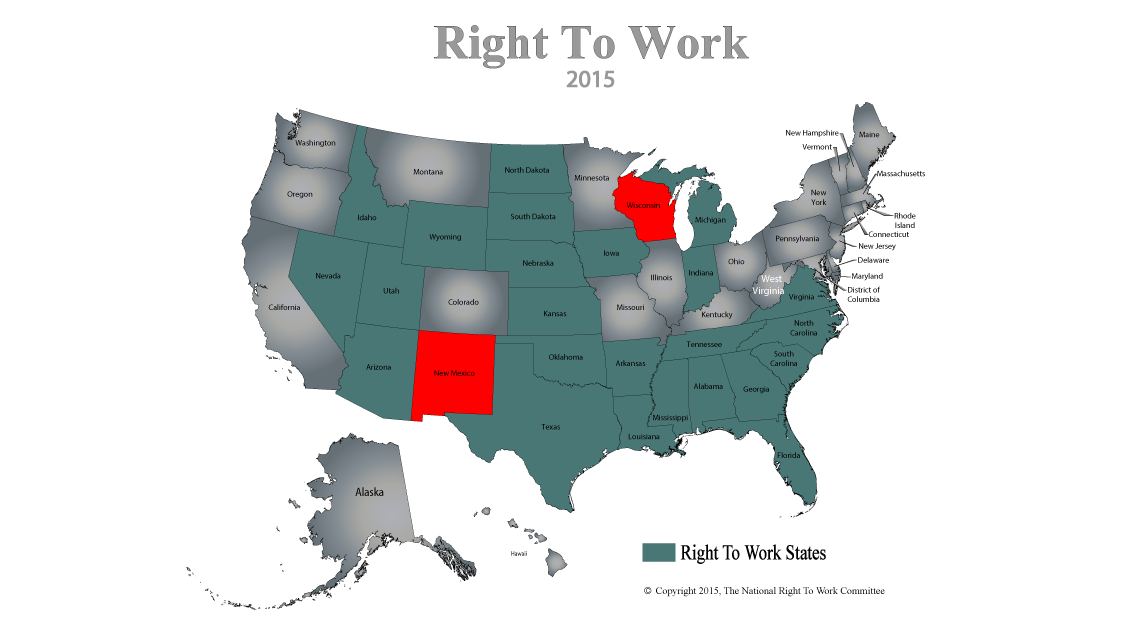
The New Mexico House moved the Right to Work Bill to the New Mexico Senate, and the Wisconsin Senate moved the Right to Work Bill to the Wisconsin House.
From the Chicago Tribune: “The Wisconsin state Senate passed a right-to-work bill Wednesday and sent it on to the Assembly, where the Republican majority is wider.
“Gov. Scott Walker, a likely presidential candidate, has promised to sign it into law and that could happen as soon as next week. The bill passed the Senate 17-15, with all Democrats and one Republican voting against it, after nearly eight hours of debate.
“The proposal would make it a crime punishable up to nine months in jail to require private-sector workers who aren’t in a union to pay dues. Supporters say it’s about worker freedom, while opponents say it will hurt businesses and lower wages. There are 24 other states with similar laws, including Michigan and Indiana which passed them in 2012.”
From KRQE News 13: “Following a debate that took combative turns, the Republican-controlled New Mexico House of Representatives has approved a right-to-work bill which also includes a 50-cent-per-hour minimum wage hike.
The legislation, which passed 37-30 Wednesday, prohibits requiring workers to join a union or to pay dues as a condition of employment. It would apply to both public and private sectors.
The bill now moves to the Senate, where the Democratic leadership has said it’s united in stopping right-to-work legislation.”
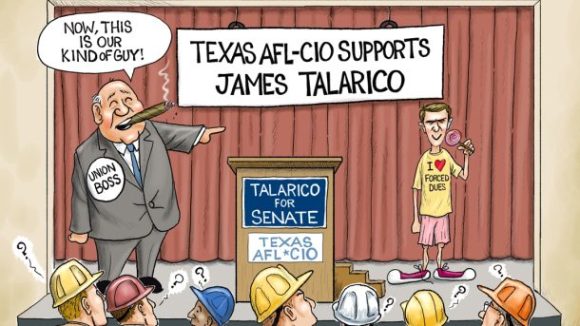
Union bosses are rallying behind Democrat Texas U.S. Senate candidate James Talarico because he opposes Right to Work protections for employees.
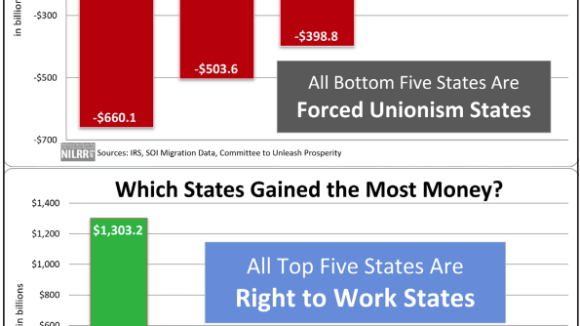
... States that continuously lacked Right to Work protections for employees from 2012-23 lost a net total of $2.05 trillion in cumulative AGI solely as a consequence of domestic out-migration of taxpayers during that 11-year period.
"Vullo makes it clear that using the threat of federal prosecution to force any employer to put employees’ Right to Work on the bargaining table violates the First Amendment.”