Union-Only Port Terminal Suspends Operations
Committee President Mark Mix: “If I were a Leatherman dockworker, I certainly wouldn’t count on Longshore Union bosses to show any flexibility” to get the terminal reopened and “save my job.”
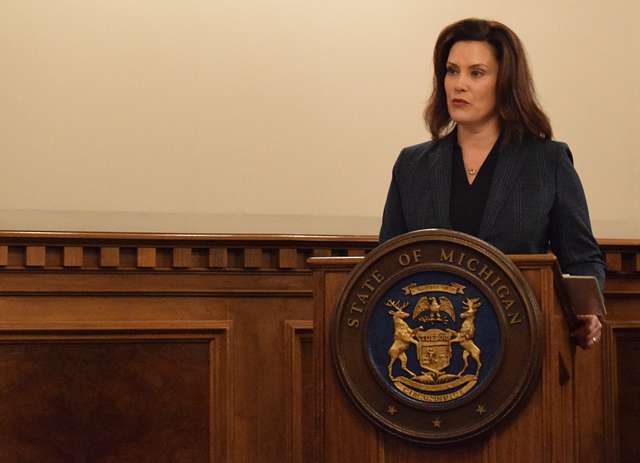
Three years ago this March, Big Labor majorities in the Michigan House and Senate rubber-stamped legislation to destroy the Wolverine State’s decade-old Right to Work law, knowing full well fellow Democrat Gov. Gretchen Whitmer had vowed to sign such legislation if granted the opportunity.
Ms. Whitmer never even tried to explain to ordinary Michiganders how this legislation would benefit them. Her reticence may well have been prudent.
After all, a statewide scientific poll conducted at the end of 2022 by the top-rated opinion research firm SurveyUSA showed that an overwhelming 88% of Michigan voters agreed with this statement:
“Workers should never be forced, or coerced, to join a union or pay dues to a union.”
National Right to Work Committee Vice President John Kalb commented:
“After an era of economic devastation in Michigan, the March 2013 institution of Right to Work protections across the state ushered in a decade of sustained employment growth in key sectors like manufacturing and impressive personal income gains.
“The hard numbers show Michigan was disastrously failing to attract and retain well-paid jobs for years and years prior to 2013. And the same data show the state became a much better place for employees and their families after the Right to Work law took effect that year.
“For example, from 2002 to 2012, manufacturing employment in forced-unionism Michigan fell by 29.6%.
“Michigan’s manufacturing job loss was worse than all but three other states’ in percentage terms, and worse than every other state’s in absolute terms.
“Over the first five years of Right to Work, Michigan enjoyed its strongest manufacturing rebound in decades, with factory employment rising by 80,000 from 2013 to 2018.
“From 2013 to 2022, the last year prior to Right to Work’s being put under a death sentence by Big Labor lawmakers and Gov. Whitmer in 2023 and then terminated in 2024, manufacturing jobs in Michigan grew by 10.9%, twice as rapidly as they did nationwide.
“Manufacturing employment in the 23 states that still lacked Right to Work laws over the entirety of those nine years grew by just 1.6%, barely more than a seventh as much as in Michigan.”
Along with stronger job growth than they had enjoyed in many years, Michiganders benefited from ample growth in their spending power from 2013 to 2022. This growth was due in significant part to the anti-inflationary impact of prohibiting compulsory unionism as a job condition.
The fact is, with Right to Work protections, the overall cost of living in Michigan relative to the remaining 23 forced-dues states fell by roughly 6% between 2012, the last year before these protections were instituted, and 2022.
The National Institute for Labor Relations Research has calculated this estimate by drawing on annual state cost-of-living indices furnished by the Missouri Economic Research and Information Center (MERIC), a state government agency.
In 2012, the average after-tax income per capita in forced-unionism Michigan, adjusted for the regional differences in cost of living for that year, was $45 lower than the average for the 23 states that were and remained non-Right to Work for the decade that followed.
By 2022, the average after-tax income per capita in Michigan, adjusted for regional differences in cost of living using indices for that year, was $2,736 higher than the forced-unionism average.
Soon after Ms. Whitmer signed Right to Work repeal into law, pro-forced unionism sociology professor Barry Eidlin published an article actually applauding the fact that, due to the pending restoration of forced union dues and fees, Michigan would no longer be “open for business.”
Indeed, since Right to Work destruction took effect in February 2024, Michigan’s total seasonally-adjusted employment has been in a downward trend, falling by 50,000 by December 2025, the last month for which data were available as this Newsletter went to press.
From January 2024 through January 2025, unemployment rose in every single Michigan county.
And in November 2024, the first time Michiganders across the state got a chance to demonstrate at the polls to elected officials who had participated in the execution of Right to Work exactly what they thought about it, they made it clear they weren’t happy at all.
In that election cycle, only seats in the Michigan House of Representatives were up for grabs. Neither Senate seats nor statewide executive offices were.
Big Labor Democrats were able to outspend their GOP counterparts by more than two-to-one, thanks largely to union bosses’ largesse.
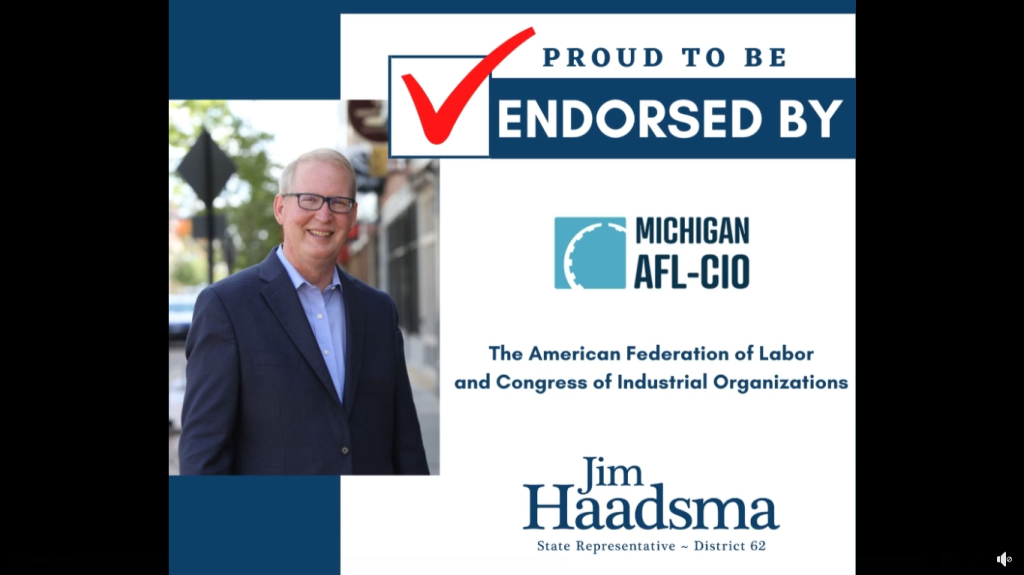
But the massive, forced-dues fueled union political machine could not prevent the defeats of four anti-Right to Work incumbents, including House Labor Committee Chairman Jim Haadsma (D-Battle Creek), who had played a key role in bringing forced-dues restoration to the floor in his chamber.
Meanwhile, the union machine was unable to engineer the defeat of a single lawmaker who had voted to retain Right to Work protections.
Mr. Kalb commented:
“In 2024, pro-Right to Work citizens could take out their indignation only against Big Labor House politicians.
“The Michigan Right to Work Committee worked hard to make sure every Right to Work supporter in the state was well aware of who had voted for forced unionism and who had defended jobs, freedom, and economic prosperity.
“In the end, Right to Work supporters gained four seats, turning a 56-54 Democrat majority into a 58-52 Republican majority.
“If Michiganders can keep the momentum going this year, they may soon have their Right to Work law back.”
With the National Right to Work Committee’s financial and strategic support, Michigan Right to Work has already begun its 2026 survey program of every candidate seeking office in the state government.
The purpose of this program is to help the people of Michigan hold their politicians accountable for the damage that’s been done to their economy.
“If Michiganders demand their Right to Work law back,” said Mr. Kalb, “and vote accordingly, there’s every reason to hope the Wolverine State can return to the days of economic growth and prosperity.
“But if Big Labor prevails, the ‘Lost Decade’ of 2000-10 may be a good indication of what will be in store for Michigan over the next 10 years.”
This article was originally published in our monthly newsletter. Go here to access previous newsletter posts.
To support our cause and help end forced unionism, go here to donate.

Committee President Mark Mix: “If I were a Leatherman dockworker, I certainly wouldn’t count on Longshore Union bosses to show any flexibility” to get the terminal reopened and “save my job.”

According to AFSCME Local 1632 President Will Harmon, Columbus Water & Power committed a grievous offense by subcontracting out the job of clearing away invasive weeds and brush spread out across two acres of its property to a tribe of roughly 40 goats without first “negotiating” with Big Labor.

One longtime IAFF official who is now in the spotlight for his crass denigration of “two-hatters” -- that is, professional firefighters who also serve as volunteers -- is Pennsylvania Democrat politician Bob Brooks.