Union-Only Port Terminal Suspends Operations
Committee President Mark Mix: “If I were a Leatherman dockworker, I certainly wouldn’t count on Longshore Union bosses to show any flexibility” to get the terminal reopened and “save my job.”
Just read Louisiana’s Governor Bobby Jindal’s recent letter:
Dear Friends –
The last couple weeks have been chock full of major economic development wins for Louisiana.
In Central Louisiana, we announced that UPS Midstream Services Inc. is investing more than $3.9 million to construct a new full-service machine facility. …
In Northeast Louisiana, Drax Biomass International announced that the company is building a new wood pellet facility in Bastrop and a storage-and-shipping facility in Baton Rouge. As NBC33 reported, the two projects will combine to create … new jobs for Louisiana.
LocalMed, a digital healthcare startup and homegrown Louisiana company, will create new jobs in Baton Rouge.
These announcements come on the heels of perhaps some of the biggest economic development news Louisiana has ever had. As part of a plan to convert natural gas to liquid fuels, Sasol is investing up to $21 billion in Southwest Louisiana. This project will create over 7,000 direct and indirect jobs.
As the New Orleans Times-Picayune reported, this project will be the largest single manufacturing investment in the history of Louisiana and it also represents one of the largest foreign direct investment manufacturing projects in the history of the entire country. Not only that, but Sasol’s investment is a huge step forward to help the United States become more energy independent.

Committee President Mark Mix: “If I were a Leatherman dockworker, I certainly wouldn’t count on Longshore Union bosses to show any flexibility” to get the terminal reopened and “save my job.”
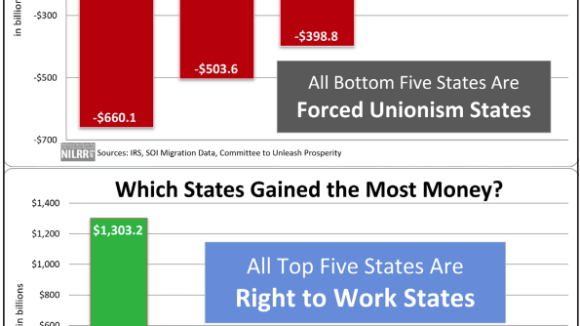
... States that continuously lacked Right to Work protections for employees from 2012-23 lost a net total of $2.05 trillion in cumulative AGI solely as a consequence of domestic out-migration of taxpayers during that 11-year period.

One of the key goals of the U.S. Department of Labor since President Donald Trump’s second term commenced in January 2025 has been to expand the number of apprenticeships in America to “at least a million.”