Big Labor’s Multi-Billion-Dollar Power Grab
Union bosses are rallying behind Democrat Texas U.S. Senate candidate James Talarico because he opposes Right to Work protections for employees.

(Roanoke Times Opinion) In 2018, the U.S. Supreme Court confirmed the wisdom of Virginia’s unequivocal statutory ban on forced union financial support in Janus v. AFSCME, a case argued and won on behalf of an independent-minded Illinois civil servant by National Right to Work Legal Defense Foundation Staff Attorney Bill Messenger.
The Janus majority also held that, in itself, “designating a union as the exclusive representative of nonmembers substantially restricts the nonmembers’ rights,” and inflicts a “significant impingement on associational freedoms.”
While Janus did not go so far as to say that government union monopoly bargaining is constitutionally prohibited, it certainly did raise the question. As I write this, the Supreme Court is being asked to take up a case arguing that it is prohibited. (On February 4, the Foundation’s Messenger submitted an amicus brief in support of the petitioner.)
Unfortunately, Virginia state Senate Majority Leader Dick Saslaw (D-Fairfax) and state House of Delegates Speaker Eileen Filler-Corn (D-Springfield) don’t think they should have to wait for the grave doubts about the constitutionality of monopolistic government unionism communicated in Janus to be resolved before this very regime is foisted on civil servants, taxpayers, and other people who rely on vital public services throughout the Commonwealth.
(click to go to the Roanoke Times to read the full commentary)
If you have questions about whether union officials are violating your rights, contact the Foundation for free help. To take action by supporting The National Right to Work Committee and fueling the fight against Forced Unionism, click here to donate now.
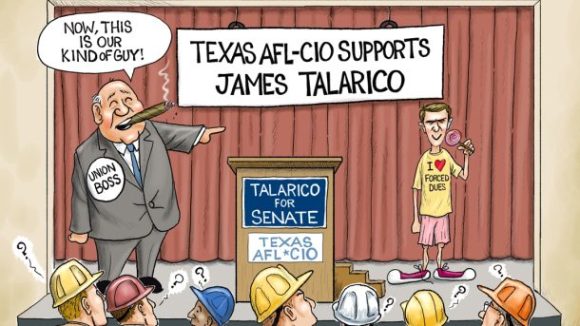
Union bosses are rallying behind Democrat Texas U.S. Senate candidate James Talarico because he opposes Right to Work protections for employees.

On June 5, a federal jury in Kansas convicted former Boilermakers President Newton Jones, who had headed the union from 2003 until 2023, his wife, Kateryna, and two other IBB bosses of embezzling millions of dollars in union dues extracted from workers as a condition of employment.
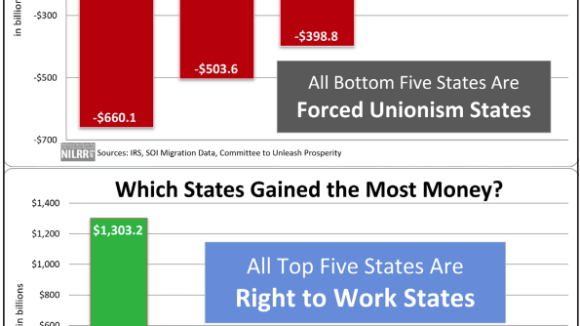
... States that continuously lacked Right to Work protections for employees from 2012-23 lost a net total of $2.05 trillion in cumulative AGI solely as a consequence of domestic out-migration of taxpayers during that 11-year period.