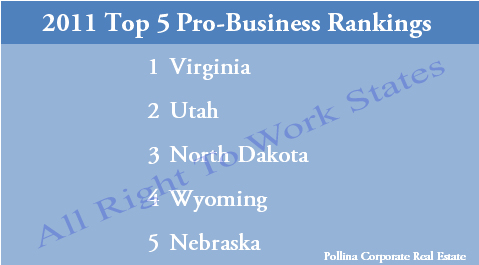
Right to Work is right for Virginia
From the Richmond Times by NRTW President Mark Mix: Weathering an economic downturn is never easy, but some states are managing better than others. Despite the recession, Virginia boasts a modest unemployment rate, and its average hourly wages top the national mean. What's the Old Dominion's secret? One factor that sets Virginia apart from its less fortunate neighbors is the state's popular Right to Work law. Virginia's Right to Work law ensures that no employee can be forced to join or pay dues to a union just to get or keep a job. Protecting employee choice has always been the most important argument in favor of Right to Work, but Virginia's economic performance is another point for worker freedom. Recent studies from the Cato Institute and the National Institute for Labor Relations Research indicate that right-to-work states enjoy higher job growth and more disposable income (after adjusting for families' cost-of-living) than their forced-unionism counterparts. Eight of the top 11 states for wage and salary growth enjoy right-to-work protections. Meanwhile, 13 of the 14 worst performers lack right-to-work laws. Workers and their families are also voting with their feet: According to the National Institute for Labor Relations Research, the young adult population in forced-unionism states has basically stagnated since 1980. Virginia, on the other hand, continues to attract a stream of new workers and entrepreneurs. Protecting worker freedom also prepares states to handle a difficult recession better than their forced-unionism counterparts. Virginia's robust job and wage growth compares favorably with the sluggish performance of union-dominated states like Michigan, Illinois and Wisconsin.
It’s ‘Labor’ Day, Not ‘Union’ Day
National Right to Work President Mark Mix makes the critical distinction between "Labor Day" and "Union Day," a distinction that union bosses chose to ignore: By Mark Mix Most Americans realize that Labor Day is about celebrating workers, not union bosses, but that won’t stop Big Labor’s apologists from stealing to spotlight to demand more power. The fact is that modern unions are built on the legal privilege of compulsion. In 28 states without Right to Work laws, nonunion employees can be fired for refusing to pay union dues. Millions more nonunion workers have no choice but to accept union bargaining over their wages and working conditions. What’s more, union officials routinely funnel nonunion workers’ dues into political campaigns aimed at defending or expanding their already extensive special privileges. As legislators from Wisconsin to Ohio can attest, this perverse cycle has made it extremely difficult to roll back union bosses’ workplace powers. Big Labor thrives on a system of government-granted special privileges. But what do workers get out of this arrangement? According to union apologists, they’d be helpless without it. But the facts reveal a different story. Compulsory unionism makes union bosses unaccountable to rank-and-file workers, whose financial support is absolutely mandatory. After all, why should union officials bother with the hard work of representing employees if they’re sitting on a forced-dues revenue stream guaranteed by the government?
NLRB Update - "Obama Labor Board Kills Important Secret Ballot Precedent"
[stream provider=youtube flv=x:/youtu.be/lxElDWlj2_E img=x:/nrtwc.org/wp-content/uploads/2011/08/201107-Lamons-Gasket-Final.jpg embed=false share=false width=580 height=280 dock=true controlbar=over bandwidth=high autostart=false /]] From the National Right To Legal Defense Foundation who represented the employees at Lamons Gasket and who secured the "Dana Rights" for employees against Card Check Forced Unionism until the Obama NLRB took them away with this decision: Obama Labor Board Kills Important Secret Ballot Precedent Worker advocate denounces NLRB’s ruling to take away protection workers have against card check forced unionism Washington, DC (August 30, 2011) – Today, Barack Obama’s National Labor Relations Board (NLRB) overturned its Dana Corp. decision, in which National Right to Work Foundation attorneys secured for employees the right to challenge union card check organizing campaigns with a secret ballot vote. Under the Foundation-won Dana decision, workers may collect signatures to request a secret ballot election during a 45-day window period following notice that their employer has recognized a union based on a card check organizing drive. The ruling is intended to counteract coercive practices frequently associated with card check, which allow organizers to bully or mislead employees into signing cards that count as “votes” toward unionization. The NLRB overturned Dana just as President Obama-appointed NLRB Chairwoman Wilma Liebman’s term expired. Meanwhile, Obama-appointed Board Member Craig Becker, who co-authored a union brief in the original Dana case, refused to recuse himself from the case. Becker, a recess nominee, faces bi-partisan opposition to his confirmation in the U.S. Senate. One Board Member, Bryan Hayes, vigorously dissented and called the ruling a blatant roll back of employee freedom. Any decertification votes that have been cast but not counted by the NLRB will now be discounted, thereby invalidating the voice of thousands of workers nationwide. The National Right to Work Legal Defense Foundation is a charitable organization that provides free legal assistance to employees nationwide. The Foundation is providing free legal aid in both the original Dana case and in the newly-decided Lamons Gasket case in which the Board overturned the Dana protections. Mark Mix, President of the National Right to Work Foundation made the following statement regarding the ruling: “The Obama Labor Board’s ruling to kill the Dana Corp. precedent that allows workers a secret ballot vote to kick out a union that gained control of the workplace in an abusive ‘card check’ campaign adds to an already exhaustive list of paybacks from the Obama Administration to Big Labor.
NLRB Update - "Obama Labor Board Kills Important Secret Ballot Precedent"
[stream provider=youtube flv=x:/youtu.be/lxElDWlj2_E img=x:/nrtwc.org/wp-content/uploads/2011/08/201107-Lamons-Gasket-Final.jpg embed=false share=false width=580 height=280 dock=true controlbar=over bandwidth=high autostart=false /]] From the National Right To Legal Defense Foundation who represented the employees at Lamons Gasket and who secured the "Dana Rights" for employees against Card Check Forced Unionism until the Obama NLRB took them away with this decision: Obama Labor Board Kills Important Secret Ballot Precedent Worker advocate denounces NLRB’s ruling to take away protection workers have against card check forced unionism Washington, DC (August 30, 2011) – Today, Barack Obama’s National Labor Relations Board (NLRB) overturned its Dana Corp. decision, in which National Right to Work Foundation attorneys secured for employees the right to challenge union card check organizing campaigns with a secret ballot vote. Under the Foundation-won Dana decision, workers may collect signatures to request a secret ballot election during a 45-day window period following notice that their employer has recognized a union based on a card check organizing drive. The ruling is intended to counteract coercive practices frequently associated with card check, which allow organizers to bully or mislead employees into signing cards that count as “votes” toward unionization. The NLRB overturned Dana just as President Obama-appointed NLRB Chairwoman Wilma Liebman’s term expired. Meanwhile, Obama-appointed Board Member Craig Becker, who co-authored a union brief in the original Dana case, refused to recuse himself from the case. Becker, a recess nominee, faces bi-partisan opposition to his confirmation in the U.S. Senate. One Board Member, Bryan Hayes, vigorously dissented and called the ruling a blatant roll back of employee freedom. Any decertification votes that have been cast but not counted by the NLRB will now be discounted, thereby invalidating the voice of thousands of workers nationwide. The National Right to Work Legal Defense Foundation is a charitable organization that provides free legal assistance to employees nationwide. The Foundation is providing free legal aid in both the original Dana case and in the newly-decided Lamons Gasket case in which the Board overturned the Dana protections. Mark Mix, President of the National Right to Work Foundation made the following statement regarding the ruling: “The Obama Labor Board’s ruling to kill the Dana Corp. precedent that allows workers a secret ballot vote to kick out a union that gained control of the workplace in an abusive ‘card check’ campaign adds to an already exhaustive list of paybacks from the Obama Administration to Big Labor.
NRTW On the Air
Mark Mix, President of the National Right to Work, recently appeared on Fox Business’ The Willis Report to discuss the effects of Right to Work and the Boeing situation in South Carolina. [stream provider=youtube flv=http%3A//www.youtube.com/watch%3Fv%3Ds54rFy9Db90 img=x:/img.youtube.com/vi/s54rFy9Db90/0.jpg embed=false share=false width=580 height=280…

NLRB Braintrust at it Again
The NLRB is now proposing that private businesses post notices that workers have a right to join a union but refuses to require a similar posting that workers have the right NOT to join a union either.

Right To Work Indecisiveness Upended Romney in Iowa
According to the Illinois Review, “Many attribute Romney’s poor performance to flyers Right to Work supporters passed out at the straw poll highlighting Romney’s failure to support a National Right to…

Forced-Unionism Issue Looms Large For 2012
Right to Work Committee Begins Lobbying Presidential Hopefuls (Source: July 2011 NRTWC Newsletter) This summer, New Hampshire is the site of an extended battle over the Right to Work issue, as pro-Right to Work citizens seek to secure two-thirds majority votes in the state House and Senate to override Big Labor Gov. John Lynch's veto of legislation (H.B.474) prohibiting compulsory union dues and fees. Because Right to Work has been in the New Hampshire news since both chambers of the state's General Court approved H.B.474 earlier this year, WMUR-TV (ABC) news anchor Josh McElveen decided to bring up the issue at the June 13 GOP presidential debate at St. Anselm College in Manchester, N.H. Mr. McElveen asked former Minnesota Gov. Tim Pawlenty, one of the seven 2012 presidential hopefuls participating in the debate, whether he would, if elected, support "a federal Right to Work law." Mr. Pawlenty ignited the debate's longest and most enthusiastic round of applause with his response: "We live in the United States of America, and people shouldn't be forced to belong [to] or be a member in any organization, and the government has no business telling people what group you have to be a member of or not. "I support strongly Right to Work legislation."