Union Special Privileges vs. Affordability
In addition to helping make the necessities and amenities of life more affordable, Right to Work laws help keep individual and family aggregate state-local tax burdens from spiraling out of control.
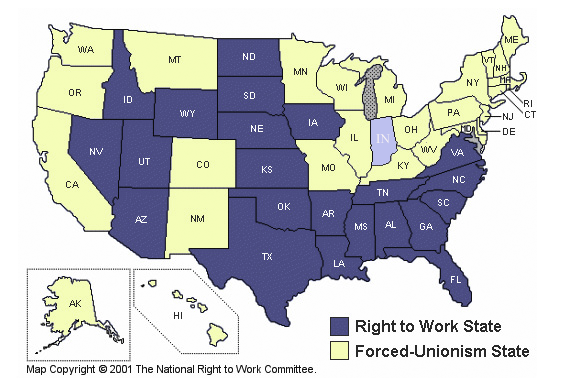
As Indiana soon becomes a haven for business in the “Rust Belt,” an influential columnist in Michigan is imploring Gov. Rick Snyder to display leadership on Right to Work.
Tom Walsh writes:
By discouraging a right-to-work debate in Michigan, is Gov. Rick Snyder guilty of “kicking the can down the road” — and thereby perpetuating the stigma that Michigan has an unfriendly business climate dominated by militant labor unions?
It’s an interesting question, especially since the kick-the-can analogy has been used so often — by Snyder himself, among others — to assess blame for allowing Michigan’s other economic woes to reach crisis proportions.
Snyder has said that the state of Michigan, too, suffered from a kick-the-can refusal to face up to fiscal problems until he took office last year.So why do I raise the kick-the-can issue now in connection with right-to-work? Several reasons:
• Michigan has a lousy reputation nationally as a place to do business, largely because of a perception that it’s a stronghold of organized labor.
• That image is hard to shake, despite data that show labor union penetration dropping and the gap between Michigan and other states’ unionization rates shrinking by half since 2003.
• A spirited right-to-work debate, no matter the outcome, would send a national message that Michigan is seriously looking at ways to change its culture and boost job creation.
• Lastly, next-door-neighbor Indiana may soon become the first Midwest industrial state to enact a right-to-work law forbidding compulsory union membership and the payment of union dues or fees as a condition of employment. The house approved the measure Wednesday. There are now 22 states nationwide.
Snyder has declared that right-to-work is “too divisive” to tackle right now, and he has urged the Legislature not to send such a bill to his desk. But just because an issue is divisive doesn’t mean it should be ducked.
If the right-to-work debate is divisive, it’s probably also inevitable in Michigan, whether Indiana acts first or not.

In addition to helping make the necessities and amenities of life more affordable, Right to Work laws help keep individual and family aggregate state-local tax burdens from spiraling out of control.

In response to a staffing crisis, the elected Lee County School Board (LCSB) approved an incentive plan to attract and retain teachers for high-need schools and hard-to-fill subject areas.

In the wake of Big Labor’s capture of the governorship and tightening of its grip over the Virginia General Assembly in last fall’s elections, union strategists are eager for passage of a law mandating union monopoly bargaining over the compensation and work rules of state and local civil servants.