House Narrowly Okays Union-Only PLAs at expense of military construction

House Narrowly Okays Union-Only PLAs at expense of military construction

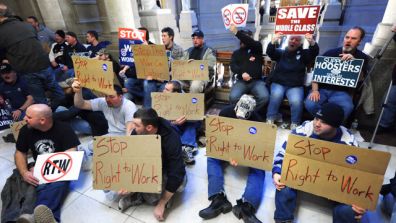
Although fewer than 12% of the 229 Republicans present and voting on the anti-Right to Work, pro-PLA LaTourette Amendment sided with Big Labor, that was enough for union lobbyists to grab a 204-203 victory. Handful of Big Labor-Appeasing Republicans Make the Difference (Source: July 2011 NRTWC Newsletter) Back in February 2009, one of the first actions President Barack Obama took after settling in at the White House was to issue Executive Order 13502, which promotes union-only "project labor agreements" (PLAs) on federally funded public works. In April 2010, the Obama Administration issued a "final rule" implementing the order. "E.O.13502 now pressures federal agencies to acquiesce to PLAs on all large public works," noted Greg Mourad, vice president of the National Right to Work Committee. "In practice, it is designed to force nonunion companies wishing to participate in public works using $25 million or more in federal funds to impose union monopoly bargaining on their employees and hire new workers through discriminatory union hiring halls. "Under union-only PLAs, independent workers who already have their own retirement funds are nevertheless forced to contribute to Big Labor-manipulated pension funds. "Rather than compromise the freedom of their employees and the efficiency of their operations, most independent construction firms simply refuse to submit bids on PLA projects." Results of 2010 Elections Raised Hopes of Pro-Right to Work Citizens
Time to Give Indiana an Economic Edge

Time to Give Indiana an Economic Edge

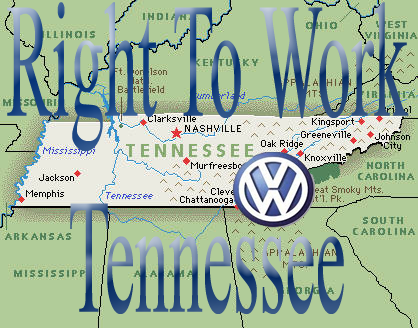
As Right to Work legislation finds its way back to the top of the legislative agenda in the state capital, Andrea Neal looks at the benefits of enacting a Right to Work bill in the Hoosier State: It doesn't take an economist to spot the common thread in these recent economic development headlines: Chattanooga, Tenn., July 29: "Volkswagen hires 2,000th employee." Shreveport, La., July 28: "NJ-based bag manufacturer to build Louisiana plant." Decatur, Ala., July 21: "Polyplex to build $185 million plant." West Point, Ga., July 7: "Kia builds vehicle No. 300,000." All four stories have Southern datelines. All come from states with right-to-work laws, which prohibit labor contracts that [force] employees to join a union or pay a union representation fee. This is the issue that prompted the five-week House Democratic walkout during the 2011 Indiana General Assembly. The Democrats -- a minority in both House and Senate -- had no other leverage. So when a right-to-work bill came up unexpectedly in a session that was supposed to be about the budget, redistricting and education, they bolted. Republicans capitulated and took the legislation off the table. In 2012, it will return with a vengeance, and this time Democrats can't avoid it. Right-to-work has been promised a full public airing. The Interim Study Committee on Employment Issues, chaired by Sen. Phil Boots, R-Crawfordsville, is taking a first crack this summer and hopes to recommend a bill by November. Gov. Mitch Daniels, who didn't support the bill last session, has hinted he might this time around.

The Inescapable SEIU-NLRB Connection

John Ranson, writing for TownHall.com, points out how the SEIU and their cronies have a heavy hand in the role that the NLRB's effort to punish companies for moving to Right to Work states: In just another example of the Obama administration making law by fiat, the National Labor Relations Board head Craig Becker is proposing new rules that would shotgun the formation of new union shops in as quick as ten days. After the defeat of card check at the legislative ballot box, the former SEIU goon [Becker] is acting creatively in order to implement portions of card check unilaterally. What would one expect from a guy appointed to his position despite his nomination being rejected by the Senate? Obama then made a recess appointment of Becker to the NLRB, the presidential equivalent of Enron accounting for political appointees. NLRB and Becker have been in the news lately because they’ve attacked Boeing for opening a plant in [Right to Work] South Carolina, a state that is less accommodating to union employment but more accommodating to workers and management with project deadlines to keep. But the attack on Boeing is nothing compared to the attack that Becker and organized labor are going to launch against the rest of us starting today.

What does the $2.2 Billion Big Labor spent on politicians buy labor bosses?

What does the $2.2 Billion Big Labor spent on politicians buy labor bosses?

BigGovernment.com reports that $2.2 Billion was spent by Big Labor during the last two election cycles from its forced-dues fed treasuries.  This by far exceed Big Labor's $1/2 Billion 20-year cumulative political contributions found at OpenSecrets.org. The big question: What does the $2.2 Billion Big Labor spent on politicians buy labor bosses?  The list is so extensive that it deserves a blog post of its own.  Please consider commenting with your own suggestions for the list that may be added to the upcoming related blog post. From BigGovernment.com: The [Professor Anthony Davies’ series of charts] represent dollars flowing to politicians from the “Top-100” special interest donors over the last 20 years.  [In Davies' chart Big Labor spent $500 million combined over a 20-year time period.] Further investigation reveals that the money represented on this chart is only the tip of the iceberg. According to the U.S. Department of Labor (DOL), Big Labor spent $2.2 Billion on political activities during the 2008 & 2010 election cycles alone — eclipsing by four times the 20-year $1/2 Billion from the chart. But, then no one should be shocked by this. You see Big Labor has special powers above all other special interests..