Time for Kentucky to Get Right to Work

Time for Kentucky to Get Right to Work

Enacting a Right to Work law in Kentucky would be a boon for jobs and economic prosperity -- but don't just take our word for it.  The Bowling Green Daily News agrees: Gov. Steve Beshear and the Democrat-controlled House are beholden to labor unions in this state and for that reason, year after year we continue to lose companies and jobs to other Southern states because Kentucky is not a right-to-work state. Right-to-work laws protect workers’ freedoms by not forcing them to pay dues to a union upon becoming employed or throughout employment. Nearly any citizen in a right-to-work state is protected by a state’s right-to-work law. Labor unions make up less than 9 percent of Kentucky’s workforce, so it would make sense that Beshear and the House would have more concern for the majority of the workforce. Sadly, they don’t. They need the unions, who contribute millions of dollars every election year through political action committees or other ways to encourage the governor and those in the House to follow part of their agenda, which is not allowing Kentucky to become a right-to-work state. Kentucky is the only Southern state not to have a right-to-work law. For that reason, many companies don’t even consider our state when choosing plant locations. Business 101 would tell you that this is simply bad business. The governor and House are hindering our state because they ignore reality. Shame on them. It reflects poor leadership and it holds our state back when competing for jobs that could be coming to Kentucky. Simpson County Judge-Executive Jim Henderson is a strong supporter of the right-to-work concept. Henderson said on a number of occasions during the process of trying to get a company to come to Franklin, it was eliminated because of not being a right-to-work state. He said it was communicated through correspondence and other means of communication that not having a right-to-work law is why companies aren’t coming to his city.One only has to look at companies such as Nissan North America. The company admitted that one reason it decided to move its headquarters from California to Tennessee and not Kentucky was because of the lower business costs. Interestingly enough, the average Kentuckian has to work 13 months to make what an average Tennessean can in one year.
Time to Give Indiana an Economic Edge

Time to Give Indiana an Economic Edge

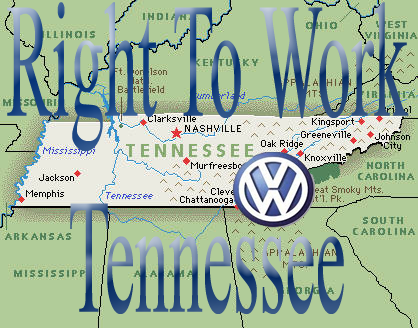
As Right to Work legislation finds its way back to the top of the legislative agenda in the state capital, Andrea Neal looks at the benefits of enacting a Right to Work bill in the Hoosier State: It doesn't take an economist to spot the common thread in these recent economic development headlines: Chattanooga, Tenn., July 29: "Volkswagen hires 2,000th employee." Shreveport, La., July 28: "NJ-based bag manufacturer to build Louisiana plant." Decatur, Ala., July 21: "Polyplex to build $185 million plant." West Point, Ga., July 7: "Kia builds vehicle No. 300,000." All four stories have Southern datelines. All come from states with right-to-work laws, which prohibit labor contracts that [force] employees to join a union or pay a union representation fee. This is the issue that prompted the five-week House Democratic walkout during the 2011 Indiana General Assembly. The Democrats -- a minority in both House and Senate -- had no other leverage. So when a right-to-work bill came up unexpectedly in a session that was supposed to be about the budget, redistricting and education, they bolted. Republicans capitulated and took the legislation off the table. In 2012, it will return with a vengeance, and this time Democrats can't avoid it. Right-to-work has been promised a full public airing. The Interim Study Committee on Employment Issues, chaired by Sen. Phil Boots, R-Crawfordsville, is taking a first crack this summer and hopes to recommend a bill by November. Gov. Mitch Daniels, who didn't support the bill last session, has hinted he might this time around.

Teachers Aren't 'Interchangeable' in Tennessee

Teachers Aren't 'Interchangeable' in Tennessee

Intense and persistent lobbying by the National Right to Work Committee’s Tennessee members and supporters helped convince GOP legislators and Gov. Bill Haslam (R) to prohibit union monopoly bargaining in public schools. Credit: Chattanooga (Tenn.) Times Free Press Volunteer State Teacher Union Bosses Losing Monopoly Privileges This year, Right to Work proponents have scored a series of remarkable, though still mostly very tenuous, state victories over government union kingpins. In March, Wisconsin and Ohio became the first states ever to revoke government union bosses' privilege to get workers fired for refusal to pay dues or fees to an unwanted union after previously passing a law authorizing compulsory unionism. The following month, Right to Work Oklahoma passed legislation denying government union bosses the legal power to force municipal officials to recognize them as public employees' "exclusive" bargaining agents. And now Right to Work Tennessee has achieved another milestone by effectively repealing the mislabeled "Education Professional Negotiations" Act, which authorized and promoted union monopoly-bargaining control over teachers and other K-12 public school instructional employees. Union lobbyists rammed public school monopoly bargaining through the Tennessee Legislature in 1978. Big Labor puppet Gov. Ray Blanton (D) then eagerly signed the measure. As a consequence of the Blanton law, educators in 92 Tennessee school systems, roughly two-thirds of all the districts in the state, are currently forced to accept union monopoly bargaining in order to keep their jobs. The monopoly-bargaining system, now statutorily imposed on some or all state and local government employees in 36 states, hands union officials "exclusive" power to bargain over wages, benefits, and working conditions. 'We're Putting the Entire Education System at Risk' Even public employees who choose not to join a union must work under contract terms negotiated by union bosses, or quit their jobs. Independent-minded employees are stripped of any freedom to negotiate with employers on their own behalf.

Teachers Aren't 'Interchangeable' in Tennessee

Teachers Aren't 'Interchangeable' in Tennessee

Intense and persistent lobbying by the National Right to Work Committee’s Tennessee members and supporters helped convince GOP legislators and Gov. Bill Haslam (R) to prohibit union monopoly bargaining in public schools. Credit: Chattanooga (Tenn.) Times Free Press Volunteer State Teacher Union Bosses Losing Monopoly Privileges This year, Right to Work proponents have scored a series of remarkable, though still mostly very tenuous, state victories over government union kingpins. In March, Wisconsin and Ohio became the first states ever to revoke government union bosses' privilege to get workers fired for refusal to pay dues or fees to an unwanted union after previously passing a law authorizing compulsory unionism. The following month, Right to Work Oklahoma passed legislation denying government union bosses the legal power to force municipal officials to recognize them as public employees' "exclusive" bargaining agents. And now Right to Work Tennessee has achieved another milestone by effectively repealing the mislabeled "Education Professional Negotiations" Act, which authorized and promoted union monopoly-bargaining control over teachers and other K-12 public school instructional employees. Union lobbyists rammed public school monopoly bargaining through the Tennessee Legislature in 1978. Big Labor puppet Gov. Ray Blanton (D) then eagerly signed the measure. As a consequence of the Blanton law, educators in 92 Tennessee school systems, roughly two-thirds of all the districts in the state, are currently forced to accept union monopoly bargaining in order to keep their jobs. The monopoly-bargaining system, now statutorily imposed on some or all state and local government employees in 36 states, hands union officials "exclusive" power to bargain over wages, benefits, and working conditions. 'We're Putting the Entire Education System at Risk' Even public employees who choose not to join a union must work under contract terms negotiated by union bosses, or quit their jobs. Independent-minded employees are stripped of any freedom to negotiate with employers on their own behalf.