Union Special Privileges vs. Affordability
In addition to helping make the necessities and amenities of life more affordable, Right to Work laws help keep individual and family aggregate state-local tax burdens from spiraling out of control.
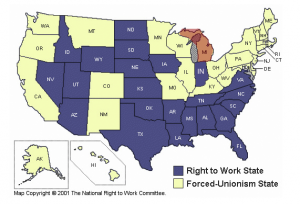 Time Magazine suggested that Indiana’s enactment of Right to Work protections for workers is a big deal primarily because of it is the first state in the “Rust Belt” to seek to attract jobs and business through Right to Work laws. We may be seeing evidence that they are right.
The Associated Press reports “Indiana’s move to become the Rust Belt’s first “right-to-work” state has intensified debate over the issue in neighboring Michigan. Supporters of right-to-work laws say they’re more convinced than ever that Michigan should take a similar step in hopes of lessening union clout and attracting more jobs.”
Unfortunately for Michigan workers and taxpayers, Gov. Rick Snyder (R) has decided to punt on the issue. Other members of the Republican establishment including the Senate Majority Leader Randy Richardville are unwilling to cross their union boss allies. This is an effort that will take time. But have no fear, in order to compete, Michigan will need to break big labor’s stranglehold on its economy with a Right to Work law. As the Rolling Stones sung, “time is on our side.”

In addition to helping make the necessities and amenities of life more affordable, Right to Work laws help keep individual and family aggregate state-local tax burdens from spiraling out of control.

In response to a staffing crisis, the elected Lee County School Board (LCSB) approved an incentive plan to attract and retain teachers for high-need schools and hard-to-fill subject areas.

In the wake of Big Labor’s capture of the governorship and tightening of its grip over the Virginia General Assembly in last fall’s elections, union strategists are eager for passage of a law mandating union monopoly bargaining over the compensation and work rules of state and local civil servants.