Big Labor’s Multi-Billion-Dollar Power Grab
Union bosses are rallying behind Democrat Texas U.S. Senate candidate James Talarico because he opposes Right to Work protections for employees.
March 10, 2010
National Right to Work Vice President Blasts the Police and Firefighter Monopoly Bargaining Bill in Testimony to Congress
Big Labor power grab would be a disaster for workers, taxpayers and struggling state economies
Washington, D.C (March 10, 2010) – National Right to Work Committee Vice President Doug Stafford, urged members of Congress to oppose H.R. 413/ S.1611, the Police and Firefighter Monopoly Bargaining Bill in a hearing before the House Subcommittee on Health, Employment, Labor and Pensions this morning.
As detailed in Mr. Stafford’s testimony, if it becomes law H.R. 413 and S. 1611 would force monopoly bargaining on every police officer, firefighter, and emergency medical technician (EMT) in the country, putting them under the monopoly control of union bosses. Mr. Stafford blasted the bill as “yet another bill in a long line of paybacks to union bosses,” in his testimony before the House HELP Subcommittee:
“First, let’s be clear. The ultimate goal of this legislation is to force every firefighter and police officer in the country under union boss control, whether the individual public safety officers want it or not. And whether state and local governments want it or not.
“Under monopoly bargaining, individual workers lose the power to speak for themselves in dealing with their employers, to the detriment of workers and taxpayers. In addition to imposing monopoly bargaining on countless workers, H.R. 413 and its companion bill in the Senate, S. 1611, would override state labor laws across the country.”
Currently, state and local governments have the authority to enter into monopoly bargaining agreements. Many have chosen to do so and many have not. But H.R. 413 and S. 1611 would grant the Federal Labor Relations Authority (FLRA) oversight of the labor-management laws of public safety workers in political subdivisions across the country, stripping localities of the right to govern themselves.
Mr. Stafford’s testimony also demonstrated how monopoly bargaining strains the already-vulnerable budgets of state and local government:
“This power comes with a price — H.R. 413 and S. 1611 would also have a detrimental impact on the budgets of state and local governments. Last year, Vallejo, California — where union bosses have already been granted control over public safety workers — went bankrupt after nearly 75 percent of its budget was spent on unionized police and firefighters. And today, despite a $26 billion state budget deficit, out-of-control public sector union bosses aren’t shouldering cuts or taking blame for the problems they’ve caused — they’re threatening strikes!
“In other states where union bosses have been granted monopoly bargaining privileges over public sector workers, we’re seeing the exact same thing. In fact, the Mayor of Lancaster, Pennsylvania recently stated that these struggling cities are ‘handcuffed’ by public sector monopoly bargaining.
“Put simply, passage of the Police and Firefighter Monopoly Bargaining Bill could be the last economic straw for already struggling communities. During these troubled economic times, the last thing Congress should be considering is a Big Labor power grab that would hurt workers and bust state budgets.”
###
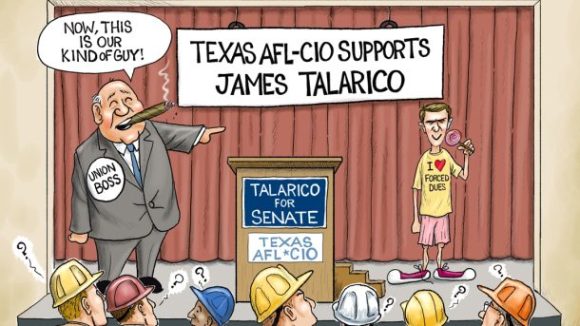
Union bosses are rallying behind Democrat Texas U.S. Senate candidate James Talarico because he opposes Right to Work protections for employees.
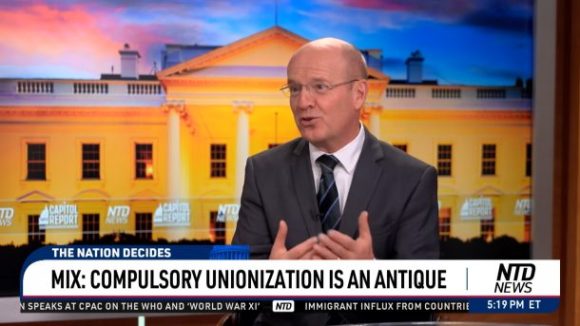
"Vullo makes it clear that using the threat of federal prosecution to force any employer to put employees’ Right to Work on the bargaining table violates the First Amendment.”
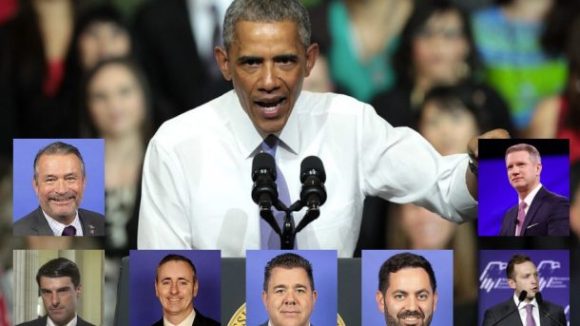
“Under the FLCA [...] monopolistic union contracts would be imposed on employees and business owners after only 120 days of negotiation."