Union Boss Trumka -- Obama has a "White Guy Problem"
But Forced Union Dues Can Fix That Richard Trumka has found his purpose. He wants to use his forced-union dues treasury to help solve President Obama’s “white guy problem.” Adding insult to…
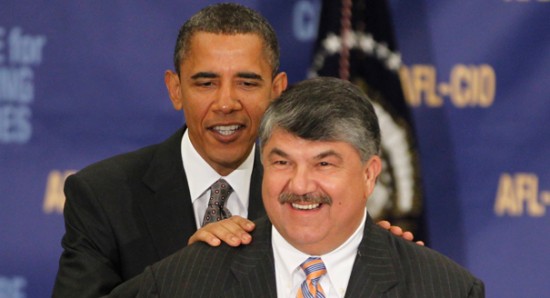
But Forced Union Dues Can Fix That Richard Trumka has found his purpose. He wants to use his forced-union dues treasury to help solve President Obama’s “white guy problem.” Adding insult to…
But Forced Union Dues Can Fix That Richard Trumka has found his purpose. He wants to use his forced-union dues treasury to help solve President Obama’s “white guy problem.” Adding insult to…

[media-credit id=7 align="alignleft" width="300"][/media-credit]Margaret Thatcher once quipped that the problem with socialism is eventually you run out of other people's money. The same can be said for the union bosses -- after taking advantage of so many workers for so long, eventually you run out of people who want to be taken advantage of. That's why it is not surprising to see AFL-CIO union boss Richard Trumka begging students to become part of Big Labor. Red Alert Politics reports "Trumka practically begged liberal students to join the labor movement in a speech this morning at Campus Progress’ annual national conference in Washington, D.C. 'The American labor movement truly needs you,' Trumka told attendees of the conference." They continue: Trumka tried to explain every which way to Sunday why it would benefit the college students to team up with the teamsters. The union boss even admitted that he could see why unions would turn off young people. “You probably think we’re a bunch of stodgy, old school people with outdated ideas, too interested in what’s good for us and too disinterested in what’s good for the others in our community,” said Trumka. “And I’ll be perfectly frank with you, there’s a grain of truth to that.” Trumka admitted that unions were often seen as self-serving and as slow-to-change institutions, thus young people might not necessarily consider joining a union to be in their best interest.

Corruption? Union bosses exercise political dominance in Connecticut. The governor’s allies the SEIU have run a campaign of sabotage against a nursing home chain without a peep of protest. Now big labor’s hand-pick candidate for Congress, state House Speaker Chris…

Corruption? Union bosses exercise political dominance in Connecticut. The governor’s allies the SEIU have run a campaign of sabotage against a nursing home chain without a peep of protest. Now big labor’s hand-pick candidate for Congress, state House Speaker Chris…

[media-credit id=7 align=”alignright” width=”300″][/media-credit]The state’s teacher union in Louisiana is threatening to sue schools who participate in the state’s voucher program, according to the Pelican Post. The Louisiana Association of Educators (LAE)…

CLick image to send Governor Dannel Malloy a message. Connecticut Gov. Dannel Malloy will contort himself into any position to support the union bosses in Connecticut. He is even willing to turn a blind eye to the SEIU’s recent…

CLick image to send Governor Dannel Malloy a message. Connecticut Gov. Dannel Malloy will contort himself into any position to support the union bosses in Connecticut. He is even willing to turn a blind eye to the SEIU’s recent…
WASHINGTON, D.C. | July 24, 2012 – On Wednesday, July 25 at 10:00 a.m., the Subcommittee on Health, Employment, Labor, and Pensions, chaired by Rep. Phil Roe (R-TN), will hold a hearing entitled “Examining Proposals to…