The Latest

NLRB'S  Overreach

NLRB'S Overreach

[media-credit id=7 align="alignright" width="150"][/media-credit]In their aggressive overreach to help the union bosses, the National Labor Relations Board has a devastating string of courtroom losses that are putting them back into place.  The House Education and Workforce Committee looks at their grasp for more power: This week, the Obama National Labor Relations Board (NLRB) suffered yet another defeat in federal court. On Monday, U.S. District Judge James Boasberg – appointed to the federal bench last year by President Obama – rejected the board’s recent ambush election rule. During the final days of 2011, the Obama labor board jammed through the regulatory process sweeping changes to long-standing rules governing union elections, changes that undermine employer free speech and worker free choice. As Education and the Workforce Committee Chairman John Kline noted: The Obama board’s rush to enact this rule before it loses its quorum confirms what my Republican colleagues and I have suspected all along – this board is not fighting for the best interests of our workforce, but instead is determined to advance an activist, pro-union agenda at any cost. Yet in their haste to adopt a flawed rule, board members Mark Pearce and Craig Becker neglected to follow the law. Citing Hollywood icon Woody Allen, Judge Boasberg writes: Eighty percent of life is just showing up. When it comes to satisfying a quorum requirement, though, showing up is even more important than that. Indeed, it is the only thing that matters – even when the quorum is constituted electronically. In this case, because no quorum ever existed for the pivotal vote in question, the Court must hold that the challenged rule is invalid.

NLRB'S  Overreach

NLRB'S Overreach

[media-credit id=7 align="alignright" width="150"][/media-credit]In their aggressive overreach to help the union bosses, the National Labor Relations Board has a devastating string of courtroom losses that are putting them back into place.  The House Education and Workforce Committee looks at their grasp for more power: This week, the Obama National Labor Relations Board (NLRB) suffered yet another defeat in federal court. On Monday, U.S. District Judge James Boasberg – appointed to the federal bench last year by President Obama – rejected the board’s recent ambush election rule. During the final days of 2011, the Obama labor board jammed through the regulatory process sweeping changes to long-standing rules governing union elections, changes that undermine employer free speech and worker free choice. As Education and the Workforce Committee Chairman John Kline noted: The Obama board’s rush to enact this rule before it loses its quorum confirms what my Republican colleagues and I have suspected all along – this board is not fighting for the best interests of our workforce, but instead is determined to advance an activist, pro-union agenda at any cost. Yet in their haste to adopt a flawed rule, board members Mark Pearce and Craig Becker neglected to follow the law. Citing Hollywood icon Woody Allen, Judge Boasberg writes: Eighty percent of life is just showing up. When it comes to satisfying a quorum requirement, though, showing up is even more important than that. Indeed, it is the only thing that matters – even when the quorum is constituted electronically. In this case, because no quorum ever existed for the pivotal vote in question, the Court must hold that the challenged rule is invalid.

SEIU in Bed With Wall Street

Peter Schweizer of the Government Accountability Project has discovered that the biggest funder of the Occupy Wall Street movement is receiving millions of dollars from Wall Street. The SEIU has an exclusive deal with Visa that is putting millions into their pockets. Here is the story: With the Service Employees International Union (SEIU) and AFL-CIO spending tens of millions on political activism, including the recall election of Wisconsin Governor Scott Walker, union members might do well to see where the money is coming from. Big unions are morphing into the kinds of big businesses and banks they decry, hawking to their members everything from high interest credit cards to home loans. And contrary to Big Labor’s claims, these products offer no real benefit to union members—only to the union bosses. As the collection of union dues have dipped, union bosses are increasingly looking for ways to bend the revenue curve in their favor by profiting off loans and credit extended to their members. Consider, for example, the "SEIU New Rewards Visa Card" and the AFL-CIO "Union Plus" card. With each new enrollment and subsequent swipe of the card, the union bags a fee and a percentage respectively.

Pensions are America's Ticking Time Bomb

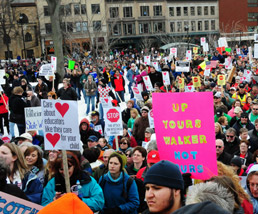
You know the union bosses' spending and benefits orgy is coming to an end when liberals like Fareed Zakaria of Time Magazine recognize the dangers unfunded pensions that union activists and pro-big labor politicians have created: "A day after Governor Scott Walker won his recall election, the New York Times wrote, "The biggest political lesson from Wisconsin may be that the overwhelming dominance of money on the Republican side will continue to haunt Democrats." Democrats have drawn much the same conclusion. "You've got a handful of self-interested billionaires who are trying to leverage their money across the country," said David Axelrod, Barack Obama's senior campaign strategist. "Does that concern me? Of course that concerns me." Warren Buffett calls the costs of public-sector retirees a "time bomb." They are the single biggest threat to the U.S.'s fiscal health. If the U.S. is going to face a Greek-style crisis, it will not be at the federal level but rather with state and local governments. The numbers are staggering. In California, total pension liabilities--the money the state is legally required to pay its public-sector retirees--are 30 times its annual budget deficit. Annual pension costs rose by 2,000% from 1999 to 2009. In Illinois, they are already 15% of general revenue and growing. Ohio's pension liabilities are now 35% of the state's entire GDP.