Big Labor’s Multi-Billion-Dollar Power Grab
Union bosses are rallying behind Democrat Texas U.S. Senate candidate James Talarico because he opposes Right to Work protections for employees.
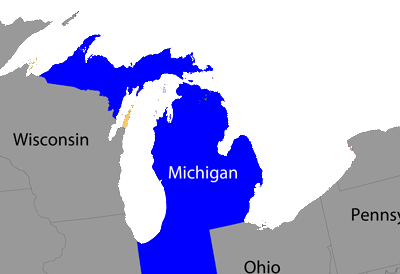 Dan Calabrese examines the union bosses lawsuit against Michigan Right to Work and points out the absurdity of their argument:
You knew the unions were going to try. They have to. It’s what they do. There may be no legal basis whatsoever for claiming that right-to-work is unconstitutional, but they have to do whatever it takes to manufacture one. Just so they can check off the “tried suing” box.
But the argument they’re making is priceless:
– The suit claims Public Act 348 violates the U.S. Constitution by allowing state regulators to fine or penalize private sector employers or unions, a power afforded to the federal government by the National Labor Relations Act.
The state law authorizes a civil fine of up to $500 for forcing or trying to compel an employee to financially support a labor union, which is barred under the right-to-work law that takes effect March 27.
So let me see if I have this straight. The unions object to right-to-work because they don’t think the state should have the right to fine companies? If so, of course, this would not only invalidate Michigan’s right-to-work law but those of 23 other states. Why has no federal court ever taken such an action? Because the argument is ridiculous, which the unions know perfectly well. But you don’t go tearing down tents and letting your member punch people in front of the capital, only to shrink from making ridiculous legal arguments.
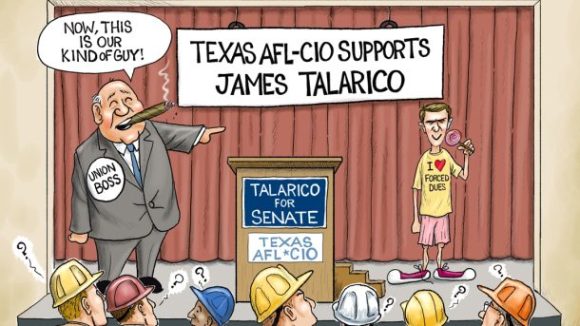
Union bosses are rallying behind Democrat Texas U.S. Senate candidate James Talarico because he opposes Right to Work protections for employees.
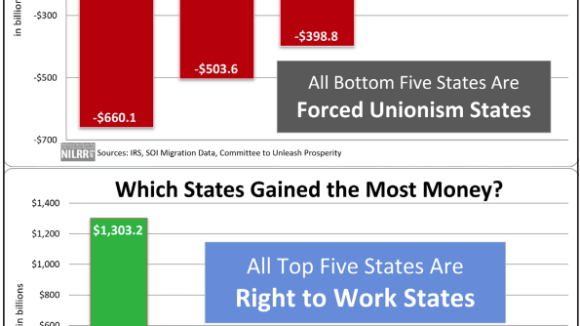
... States that continuously lacked Right to Work protections for employees from 2012-23 lost a net total of $2.05 trillion in cumulative AGI solely as a consequence of domestic out-migration of taxpayers during that 11-year period.
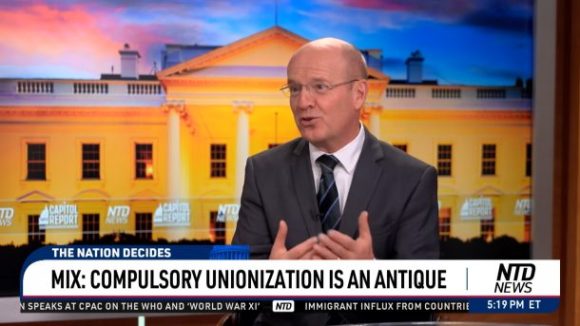
"Vullo makes it clear that using the threat of federal prosecution to force any employer to put employees’ Right to Work on the bargaining table violates the First Amendment.”