Union-Only Port Terminal Suspends Operations
Committee President Mark Mix: “If I were a Leatherman dockworker, I certainly wouldn’t count on Longshore Union bosses to show any flexibility” to get the terminal reopened and “save my job.”

Kentucky’s CBS affiliate WKYT television reports that KY Gov. Matt Bevin announced a new $1.3 billion aluminum mill is coming to Eastern Kentucky creating 550 permanent jobs and 1,000 construction jobs. The new Braidy Industries, Inc. factory will produce automotive and aerospace industries sheet and plate in Greenup County.
“If Kentucky wasn’t a right-to-work state, it wouldn’t have been on the list,” said Braidy Industries Chairman and CEO Craig Bouchard.
More from the WKYT report:
“Braidy Industries’ decision to locate in Eastern Kentucky has the potential to be as significant as any economic deal ever made in the history of Kentucky,” said Gov. Bevin. “This $1.3 billion investment will create enormous opportunity for people in the region, and would not have been possible without our recently passed right-to-work legislation. I look forward to the success of Braidy Industries as they leverage the incredible work ethic found in Eastern Kentucky. The ripple effect of this investment will be significant and will produce positive change in the region for generations to come.”
Braidy Industries will construct the 2.5 million-square-foot aluminum mill on more than 300 acres near South Shore in Greenup County. The company expects construction to begin in early 2018, with completion in 2020. Construction will create about 1,000 jobs.
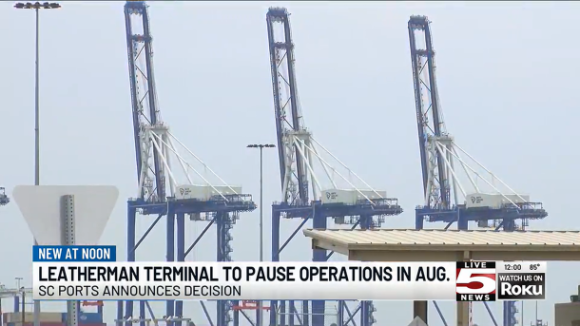
Committee President Mark Mix: “If I were a Leatherman dockworker, I certainly wouldn’t count on Longshore Union bosses to show any flexibility” to get the terminal reopened and “save my job.”

Union bosses are rallying behind Democrat Texas U.S. Senate candidate James Talarico because he opposes Right to Work protections for employees.
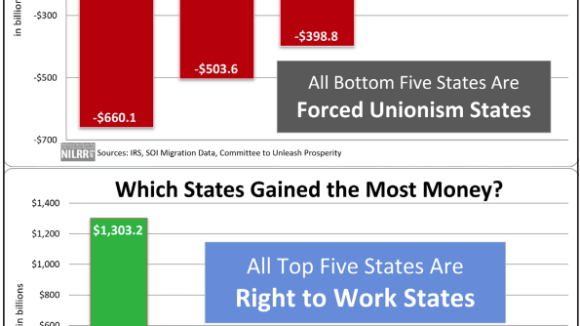
... States that continuously lacked Right to Work protections for employees from 2012-23 lost a net total of $2.05 trillion in cumulative AGI solely as a consequence of domestic out-migration of taxpayers during that 11-year period.