Job Losses Increase Pressure For Reform

Job Losses Increase Pressure For Reform

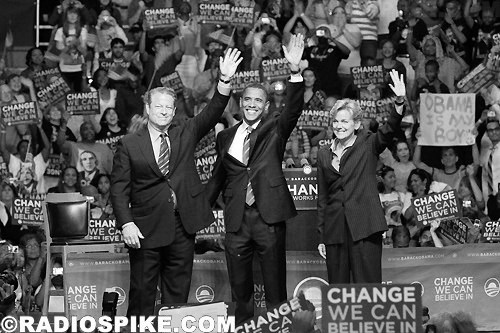
(Source: August 2010 NRTWC Newsletter) Grass-Roots Right to Work Efforts Expanding in Midwestern States Pro-forced unionism politicians like Gov. Jennifer Granholm (D-Mich., shown here with former Vice President Gore and President Obama) have lost credibility due to the extraordinarily poor economic performance of forced-unionism states. Credit: Radiospike.com All across America, Right to Work states have long benefited from economic growth far superior to that of states in which millions of employees are forced to join or pay dues or fees to a labor union just to keep their jobs. But over the past decade, the contrast between Right to Work states and forced-union-dues states has been especially stark in the Midwest. Four Midwestern forced-unionism states -- Michigan, Ohio, Illinois and Indiana -- suffered absolute private-sector job declines over the past decade that were worse than those of any of the other 46 states. Midwestern forced-unionism states (the four just mentioned, plus Missouri, Wisconsin and Minnesota) lost a net total of 1.88 million private-sector jobs. Combined, these seven forced-unionism states had 8.1% fewer private-sector jobs in 2009 than they did back in 1999. Meanwhile, the five Midwestern Right to Work states (North Dakota, Nebraska, South Dakota, Iowa and Kansas) experienced an overall private-sector job increase of 2.3%. Moreover, from 1999 to 2009, real personal income in Midwestern Right to Work states grew by 17.3% -- an increase two-and-a-half times as a great as the combined real personal income growth in Midwestern forced-unionism states. State Right to Work laws prohibit the firing of employees simply for exercising their right to refuse to join or bankroll an unwanted union. At this time, 22 states have Right to Work laws on the books. However, because of intensifying grass-roots efforts in many of the remaining 28 forced-unionism states, the number of Right to Work states could be on the rise over the course of the next few years. Recession's End Won't Suffice to Revive Big Labor-Controlled States

Forced-Unionism Issue Hot in West Virginia

Forced-Unionism Issue Hot in West Virginia

(Source: August 2010 NRTWC Newsletter) Like President Obama, Gov. Joe Manchin has an established record of supporting union monopoly bargaining. As a U.S. senator, Mr. Manchin could help Big Labor corral state and local employees nationwide into unions. Credit: blogs.wvgazette.com Would-Be U.S. Senators Urged to Stand Up to Big Labor Bosses West Virginia Gov. Joe Manchin (D) is an unabashed proponent of labor laws foisting union monopoly bargaining on public employees and government agencies. As recently as this June, in an interview with the Charleston Daily Mail, Mr. Manchin endorsed a state law forcing local school boards in West Virginia to grant a single teacher union the power to speak for all teachers in their district, including those who don't want to join. According to the Daily Mail's account, the governor actually said that such a monopoly-bargaining law would constitute a "solution" to "West Virginia's education woes"! Fortunately for independent-minded public employees and taxpayers, West Virginia legislators have up to now refused to send to the governor's desk legislation handing government union bosses monopoly power to bargain over public employee salaries, benefits, and work rules.

Why Are Oakland Burglars Breathing Easier?

Why Are Oakland Burglars Breathing Easier?

Police Chief Anthony Batts to Oaklanders: If your home is burglarized, don't call us. Credit: AP (Source: August 2010 NRTWC Newsletter) Public-Safety Union Monopoly Undercuts California Law Enforcement On Tuesday, July 13, Oakland, Calif., became a friendlier place for burglars, embezzlers, car thieves, bad-check passers, extortionists, and an array of other criminals. That afternoon, Oakland, a major West Coast port city with roughly 400,000 residents, laid off 80 police officers, or 10% of its force, to help eliminate a budget deficit of over $30 million. In response, the city police department implemented a new policy in which officers aren't being dispatched to take reports for 44 "lower priority" crimes. Oaklanders whose homes or vehicles are burglarized must now go online or visit a police station to file reports. However, the police department warns them that, even if they do: "There will be no follow-up investigation, and the primary reason for filing the report is for

Committee Members Actions Trip Up Government Union Sneak Play

Committee Members Actions Trip Up Government Union Sneak Play

(Source: August 2010 NRTWC Newsletter) Public-Safety Forced Unionism Still High on Capitol Hill Agenda The American people do not support Big Labor's legislative scheme to establish a new federal mandate imposing union "exclusive representation" (monopoly bargaining) over state and local police, firefighters, and other public-safety employees nationwide. And powerful union-label politicians like U.S. House Speaker Nancy Pelosi (D-Calif.) and U.S. Senate Majority Leader Harry Reid (D-Nev.) know this public-safety scheme (H.R.413/S.3194) is unpopular. That's why they have repeatedly tried to sneak it through Congress. Most recently, in June, Ms. Pelosi and her top lieutenants cut a deal with AFL-CIO President Richard Trumka and other union bigwigs to attach H.R.413, the House version of the Police/Fire Monopoly-Bargaining Bill, to a massive spending bill that provides funding for U.S. troops. International Association of Firefighters (IAFF) union boss Harold Schaitberger openly admitted to helping concoct the scheme to tack H.R.413 on to H.R.4899, the Fiscal Year (FY) 2010 Supplemental Appropriations Act, in a June 30 message to officers of his union subsidiaries. Early last month, the National Right to Work Committee obtained a copy of Mr. Schaitberger's communication. Firefighters Union Chief 'Argued Strongly' For War Supplemental Strategy Mr. Schaitberger reported that he had "argued strongly" for attaching H.R.413 "to the War Supplemental funding proposal for our troops in Afghanistan." The backroom deal between House leaders and the union hierarchy allowed the public-safety forced-unionism measure to come to the floor so quickly that Right to Work members and their allies had virtually no time to mobilize for the vote.

Michelle Malkin: Obama’s Big Labor ethics loophole

[stream provider=youtube flv=http%3A//www.youtube.com/watch%3Fv%3D8ia-l1RASG8 img=x:/img.youtube.com/vi/8ia-l1RASG8/0.jpg embed=false share=false width=350 height=250 dock=true controlbar=over bandwidth=high autostart=false /] Michelle Malkin highlights the non-existent ethical standards applied to Obama Big Labor politcal appointees like  SEIU/AFL-CIO lawyer Craig Becker who Obama appointed to the National Labor Relations Board (NLRB): Everything you need to know about President Obama’s fraudulent ethics pledge can be summed up in four words: SEIU lawyer Craig Becker. It’s no surprise that Becker now refuses to hold himself accountable for the ethics pledge he himself signed in April. As the past two years have taught us, Team Obama’s operational slogan is: Rules are for fools. The contractual ethics commitment states: “I will not for a period of two years from the date of my appointment participate in any particular matter involving specific parties that is directly and substantially related to my former employer or former clients, including regulations and contracts.” Yet, Becker has participated in numerous NLRB cases involving the SEIU and its affiliates — and is parsing the definition of “former employer” by arguing that local SEIU chapters are “separate and distinct legal entities” that don’t fall under the ethics rules. The National Right to Work Foundation, which has fought both national and local SEIU officials in court on behalf of rank-and-file workers’ rights, eviscerates Becker’s lawyerly blather. SEIU’s own constitution considers local affiliates “constituent subordinate bodies” of the national union, the foundation notes. “Moreover, in 2009 over 85 percent of the SEIU’s receipts came from a per capita tax on the locals’ membership dues and fees. The national union even has the power to assume control over its locals if they do not conform to International policies.”