Mix: Indiana Rejects Forced Unionism

Mix: Indiana Rejects Forced Unionism

Writing for the Investor's Business Daily, National Right to Work President Mark Mix summarizes what our victory in Indiana really means: For the past two weeks, Big Labor bosses around the country have had their eyes on the Indiana capitol — watching in horror as the General Assembly passed a right-to-work bill with commanding majorities. The passage of Indiana's right-to-work law is an extraordinarily bitter defeat for the union brass. Less than a year ago, despite the fact that Hoosiers had elected substantial pro-right-to-work majorities to both chambers in 2010, union strategists remained confident they could preserve the forced-unionism status quo. Last year, union bigwigs convinced the entire Democratic caucus of the Indiana House of Representatives to flee the state for five weeks in order to deny the body a quorum it needed to bring up and pass right-to-work legislation. Big Labor clearly believed whatever it lacked in legislative numbers it could make up for in zeal. But polls showed Hoosiers overwhelmingly disapproved of the "fleabagger" tactic, and right-to-work supporters kept turning up the pressure on Republican Gov. Mitch Daniels and GOP legislative leaders to fight back against Big Labor. Thanks to legislation passed after last year's walkout, House members failing to show up to do their jobs when the General Assembly is in session may be hit with $1,000-a-day fines. In the opening weeks of the 2012 session, House Democrats went public about their reluctance to jump over a cliff again for the union hierarchy. Finally, on Jan. 24, House Minority Leader Pat Bauer announced an end to his caucus' boycott of the bill. It passed the next day. Ever since, the caterwauling by Big Labor and its allies has resounded across the state. But what's so bad about a law that merely says an individual shouldn't be forced at the workplace to support financially an organization that he or she doesn't believe acts in his or her interests? Rather than address this question, union propagandists skirt it. Union officials never act contrary to the interests of any employee, they implicitly argue. Any employee who says otherwise they brand as a hypocritical "freeloader"!

Indiana Passes Right To Work -- National Right to Work Committee Statement

Indiana Passes Right To Work -- National Right to Work Committee Statement

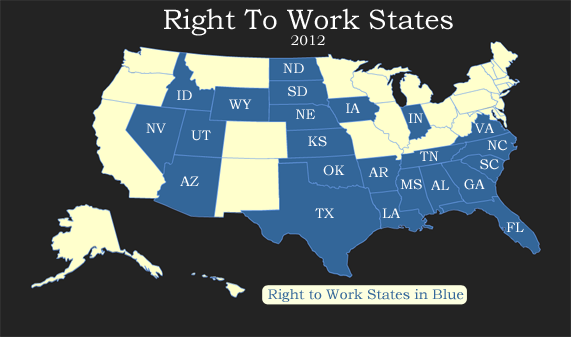
Indianapolis, Indiana – Today, Mark Mix, President of the 2.6 million-member National Right to Work Committee, praised the Indiana House and Senate for passage of the Indiana Right to Work Law. Mr. Mix said, “This is a great day for Indiana’s workers and taxpayers. “After a ten-year struggle involving hundreds of thousands of mobilized Hoosiers, Indiana will finally be able to enjoy all the benefits of a Right to Work law,” said Mr. Mix. “Today, the Indiana Senate passed the Right to Work Bill by a vote of 28 to 22. The bill has already passed the House, so it now goes straight to Governor Daniels, who has vowed to sign it, making Indiana America’s 23rd Right to Work state,” continued Mix. Mr. Mix continued, “The Right to Work Law will free nearly 200,000 Hoosiers who have been forced to pay tribute to a union boss for the privilege of getting up everyday and going to work so they can provide for their families.” Proponents of the bill expect that passage of the Right to Work law will provide significant economic benefits for Indiana and Indiana workers. For the past decade, non-agricultural employment in Right to Work states grew twice as fast compared to that in non-Right to Work states like Indiana, according to data from the Department of Labor. “On the job front,” said Mr. Mix, “virtually every site selection consultant on record has testified that as many as half of their clients will not even consider expanding or relocating to non-Right to Work states.” Governor Daniels experienced this problem firsthand, reporting recently that when Volkswagen was looking to build a production facility in America, he was unable to get the company to even return his phone calls. Volkswagen ended up choosing to open its new facility in the Right to Work state of Tennessee. Today’s action makes Indiana the first Right to Work state in the Manufacturing Belt, and supporters say it will give Hoosiers a significant advantage over all of its neighbors and the rest of the 27 non-Right to Work states. “Besides enjoying an influx of new jobs, Right to Work states also enjoy higher personal income,” said Mr. Mix. In particular, Mr. Mix drew attention to a study by Dr. Barry Poulson, a past president of the North American Economics and Finance Association and also a professor of economics at the University of Colorado, who compared household incomes in 133 metropolitan areas in Right to Work states with those of 158 metropolitan areas in non-Right to Work states. “Among other results, he found that the average real income for households in Right to Work state metro areas, when all else was equal, was $4,258 more than non-Right to Work state metro areas,” said Mr. Mix.

Damn Our Union Members, "There's Bigger Fish to Fry"

Damn Our Union Members, "There's Bigger Fish to Fry"

Why Right To Work Laws Are Important While Big Labor Bosses continue to pour forced-union dues into campaigns to stop Right To Work freedom, they also continue to shower Barack Obama with forced-dues money even-though Obama just killed a pipeline project that would have created jobs for 20,000 workers, many of which would be union members. If most of their members had the Right To Work, they could stop paying dues and force union officials to pay attention to union member jobs rather playing politics with union families' income. From Lachlan Markay's post: The Obama Administration’s decision to forego the Keystone pipeline has forced the country’s labor groups into a bitter civil war. At issue is the central purpose of the labor movement: those who feel it should represent workers in the workplace generally oppose the administration’s decision; those who see unions as primarily political organizations have generally supported it. Unions that had a stake in the Keystone decision were livid that the administration abandoned it, and equally angry at their fellow union members who had supported that decision, according to a Friday report from Politico Pro ($): “People are p****d,” said one U.S. labor official who supports the proposed TransCanada pipeline. “The emotions are really, really raw right now. This is a big deal.” “It’s repulsive, it’s disgusting and we’re not going to stand idly by,” Laborers’ International Union of North America General President Terry O’Sullivan told POLITICO. “The rules have changed. So we’ll react accordingly.”… But other top figures in the labor movement defended the decision. Their argument: re-electing President Obama is a higher priority than preserving union jobs, and to that end, unions had to prevent Republicans from gaining the upper hand on the top political issue of the day.