Right To Work Witness Speaks Out; NRTW Exposes NLRB Card Check Plans

Rep. John Kline’s (R-MN) Education and Workforce Committee probed the unelected Obama-appointed National Labor Relations Board’s (NLRB) ill-conceived ‘Ambush Elections’ proposals that will negatively impact employees and bring Card Check Forced Unionism closer to reality.  Though  most of the news related to hearing was swallowed by the continuing increase in Obama’s unemployment numbers report on Friday, the hearing should not be overlooked. DANA employee Larry Getts (a NRTW provided witness) testified that he and his fellow co-workers came under attack by union operatives during a UAW Card Check campaign.  He appealed to congress to stop the NLRB’s planned quickie elections that would leave workers unable to investigate their options during an extremely short time period that will include union organizers flooding employees with lies.   On the same day of the Ed & Workforce hearing, the National Right To Work distributed copies of David A. Bego’s The Devil At My Doorstep, a firsthand account of SEIU’s three-year attempt to organize Bego’s employees through intimidation and without allowing his employees a secret ballot election.  National Right To Work President Mark Mix included the following explanation of the NLRB's plans with a copy of The Devil At My Doorstep book that the National Right To Work Committee gave to members of congress:

Teachers Aren't 'Interchangeable' in Tennessee

Teachers Aren't 'Interchangeable' in Tennessee

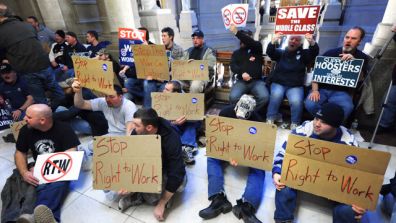
Intense and persistent lobbying by the National Right to Work Committee’s Tennessee members and supporters helped convince GOP legislators and Gov. Bill Haslam (R) to prohibit union monopoly bargaining in public schools. Credit: Chattanooga (Tenn.) Times Free Press Volunteer State Teacher Union Bosses Losing Monopoly Privileges This year, Right to Work proponents have scored a series of remarkable, though still mostly very tenuous, state victories over government union kingpins. In March, Wisconsin and Ohio became the first states ever to revoke government union bosses' privilege to get workers fired for refusal to pay dues or fees to an unwanted union after previously passing a law authorizing compulsory unionism. The following month, Right to Work Oklahoma passed legislation denying government union bosses the legal power to force municipal officials to recognize them as public employees' "exclusive" bargaining agents. And now Right to Work Tennessee has achieved another milestone by effectively repealing the mislabeled "Education Professional Negotiations" Act, which authorized and promoted union monopoly-bargaining control over teachers and other K-12 public school instructional employees. Union lobbyists rammed public school monopoly bargaining through the Tennessee Legislature in 1978. Big Labor puppet Gov. Ray Blanton (D) then eagerly signed the measure. As a consequence of the Blanton law, educators in 92 Tennessee school systems, roughly two-thirds of all the districts in the state, are currently forced to accept union monopoly bargaining in order to keep their jobs. The monopoly-bargaining system, now statutorily imposed on some or all state and local government employees in 36 states, hands union officials "exclusive" power to bargain over wages, benefits, and working conditions. 'We're Putting the Entire Education System at Risk' Even public employees who choose not to join a union must work under contract terms negotiated by union bosses, or quit their jobs. Independent-minded employees are stripped of any freedom to negotiate with employers on their own behalf.

Teachers Aren't 'Interchangeable' in Tennessee

Teachers Aren't 'Interchangeable' in Tennessee

Intense and persistent lobbying by the National Right to Work Committee’s Tennessee members and supporters helped convince GOP legislators and Gov. Bill Haslam (R) to prohibit union monopoly bargaining in public schools. Credit: Chattanooga (Tenn.) Times Free Press Volunteer State Teacher Union Bosses Losing Monopoly Privileges This year, Right to Work proponents have scored a series of remarkable, though still mostly very tenuous, state victories over government union kingpins. In March, Wisconsin and Ohio became the first states ever to revoke government union bosses' privilege to get workers fired for refusal to pay dues or fees to an unwanted union after previously passing a law authorizing compulsory unionism. The following month, Right to Work Oklahoma passed legislation denying government union bosses the legal power to force municipal officials to recognize them as public employees' "exclusive" bargaining agents. And now Right to Work Tennessee has achieved another milestone by effectively repealing the mislabeled "Education Professional Negotiations" Act, which authorized and promoted union monopoly-bargaining control over teachers and other K-12 public school instructional employees. Union lobbyists rammed public school monopoly bargaining through the Tennessee Legislature in 1978. Big Labor puppet Gov. Ray Blanton (D) then eagerly signed the measure. As a consequence of the Blanton law, educators in 92 Tennessee school systems, roughly two-thirds of all the districts in the state, are currently forced to accept union monopoly bargaining in order to keep their jobs. The monopoly-bargaining system, now statutorily imposed on some or all state and local government employees in 36 states, hands union officials "exclusive" power to bargain over wages, benefits, and working conditions. 'We're Putting the Entire Education System at Risk' Even public employees who choose not to join a union must work under contract terms negotiated by union bosses, or quit their jobs. Independent-minded employees are stripped of any freedom to negotiate with employers on their own behalf.

Union Bosses Out For Revenge in Wisconsin

Union Bosses Out For Revenge in Wisconsin

The implementation and retention of its new state public-sector Right to Work law are critical for Wisconsin's efforts to furnish relief for taxpaying individuals and businesses and reinvigorate private-sector income growth. Credit: Rick McKee/Augusta (Ga.) Chronicle  Pro-Right to Work Legislators Targeted in July 'Recall' Elections (Source: June 2011 NRTWC Newsletter) For at least a decade leading up to the election of Right to Work advocate Scott Walker (R) as governor, Wisconsin, like many other forced-unionism states, was on an unsustainable fiscal path. From 2000 through 2010, total taxpayer costs for compensation of Wisconsin state and local government employees grew by an inflation-adjusted 9.2%, to a total of $19.83 billion last year. By 2010, state and local government compensation swallowed up the equivalent of nearly 17% of all private-sector wages, salaries, bonuses and benefits in Wisconsin. And over the past decade Badger State government employee compensation grew more than two-and-a-half times as fast as private-sector employee compensation, in percentage terms. Upon Taking Office, Governor Properly Focused His Energy On Forced-Dues Repeal Measure

Right to Work Bill Introduced in U.S. House

Right to Work Bill Introduced in U.S. House

Rep. Steve King is lead sponsor of H.R.2040, the House version of the National Right to Work Act. Credit: Congressman King’s Office Would Bar Firing Employees For Refusal to Bankroll Unwanted Union (Source: June 2011 NRTWC Newsletter) With their hopes buoyed by the passage earlier this year of two new state laws barring the extraction of forced union dues from public servants in Wisconsin and Ohio, pro-Right to Work Americans are now preparing to take the offensive in the U.S. Congress. "National Right to Work Committee members and their grass-roots allies in the Badger and Buckeye States stunned Big Labor in March when they successfully lobbied for legislation removing government union bosses' forced-dues privileges," recalled Committee Vice President Mary King. "Now it's time for Committee members and supporters nationwide to show we can lobby just as effectively in support of legislation that would repeal federally-imposed forced union dues and fees." S.504 and H.R.2040 Would Repeal Federally-Imposed Forced Union Dues Ms. King continued: "When it comes to private-sector forced unionism, Congress is the culprit.