Big Labor’s Multi-Billion-Dollar Power Grab
Union bosses are rallying behind Democrat Texas U.S. Senate candidate James Talarico because he opposes Right to Work protections for employees.

In an article posted by Stan Greer in CNS, they address the concern of lowered access to in-person learning and education that COVID-19 has introduced. However, the issues are deeper than that and may be related to corrupt Union schemes.
Here’s a quote from the article:
Citing data from the respected Burbio website, CBS specified that Florida and Wyoming were already offering face-to-face teaching to nearly all students. More than 70% of all schoolchildren in four other states — Alabama, North Dakota, Texas, and Utah — were able to attend school full-time and in-person at their and their parents’ discretion.
All six of these states have one important thing in common: long-standing Right to Work laws that prohibit the firing of employees for refusal to pay dues or fees to an unwanted union.
Meanwhile, as CBS went on to report, there had been very little progress towards reopening in a number of other states.
Stan Greer, CNS
In fact, in most Forced-Unionism states, 75% of students don’t have in-person learning opportunities.
You can go here to access the full article.
If you have questions about whether union officials are violating your rights, contact the Foundation for free help.
If you feel pulled to support our cause and help those suffering from Forced Unionism, go here to donate.
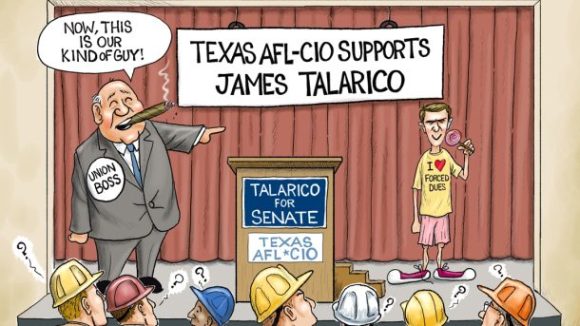
Union bosses are rallying behind Democrat Texas U.S. Senate candidate James Talarico because he opposes Right to Work protections for employees.
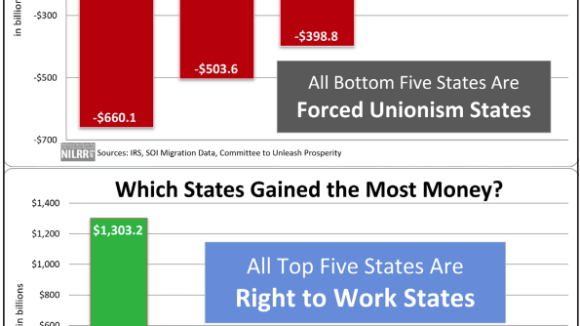
... States that continuously lacked Right to Work protections for employees from 2012-23 lost a net total of $2.05 trillion in cumulative AGI solely as a consequence of domestic out-migration of taxpayers during that 11-year period.
“Since Janus, the actively employed membership of the nation’s largest teacher union, the [NEA], has fallen substantially."