Union-Only Port Terminal Suspends Operations
Committee President Mark Mix: “If I were a Leatherman dockworker, I certainly wouldn’t count on Longshore Union bosses to show any flexibility” to get the terminal reopened and “save my job.”

In 2018, thanks largely to the efforts of National Right to Work Legal Defense Foundation attorneys and their employee clients, the U.S. Supreme Court finally recognized that public employees nationwide have a constitutional right to join and pay dues to a union, or refuse to do either.
From the very day the High Court’s landmark ruling in Janus v. AFSCME was announced eight years ago, it was obvious this decision would not be self-enforcing.
One tool state lawmakers have to ensure civil servants can exercise their Janus rights is to terminate the automatic deduction of union dues from public employees’ paychecks.
And with strong support from the National Right to Work Committee and its members, several states have withdrawn this unwarranted perk for government union bosses, requiring them to act as their own dues collectors.
In 2021, West Virginia protected all kinds of state and local employees from automatic union dues deductions. Two years later, Arkansas, Tennessee and Florida ended automatic payroll deduction privileges for many, but not all, government union bosses, opening their laws to court challenges.
Unfortunately, Arkansas, Tennessee and Florida opted to allow the government to continue collecting dues for all or most public-safety union bosses.
Already, politicians’ failure to protect public employees across the board has helped union bosses get similar laws in Indiana, Missouri and Kentucky overturned in court because of “equal protection” concerns.
Idaho has been the scene of fierce struggles over government union bosses’ special privileges for several years now.
For example, in 2024, a move to eliminate so-called “official time,” i.e., allowing government union bosses to conduct union business on taxpayers’ dime, failed on the Idaho House floor.
But the tide turned that same year, when Right to Work supporters succeeded in capturing a significant number of seats in both chambers in GOP primary contests.
National Right to Work Committee Vice President John Kalb commented: “Thanks to the Committee’s successful bids to secure roll-call floor votes on key issues, many GOP politicians who were aligned with teacher union bosses were defeated and replaced by foes of government union abuses.
Last year, a ban on automatic payroll deduction of teacher union dues, H.98, passed through the House 40-29, but never received a Senate vote during the 2025 session due to a blockade imposed by a single committee chairman.
H.745, a similar reform green-lighted by the House this year, was also blocked in a Senate committee.
Fortunately, at the last minute, several freedom-loving senators rewarded grassroots Right to Work efforts to rescue H.745 by inserting its language banning automatic payroll deductions into H.516, a bill that had already moved past the committee chokepoint.
That bill went on to pass through both chambers and was signed by GOP Gov. Brad Little on April 10.
Mr. Kalb acknowledged that the new Idaho law only “applies to K-12 educators,” instead of protecting all public employees.
He concluded: “It is an important step towards securing practicable freedom for all public workers and limiting the corruption of powerful government unions. The Committee will continue its efforts to bring this common-sense reform to more and more civil servants and states around the country.”
This article was originally published in our monthly newsletter. Go here to access previous newsletter posts.
To support our cause and help end forced unionism, go here to donate.

Committee President Mark Mix: “If I were a Leatherman dockworker, I certainly wouldn’t count on Longshore Union bosses to show any flexibility” to get the terminal reopened and “save my job.”

According to AFSCME Local 1632 President Will Harmon, Columbus Water & Power committed a grievous offense by subcontracting out the job of clearing away invasive weeds and brush spread out across two acres of its property to a tribe of roughly 40 goats without first “negotiating” with Big Labor.
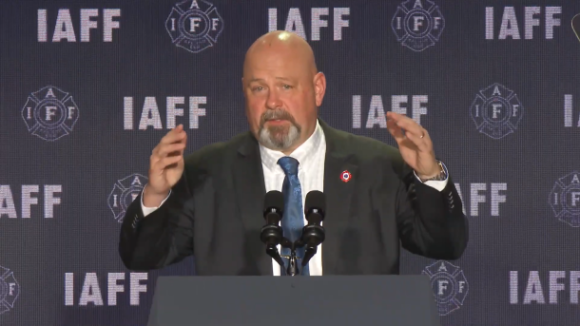
One longtime IAFF official who is now in the spotlight for his crass denigration of “two-hatters” -- that is, professional firefighters who also serve as volunteers -- is Pennsylvania Democrat politician Bob Brooks.