Union-Only Port Terminal Suspends Operations
Committee President Mark Mix: “If I were a Leatherman dockworker, I certainly wouldn’t count on Longshore Union bosses to show any flexibility” to get the terminal reopened and “save my job.”
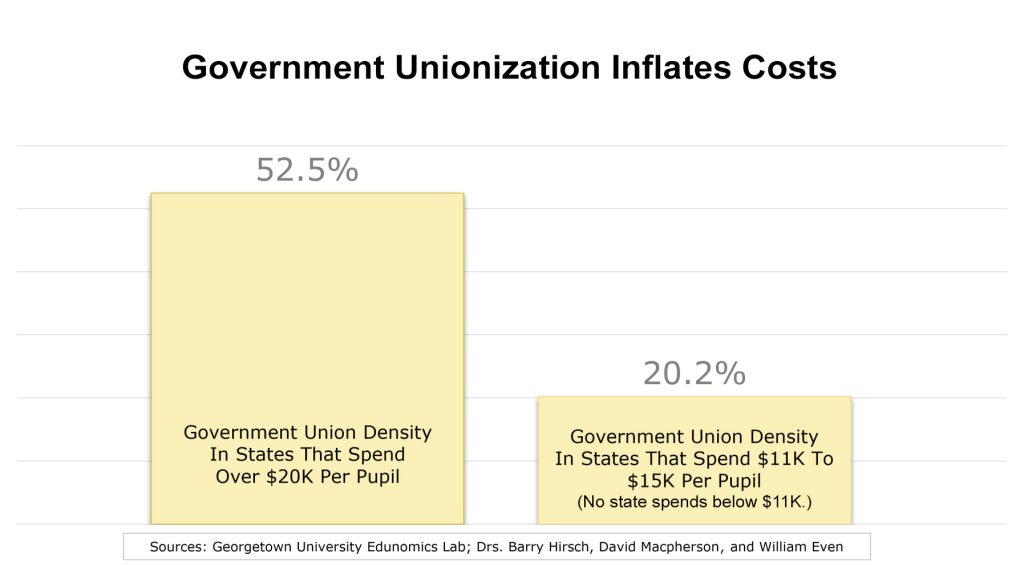
This year, with Virginia Democrats now holding majorities in both chambers of the General Assembly, the governorship, and the commonwealth’s two other elected statewide offices, Big Labor bosses were sure they could ram into law a scheme mandating unionism in the public sector.
Indeed, this winter, as both the Senate and the House of Delegates were preparing to rubber-stamp measures (H.B.1263 and S.B.378) turning Virginia into a mandatory monopoly-bargaining state with regard to nearly all front-line civil servants, union dons were already virtually declaring victory.
Referring to H.B.1263 and S.B.378, a February 10 press release issued by the American Federation of State, County and Municipal Employees (AFSCME) hierarchy gloated:
“[L]ast month, state legislation championed by AFSCME and coalition partners [e.g., other union bosses and their front groups] was reintroduced to expand collective [monopoly] bargaining . . . to all Virginia public [workplaces]. It is supported by Gov. Abigail Spanberger.” (Emphasis added.)
But as this Newsletter edition goes to press in late May, both H.B.1263 and S.B.378 are dead, and AFSCME and other government union chiefs are licking their wounds even as they prepare to try again to steamroll mandatory monopoly bargaining into law in 2027.
“Clearly, Big Labor bosses and their allies underestimated the impact of the National Right to Work Committee’s counteroffensive when they assumed, as many evidently did, that they had H.B.1263/S.B.378 in the bag early this year,” said Committee President Mark Mix.
Early in 2026’s legislative session, the Committee contacted by mail tens of thousands of Virginia individuals, businesses and families, sounding the alarm about H.B.1263/S.B.378.
Over the course of just a few weeks, Committee staff members prepared and placed a total of five op-eds, including two published the same day in the Washington Post and the Richmond Times-Dispatch, opposing the mandatory monopoly bargaining legislation.
Later, after it became clear that Democrat legislative leaders were determined to send this power grab to Gov. Spanberger’s desk, no matter what, the Committee began mobilizing citizens to contact her directly.
Committee staff mobilized thousands of Virginians to contact the governor’s office, shutting down her phone lines.
In addition to op-eds appearing in the aforementioned major newspapers, the Virginian Pilot (Newport News), the Cardinal News (Roanoke), and other influential publications ran Right to Work op-eds opposing the power grab.
Daily Committee media contacts generated radio interviews and television mentions, while mail and emails were dispatched across the commonwealth throughout the campaign.
Meanwhile, a bipartisan group of local elected officials such as Democrats Babur Lateef, the school board chairman in Prince William County, and Kenny Alexander, the mayor of Norfolk, were voicing their strong opposition to H.B.1263/S.B.378.
“In the end, the intense lobbying against this government union power grab by Right to Work supporters, local officeholders, and other citizens made the difference,” said Mr. Mix.
“After trying unsuccessfully to whitewash mandatory monopoly bargaining with a host of executive amendments, including one that would have delayed union bigwigs’ takeover of local governments for nearly three and a half years, Abigail Spanberger finally vetoed H.B.1263/S.B.378 on May 14.
“This was actually Right to Work supporters’ second big Virginia victory this year,” noted Mr. Mix.
“In late winter, a full-scale Committee mobilization had prompted union-label Democrat legislative leaders in Richmond to back away from their public promises to push for destruction of Virginia’s eight decade-old Right to Work law during this year’s session.
“Senate Majority Leader Scott Surovell and House Speaker Don Scott evidently calculated that handing government union bigwigs mandatory monopoly-bargaining privileges would be less politically difficult than restoring Big Labor’s forced-dues privileges.
“But the reality is, as the evidence mounts that empowering union bosses who are unaccountable to the public to codetermine with public officials how civil servants are compensated and managed leads to runaway spending and tax increases, mobilizing opposition to such schemes gets easier.”
This article was originally published in our monthly newsletter. Go here to access previous newsletter posts.
To support our cause and help end forced unionism, go here to donate.
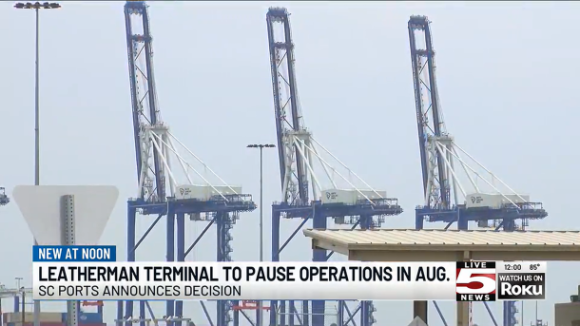
Committee President Mark Mix: “If I were a Leatherman dockworker, I certainly wouldn’t count on Longshore Union bosses to show any flexibility” to get the terminal reopened and “save my job.”

According to AFSCME Local 1632 President Will Harmon, Columbus Water & Power committed a grievous offense by subcontracting out the job of clearing away invasive weeds and brush spread out across two acres of its property to a tribe of roughly 40 goats without first “negotiating” with Big Labor.
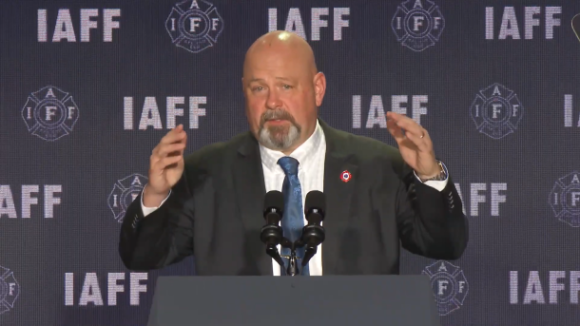
One longtime IAFF official who is now in the spotlight for his crass denigration of “two-hatters” -- that is, professional firefighters who also serve as volunteers -- is Pennsylvania Democrat politician Bob Brooks.