Big Labor’s Multi-Billion-Dollar Power Grab
Union bosses are rallying behind Democrat Texas U.S. Senate candidate James Talarico because he opposes Right to Work protections for employees.
Businesses investing in Right to Work Arkansas include Fiocchi and Albemarle Corporation, as well as Rheem and Bartlo Packaging. As a result, this will mean new jobs and economic advancements for the state. Read on in order to learn more!
Fiocchi is investing $41.5 million in order to establish in Right to Work Little Rock, Arkansas. They also plan to create 120 new jobs!
“For the past eight years, Governor Hutchinson has made firearms and ammunition a priority industry to grow and diversify our state’s economy. […] Governor Hutchinson was the first Arkansas governor to attend the SHOT Show, and he has led an Arkansas delegation to the show every year since then in an effort to actively pursue and welcome premier companies like Fiocchi to Arkansas. For more than a century, Fiocchi has been a leader in its industry, and we have witnessed firsthand their commitment and excellence in business. This expansion will help Fiocchi reach more customers as they continue to strengthen their brand throughout the region, and we are excited to celebrate alongside them today.”
AREA DEVELOPMENT MAGAZINE
Albemarle Corporation is investing $540 million and increasing their workforce by 15% when they expand two Right to Work Magnolia, Arkansas locations.
“Albemarle is known throughout the world as an industry leader and innovator. […] Their commitment to sustainability pairs perfectly with our goals of improving economic conditions in the state while maintaining an exemplary quality of life. Their decision to expand in Magnolia is a reflection on our dedicated workforce and our business climate that allows companies that call Arkansas home to reach their full potential, both on the factory floor and out in the community.” […]
“It has been a pleasure working with the Albemarle team and seeing this project come to fruition. […] Albemarle has been a household name in south Arkansas for over 50 years. Its presence is felt throughout the county as a multi-generational employer and partner in community projects, schools, and events.”
AREA DEVELOPMENT MAGAZINE
Rheem is investing $20 million in order to renovate its facility in Right to Work Fort Smith, Arkansas. This will also create 100 new jobs!
“We are excited to see Rheem grow and succeed in Fort Smith. […] Rheem is creating both corporate and manufacturing jobs that spur economic development and raise the quality of life for employees and their families.” […]
“Rheem continues to be a leader in Fort Smith and Arkansas. […] We are so pleased to work with them to secure this investment into our community.”
AREA DEVELOPMENT MAGAZINE
Bartlo Packaging is investing $1.3 million in order to relocate and expand in Right to Work Helena, Arkansas and create 50 new jobs here.
“BPS is very happy to announce a major expansion to our business and facilities in Phillips County. […] “Begun as an outgrowth of Bartlo Packaging in order to be closer to our customers in the agricultural market, BPS has grown to equal the sales and capabilities of the original New Jersey company. I personally have always felt strong ties to Helena, enjoying seven years living on 10th Street. After 30 years we have made the decision to go ‘all in’ and move the entirety of our operation to Phillips County.”
AREA DEVELOPMENT MAGAZINE
To read the previous update on economic development in Right to Work Arkansas, click here.
To support our cause, go here to donate.
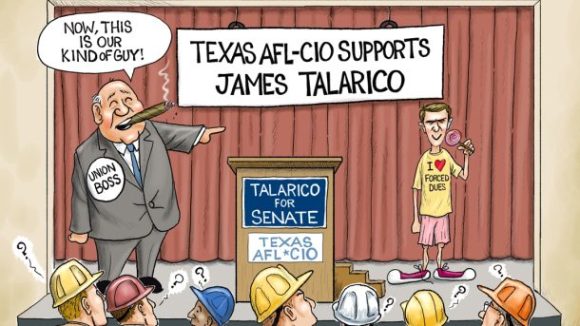
Union bosses are rallying behind Democrat Texas U.S. Senate candidate James Talarico because he opposes Right to Work protections for employees.
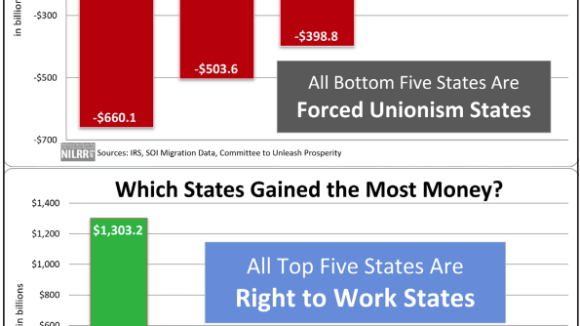
... States that continuously lacked Right to Work protections for employees from 2012-23 lost a net total of $2.05 trillion in cumulative AGI solely as a consequence of domestic out-migration of taxpayers during that 11-year period.
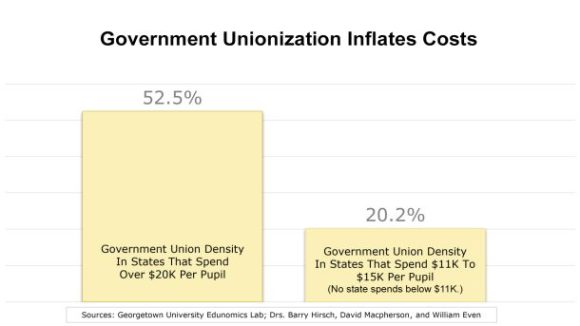
“[L]ast month, state legislation championed by AFSCME and coalition partners [...] was reintroduced to expand collective [monopoly] bargaining . . . to all Virginia public [workplaces]. It is supported by Gov. Abigail Spanberger.”